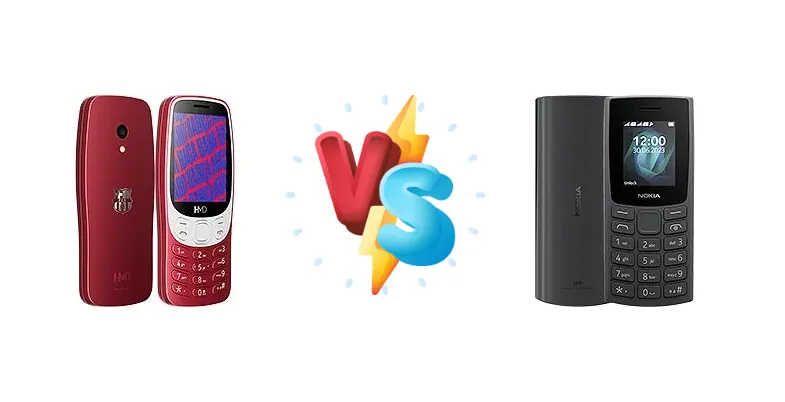
In a world dominated by smartphones, the feature phone persists, offering simplicity and reliability. We pit the HMD 3210, powered by a Unisoc chipset, against the Nokia 105 4G 2nd Edition, a mainstay in the affordable mobile space, to determine which best suits users prioritizing essential communication and long battery life.
🏆 Quick Verdict
For users needing a slight performance edge and confirmed 4G connectivity, the HMD 3210 is the better choice, thanks to its Unisoc T107 chipset. However, the Nokia 105 4G 2nd Edition remains a strong contender for those prioritizing extreme simplicity and brand recognition, assuming 4G is available.
| Network |
|---|
| 2G bands | GSM 850 / 900 / 1800 / 1900 | GSM 900 / 1800 |
| 3G bands | HSDPA 850 / 900 / 2100 | HSDPA 850 / 900 / 1700(AWS) / 1900 / 2100 |
| 4G bands | LTE | LTE |
| Speed | HSPA, LTE | HSPA, LTE |
| Technology | GSM / HSPA / LTE | GSM / HSPA / LTE |
| Launch |
|---|
| Announced | 2025, March 03 | 2024, December |
| Status | Available. Released 2025, April | Available. Released 2024, December |
| Body |
|---|
| Build | Plastic frame, plastic back | - |
| Dimensions | 122 x 52 x 13.1 mm (4.80 x 2.05 x 0.52 in) | 121.5 x 50 x 14.4 mm (4.78 x 1.97 x 0.57 in) |
| SIM | Nano-SIM + Nano-SIM | · Nano-SIM· Nano-SIM + Nano-SIM |
| Weight | - | 93 g (3.28 oz) |
| Display |
|---|
| Resolution | 240 x 320 pixels, 4:3 ratio (~167 ppi density) | 120 x 160 pixels, 4:3 ratio (~111 ppi density) |
| Size | 2.4 inches, 17.8 cm2 (~28.1% screen-to-body ratio) | 1.8 inches, 10.0 cm2 (~16.5% screen-to-body ratio) |
| Type | TFT | IPS LCD |
| Platform |
|---|
| CPU | 1.0 GHz Cortex-A7 | - |
| Chipset | Unisoc T107 (22 nm) | - |
| Memory |
|---|
| Call records | Yes | Yes |
| Card slot | microSDHC | microSDHC |
| Internal | 128MB 64MB RAM | 48MB 128MB RAM |
| Phonebook | Yes | Yes |
| Main Camera |
|---|
| Features | LED flash | - |
| Single | 2 MP | - |
| Sound |
|---|
| 35mm jack | Yes | Yes |
| Loudspeaker | Yes | Yes |
| Comms |
|---|
| Bluetooth | 5.0, A2DP | 5.0, A2DP |
| NFC | No | No |
| Positioning | No | No |
| Radio | Wireless FM radio | Wireless FM radio |
| USB | USB Type-C | USB Type-C |
| WLAN | No | No |
| Features |
|---|
| Games | Yes | Yes |
| Java | No | No |
| Messaging | SMS, MMS, Email, IM | SMS |
| Battery |
|---|
| Type | Li-Ion 1450 mAh, removable | Li-Ion 1450 mAh, removable |
| Misc |
|---|
| Colors | Blue, Red | Charcoal |
| Price | - | About 50 EUR |
HMD 3210
- Unisoc T107 offers better performance than typical feature phone chipsets.
- Confirmed 4G connectivity for faster data speeds.
- Potential for basic app functionality beyond calls and texts.
- 22nm process is relatively dated.
- Camera quality is likely to be very basic.
Nokia 105 4G 2nd Edition
- Extremely simple and easy to use.
- Strong brand recognition and reliability.
- Potentially longer standby time due to simpler chipset.
- Lack of publicly available chipset information raises performance concerns.
- 4G connectivity may vary by region and carrier.
Display Comparison
Neither device boasts a sophisticated display. Both are likely to utilize basic TFT panels with resolutions sufficient for text and simple icons. Without specific display specs for the Nokia 105 4G 2nd Edition, it's reasonable to assume a similar, low-resolution experience to the HMD 3210. Color accuracy and viewing angles will be limited on both, prioritizing legibility over visual fidelity.
Camera Comparison
Both devices are likely to feature basic cameras primarily for capturing simple snapshots. Given the market segment, image quality will be limited. Without specific camera specs for the Nokia 105 4G 2nd Edition, it’s safe to assume a similar, low-resolution sensor to the HMD 3210. Neither phone is intended for serious photography; the cameras serve as a convenient, albeit low-quality, recording option.
Performance
The HMD 3210’s Unisoc T107 (22nm) chipset, featuring a 1.0 GHz Cortex-A7 CPU, represents a significant step up in processing capability compared to the Nokia 105 4G 2nd Edition, which lacks publicly available chipset information. The Cortex-A7 architecture, while dated, allows for smoother operation of basic applications like FM radio and potentially simple web browsing. The 22nm manufacturing process, while not leading-edge, provides a reasonable balance between power consumption and performance. The Nokia 105 4G 2nd Edition likely relies on a simpler, less powerful chipset designed purely for voice calls and SMS, making the HMD 3210 the clear winner for users who want a slightly more responsive experience.
Battery Life
Both phones prioritize long battery life, a key selling point for feature phones. The HMD 3210’s Unisoc T107, while more powerful, is fabricated on a 22nm process, which helps mitigate power consumption. The Nokia 105 4G 2nd Edition, with its likely simpler chipset, may offer slightly longer standby times. However, the HMD 3210’s 4G connectivity will consume more power when actively used, potentially offsetting any gains from a less powerful processor. Real-world battery performance will depend heavily on network conditions and usage patterns.
Buying Guide
Buy the HMD 3210 if you need a feature phone with a bit more processing power for basic apps or occasional internet browsing, and require the assurance of 4G connectivity. Buy the Nokia 105 4G 2nd Edition if you prefer a minimalist experience, prioritize a well-established brand, and are content with potentially limited network capabilities depending on regional availability.
Frequently Asked Questions
❓ Does the HMD 3210's 4G connectivity actually provide a noticeable speed improvement over 2G/3G?
Yes, the HMD 3210's 4G capability offers significantly faster data speeds compared to older network standards. This translates to quicker access to web pages (though limited by the phone's browser), faster downloads, and potentially smoother performance with basic apps that require an internet connection. However, the actual speed will depend on network coverage and congestion.
❓ Is the Nokia 105 4G 2nd Edition guaranteed to work with 4G networks in all regions?
No, 4G network compatibility varies significantly by region and carrier. While the Nokia 105 4G 2nd Edition supports 4G, it's crucial to verify that the specific bands supported by the phone are compatible with your local network provider before purchasing. Check your carrier's website or contact them directly for confirmation.
❓ Can I install WhatsApp or other messaging apps on the HMD 3210?
While the HMD 3210 runs on a feature phone operating system, it *may* be possible to install a limited version of WhatsApp or other Java-based apps, depending on the app's compatibility and the phone's software version. However, the experience will likely be significantly different from a smartphone, with limited functionality and a basic interface.