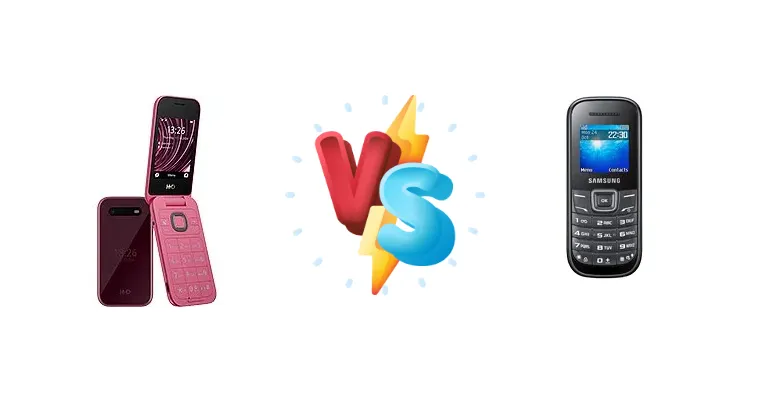
The feature phone market, while seemingly stagnant, continues to evolve. We pit the modern HMD 2660 Flip, powered by a Unisoc chipset, against the venerable Samsung E1200 Pusha, a relic of a bygone era, to understand where each device fits in today’s mobile landscape. This isn't about raw power; it's about usability, longevity, and the evolving needs of the basic mobile user.
🏆 Quick Verdict
For the vast majority of users seeking a basic mobile experience, the HMD 2660 Flip is the clear winner. Its Unisoc T107 chipset delivers a significantly more responsive experience, enabling features like basic web browsing and potentially more reliable app support. However, the Samsung E1200 Pusha remains a compelling option for those prioritizing extreme simplicity and potentially longer-term durability due to its simpler architecture.
| Network |
|---|
| 2G bands | GSM 850 / 900 / 1800 / 1900 | GSM 900 / 1800 |
| 3G bands | HSDPA 850 / 900 / 2100 | - |
| 4G bands | 1, 3, 5, 7, 8, 20, 28, 40 | - |
| EDGE | - | No |
| GPRS | - | No |
| Speed | HSPA, LTE | - |
| Technology | GSM / HSPA / LTE | GSM |
| Launch |
|---|
| Announced | 2025, March 02 | 2012. Released 2012 |
| Status | Available. Released 2025, March | Discontinued |
| Body |
|---|
| Dimensions | 198.9 x 55 x 19 mm (7.83 x 2.17 x 0.75 in) | 108 x 45 x 13.5 mm (4.25 x 1.77 x 0.53 in) |
| SIM | Nano-SIM + Nano-SIM | Mini-SIM |
| Weight | 136.4 g (4.80 oz) | 65.1 g (2.29 oz) |
| Display |
|---|
| Resolution | 240 x 320 pixels, 4:3 ratio (~143 ppi density) | 128 x 128 pixels, 1:1 ratio (~119 ppi density) |
| Size | 2.8 inches, 24.3 cm2 (~22.2% screen-to-body ratio) | 1.52 inches, 7.5 cm2 (~15.3% screen-to-body ratio) |
| Type | TFT | TFT, 65K colors |
| Platform |
|---|
| CPU | 1.0 GHz Cortex-A7 | 156 MHz |
| Chipset | Unisoc T107 (22 nm) | - |
| Memory |
|---|
| Call records | Yes | Yes |
| Card slot | microSDHC | No |
| Internal | 128MB 64MB RAM | - |
| Phonebook | Yes | Yes |
| Main Camera |
|---|
| Features | LED flash | - |
| Single | 0.3 MP | - |
| Video | Yes | - |
| Sound |
|---|
| 3.5mm jack | - | No |
| 35mm jack | Yes | No |
| Loudspeaker | Yes | Yes |
| Comms |
|---|
| Bluetooth | 5.0, A2DP | No |
| NFC | No | - |
| Positioning | No | No |
| Radio | Wireless FM radio | No |
| USB | USB Type-C 2.0 | Proprietary |
| WLAN | No | No |
| Features |
|---|
| Games | Yes | No |
| Java | No | No |
| Messaging | SMS, MMS | SMS |
| Battery |
|---|
| Charging | Compatible with a charging cradle | - |
| Stand-by | - | Up to 720 h |
| Talk time | - | Up to 7 h |
| Type | 1450 mAh, removable | Removable Li-Ion 800 mAh battery |
| Misc |
|---|
| Colors | Twilight Violet, Raspberry Red, Cosy Black | Black, White, Blue |
| Price | - | About 20 EUR |
| SAR EU | - | 0.81 W/kg (head) |
HMD 2660 Flip
- Significantly faster processor for a more responsive experience
- Potential for basic app functionality
- Charging cradle compatibility for convenient charging
- Higher power consumption than the Samsung E1200 Pusha
- More complex system potentially leading to more points of failure
Samsung E1200 Pusha
- Extremely long battery life due to ultra-low power consumption
- Exceptional simplicity and ease of use
- High potential for long-term durability due to minimal system demands
- Very slow processor limiting functionality
- Limited to basic phone functions
Display Comparison
Neither device provides display specifications beyond basic functionality. However, the HMD 2660 Flip’s modern chipset suggests a more capable display controller, potentially allowing for a slightly higher refresh rate or improved color reproduction. The Samsung E1200 Pusha’s display is likely a monochrome or very basic color panel, optimized for minimal power consumption. Bezels are expected to be substantial on both devices, reflecting their focus on cost reduction.
Camera Comparison
Neither device is marketed for its camera capabilities. It's safe to assume both feature very low-resolution cameras, primarily for basic image capture. Detailed analysis is impossible without specific sensor information, but the HMD 2660 Flip’s more powerful processor could potentially enable slightly better image processing, though expectations should remain low. The focus is on functionality, not quality.
Performance
The performance disparity is the most significant difference. The HMD 2660 Flip’s Unisoc T107, fabricated on a 22nm process, boasts a 1.0 GHz Cortex-A7 CPU. This represents a massive leap over the Samsung E1200 Pusha’s 156 MHz CPU. The Unisoc chipset allows for a far more responsive user interface, faster call setup times, and the potential for basic app functionality. The 22nm process, while not cutting-edge, is significantly more efficient than the likely older process used in the Pusha, contributing to better battery life *despite* the increased processing power. The Pusha’s CPU is essentially limited to basic phone functions, with any additional features likely implemented through dedicated hardware rather than software processing.
Battery Life
Battery capacity is not specified for either device. However, the Samsung E1200 Pusha’s extremely low-power CPU will undoubtedly result in significantly longer battery life on a single charge. The HMD 2660 Flip’s Unisoc T107, while more efficient than older processors, consumes more power. The HMD 2660 Flip’s compatibility with a charging cradle offers a convenient charging solution, but doesn’t necessarily translate to faster charging speeds.
Buying Guide
Buy the HMD 2660 Flip if you need a feature phone capable of more than just calls and texts – basic web browsing, potentially some app functionality, and a more modern user interface. Buy the Samsung E1200 Pusha if you prioritize absolute simplicity, maximum battery life from a minimal system, and a device that's likely to remain functional for years to come due to its extremely low system demands.
Frequently Asked Questions
❓ Will the HMD 2660 Flip be able to run WhatsApp or Facebook?
While the Unisoc T107 chipset *could* theoretically support basic versions of these apps, compatibility is not guaranteed. These apps are often optimized for more powerful hardware and may not function reliably, or at all, on the HMD 2660 Flip. Expect a limited experience if they do run.
❓ How much longer will the Samsung E1200 Pusha likely last compared to the HMD 2660 Flip?
The Samsung E1200 Pusha, due to its incredibly simple architecture and low power consumption, is likely to remain functional for a longer period. Fewer components mean fewer potential points of failure, and the lower stress on the battery will contribute to its longevity. It's a device built for years of reliable, basic service.
❓ Can I easily transfer contacts from my smartphone to either of these phones?
Transferring contacts can be challenging. Both phones likely support basic vCard (.vcf) import via Bluetooth or potentially a USB connection (depending on available software). However, the process may require a computer and some technical know-how. Direct smartphone-to-feature phone transfer options are limited.