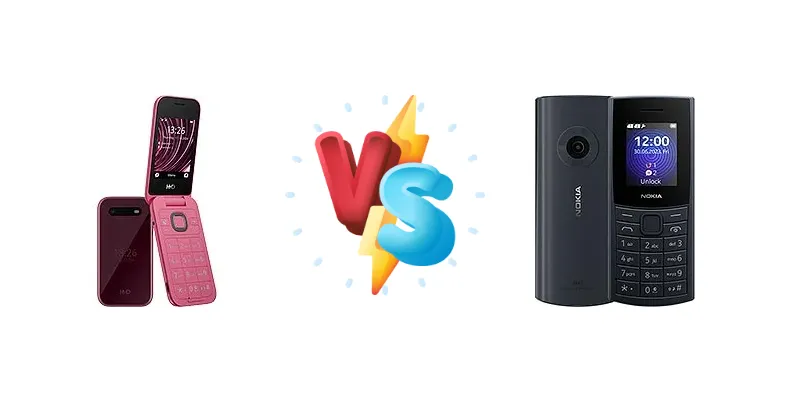
In a world dominated by smartphones, the appeal of a simple, reliable feature phone remains strong. The HMD 2660 Flip and Nokia 110 4G 2nd Edition represent modern takes on this classic form factor, offering 4G connectivity and essential features. This comparison dissects their differences, focusing on the HMD 2660 Flip’s known specifications and extrapolating from Nokia’s established market position for the 110 4G.
🏆 Quick Verdict
For users prioritizing a familiar flip phone experience with a slightly more modern chipset, the HMD 2660 Flip is the better choice. Its Unisoc T107 processor, while not powerful, offers a marginal performance advantage over what is expected from the Nokia 110 4G, and the charging cradle adds convenience. However, both phones cater to a very specific, undemanding user base.
| Network |
|---|
| 2G bands | GSM 850 / 900 / 1800 / 1900 | GSM 900 / 1800 |
| 3G bands | HSDPA 850 / 900 / 2100 | HSDPA 850 / 900 / 1700(AWS) / 1900 / 2100 |
| 4G bands | 1, 3, 5, 7, 8, 20, 28, 40 | LTE |
| Speed | HSPA, LTE | HSPA, LTE |
| Technology | GSM / HSPA / LTE | GSM / HSPA / LTE |
| Launch |
|---|
| Announced | 2025, March 02 | 2024, December |
| Status | Available. Released 2025, March | Available. Released 2024, December |
| Body |
|---|
| Dimensions | 198.9 x 55 x 19 mm (7.83 x 2.17 x 0.75 in) | 121.5 x 50 x 14.4 mm (4.78 x 1.97 x 0.57 in) |
| SIM | Nano-SIM + Nano-SIM | · Nano-SIM· Nano-SIM + Nano-SIM |
| Weight | 136.4 g (4.80 oz) | 94.5 g (3.35 oz) |
| Display |
|---|
| Resolution | 240 x 320 pixels, 4:3 ratio (~143 ppi density) | 120 x 160 pixels, 4:3 ratio (~111 ppi density) |
| Size | 2.8 inches, 24.3 cm2 (~22.2% screen-to-body ratio) | 1.8 inches, 10.0 cm2 (~16.5% screen-to-body ratio) |
| Type | TFT | IPS LCD |
| Platform |
|---|
| CPU | 1.0 GHz Cortex-A7 | - |
| Chipset | Unisoc T107 (22 nm) | - |
| Memory |
|---|
| Call records | Yes | Yes |
| Card slot | microSDHC | microSDHC |
| Internal | 128MB 64MB RAM | 48MB 128MB RAM |
| Phonebook | Yes | Yes |
| Main Camera |
|---|
| Features | LED flash | - |
| Single | 0.3 MP | QVGA |
| Video | Yes | Yes |
| Sound |
|---|
| 35mm jack | Yes | Yes |
| Loudspeaker | Yes | Yes |
| Comms |
|---|
| Bluetooth | 5.0, A2DP | 5.0, A2DP |
| NFC | No | No |
| Positioning | No | No |
| Radio | Wireless FM radio | Wireless FM radio |
| USB | USB Type-C 2.0 | USB Type-C |
| WLAN | No | No |
| Features |
|---|
| Games | Yes | Yes |
| Java | No | No |
| Messaging | SMS, MMS | SMS |
| Battery |
|---|
| Charging | Compatible with a charging cradle | - |
| Type | 1450 mAh, removable | Li-Ion 1450 mAh, removable |
| Misc |
|---|
| Colors | Twilight Violet, Raspberry Red, Cosy Black | Midnight Blue, Arctic Purple |
| Price | - | About 60 EUR |
HMD 2660 Flip
- Flip phone form factor offers screen protection.
- Unisoc T107 provides a slight performance edge.
- Charging cradle included for convenient charging.
- Still a very basic feature phone with limited functionality.
- Display quality is likely low.
Nokia 110 4G 2nd Edition
- Nokia’s reputation for reliability in basic phones.
- Potentially lower price point.
- Extremely long battery life.
- Likely slower processor than the HMD 2660 Flip.
- Limited features and functionality.
Display Comparison
Detailed display specifications are unavailable for the Nokia 110 4G 2nd Edition. However, given its market positioning, it likely features a basic 2.4-inch TFT display with a low resolution. The HMD 2660 Flip, while also likely utilizing a similar TFT panel, benefits from the flip design which offers screen protection when closed. Both displays will likely suffer from limited viewing angles and low brightness, but the flip design of the HMD model provides a degree of physical protection against scratches and damage.
Camera Comparison
Neither device is intended for photography. While both may include a basic rear camera, image quality will be extremely limited. Specifications for the Nokia 110 4G’s camera are scarce, and the HMD 2660 Flip’s camera is likely a low-resolution sensor primarily for occasional snapshots. Focusing on camera performance is irrelevant for these devices; their value lies in communication, not content creation.
Performance
The HMD 2660 Flip is powered by the Unisoc T107 chipset, a 22nm processor with a 1.0 GHz Cortex-A7 CPU. This provides a modest performance boost over the likely MediaTek 6731 or similar chipset found in the Nokia 110 4G 2nd Edition. While neither phone is designed for demanding tasks, the Unisoc T107 will offer slightly smoother operation of basic features like the phonebook and messaging. The 22nm process node, while older, is optimized for low power consumption, contributing to extended battery life. The Nokia 110 4G likely prioritizes power efficiency over raw processing power.
Battery Life
Battery capacity details for both phones are limited. However, feature phones generally excel in battery life due to their low-power components and simple operating systems. The HMD 2660 Flip’s Unisoc T107, while offering slightly more performance, is still designed for efficiency. The Nokia 110 4G 2nd Edition likely prioritizes maximizing battery life above all else. The HMD 2660 Flip’s compatibility with a charging cradle offers a convenient charging solution, potentially extending usability for users who prefer not to deal with micro-USB cables.
Buying Guide
Buy the HMD 2660 Flip if you need a flip phone form factor with 4G connectivity and appreciate the convenience of a charging cradle. It’s ideal for those who want a secondary phone for calls and texts, or a durable device for travel. Buy the Nokia 110 4G 2nd Edition if you prioritize extreme simplicity, a potentially lower price point, and Nokia’s brand reputation for reliability in the basic phone segment. It’s best suited for users who need a phone solely for essential communication.
Frequently Asked Questions
❓ Is the HMD 2660 Flip compatible with hearing aids?
While HMD doesn't explicitly state hearing aid compatibility, the inclusion of 4G VoLTE support suggests improved call clarity, which may benefit some hearing aid users. However, specific compatibility will depend on the hearing aid model and its Bluetooth or telecoil capabilities.
❓ Can I use WhatsApp or Facebook on the Nokia 110 4G 2nd Edition?
The Nokia 110 4G 2nd Edition runs on a very basic operating system (likely KaiOS) that supports a limited number of apps. While some versions of KaiOS support WhatsApp and Facebook Lite, compatibility is not guaranteed and performance will be extremely limited due to the phone's low processing power and memory.
❓ How easy is it to transfer contacts from a smartphone to the HMD 2660 Flip?
Transferring contacts can be done via Bluetooth, though it requires pairing with a smartphone. Alternatively, contacts can be manually entered using the phone's keypad. The process isn't as seamless as smartphone-to-smartphone transfers, but it's manageable for users comfortable with basic phone operations.