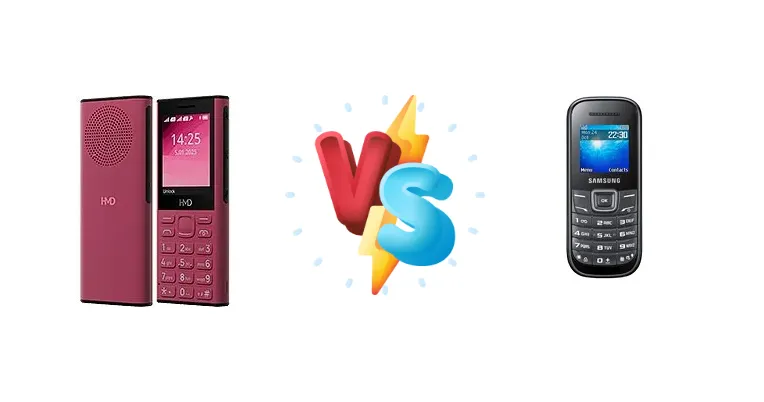
The HMD 130 Music and Samsung E1200 Pusha represent vastly different eras of mobile technology. The Pusha, a relic of the early 2000s, embodies simplicity and durability, while the HMD 130 Music, despite its budget positioning, brings modern smartphone functionality to a wider audience. This comparison isn't about finding a 'better' phone in the traditional sense, but understanding the trade-offs between basic communication and contemporary features.
🏆 Quick Verdict
For the vast majority of users, the HMD 130 Music is the clear choice. Its Unisoc 6531F chipset delivers a significantly more versatile experience, enabling music playback, basic apps, and future-proofing against increasingly demanding network standards. The Samsung E1200 Pusha remains viable only for those prioritizing extreme simplicity and longevity above all else.
| Network |
|---|
| 2G bands | GSM 900 / 1800 | GSM 900 / 1800 |
| EDGE | No | No |
| GPRS | No | No |
| Technology | GSM | GSM |
| Launch |
|---|
| Announced | 2025, March 02 | 2012. Released 2012 |
| Status | Available. Released 2025, March | Discontinued |
| Body |
|---|
| Dimensions | 130.5 x 52.9 x 14.8 mm (5.14 x 2.08 x 0.58 in) | 108 x 45 x 13.5 mm (4.25 x 1.77 x 0.53 in) |
| SIM | Dual SIM (Mini-SIM, dual stand-by) | Mini-SIM |
| Weight | 83.1 g (2.93 oz) | 65.1 g (2.29 oz) |
| Display |
|---|
| Resolution | 240 x 320 pixels, 4:3 ratio (~167 ppi density) | 128 x 128 pixels, 1:1 ratio (~119 ppi density) |
| Size | 2.4 inches, 17.8 cm2 (~25.8% screen-to-body ratio) | 1.52 inches, 7.5 cm2 (~15.3% screen-to-body ratio) |
| Type | TN TFT | TFT, 65K colors |
| Platform |
|---|
| CPU | - | 156 MHz |
| Chipset | Unisoc 6531F | - |
| Memory |
|---|
| Call records | Yes | Yes |
| Card slot | microSDHC | No |
| Internal | 8MB 8MB RAM | - |
| Phonebook | Yes | Yes |
| Sound |
|---|
| 3.5mm jack | - | No |
| 35mm jack | Yes | No |
| Loudspeaker | Yes | Yes |
| Comms |
|---|
| Bluetooth | 5.0, A2DP | No |
| NFC | No | - |
| Positioning | No | No |
| Radio | Unspecified | No |
| USB | USB Type-C 1.1 | Proprietary |
| WLAN | No | No |
| Features |
|---|
| Games | Yes | No |
| Java | No | No |
| Messaging | SMS | SMS |
| Sensors | No | - |
| Battery |
|---|
| Stand-by | - | Up to 720 h |
| Talk time | - | Up to 7 h |
| Type | 2500 mAh, removable | Removable Li-Ion 800 mAh battery |
| Misc |
|---|
| Colors | Dark Blue, Purple, Gray | Black, White, Blue |
| Price | - | About 20 EUR |
| SAR EU | - | 0.81 W/kg (head) |
HMD 130 Music
- Modern chipset enables music playback and apps
- Color display offers a more engaging experience
- Potential for future software updates and feature additions
- Battery life is significantly shorter than the Samsung E1200 Pusha
- Build quality may not be as robust as the older model
Samsung E1200 Pusha
- Exceptional battery life (weeks on a single charge)
- Extreme durability and simplicity
- Very low cost
- Limited functionality – primarily for calls and texts
- Outdated technology with no future support
- Lack of modern features like music playback or a color display
Display Comparison
Details regarding the displays of both devices are unavailable. However, given the market segment, the Samsung E1200 Pusha likely features a small, low-resolution monochrome or basic color LCD. The HMD 130 Music, being a more modern device, almost certainly has a color display, though its resolution and panel technology are likely basic. The HMD 130 Music's display, even if low-resolution, will offer a more visually engaging experience due to its color capabilities.
Camera Comparison
Camera details are unavailable for both devices. It's highly probable the Samsung E1200 Pusha lacks a camera entirely. The HMD 130 Music may include a very basic camera, but image quality will be limited by the chipset's processing capabilities and sensor quality. The presence of *any* camera, however rudimentary, gives the HMD 130 Music an advantage.
Performance
The performance disparity is immense. The Samsung E1200 Pusha's 156 MHz CPU is a product of its time, capable of handling only basic call functions and SMS messaging. In contrast, the HMD 130 Music's Unisoc 6531F chipset, while entry-level, is a modern ARM-based processor capable of running a full operating system (likely a feature phone OS) and supporting applications like music players, FM radio, and potentially even basic internet browsing. The Unisoc 6531F's architecture allows for significantly more complex tasks and better responsiveness.
Battery Life
The Samsung E1200 Pusha is renowned for its exceptional battery life, potentially lasting weeks on a single charge due to its minimal power consumption. The HMD 130 Music, with its more powerful chipset and color display, will have a significantly shorter battery life, likely measured in days rather than weeks. However, the HMD 130 Music's battery life is still likely sufficient for several days of typical use, and the convenience of modern features outweighs the longevity advantage for many users.
Buying Guide
Buy the HMD 130 Music if you need a device capable of playing music, running basic applications like a radio, and offering a degree of future compatibility with evolving mobile networks. Buy the Samsung E1200 Pusha if you prioritize an exceptionally long battery life, absolute simplicity, and a phone that can withstand significant physical abuse without concern for data loss or complex settings.
Frequently Asked Questions
❓ Is the Unisoc 6531F chipset capable of running any apps beyond basic functions?
Yes, the Unisoc 6531F is capable of running basic Java-based applications and potentially lightweight Android Go apps, depending on the HMD 130 Music's software implementation. This allows for features like FM radio, simple games, and potentially basic social media access.
❓ How does the build quality of the Samsung E1200 Pusha compare to the HMD 130 Music?
The Samsung E1200 Pusha is known for its exceptionally robust build quality, designed to withstand significant physical abuse. The HMD 130 Music, while likely reasonably durable, will likely not match the Pusha's level of ruggedness due to its more complex internal components and plastic construction.
❓ Can the HMD 130 Music be used for internet browsing?
While the Unisoc 6531F chipset *technically* supports basic internet connectivity, the experience will be extremely limited due to the likely lack of a fast data connection (2G or potentially 3G) and a small, low-resolution display. It's not a practical device for regular web browsing.