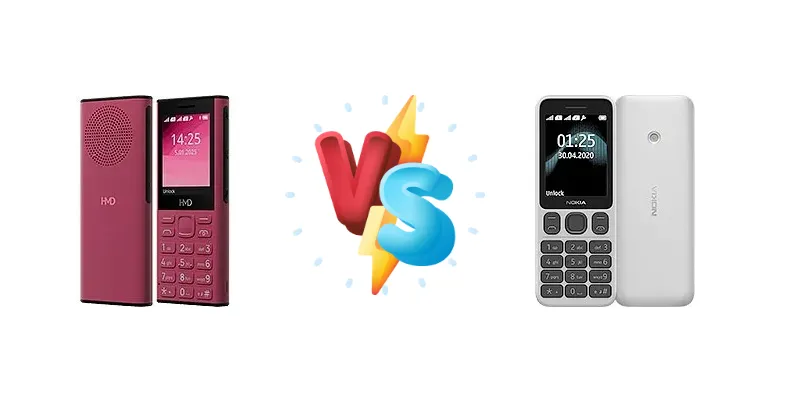
In the realm of ultra-affordable mobile phones, the HMD 130 Music and Nokia 125 represent distinct approaches. The HMD 130 Music attempts to bridge the gap between a traditional feature phone and a basic smartphone with its Unisoc chipset, while the Nokia 125 doubles down on simplicity and durability. This comparison dissects their key differences to help you choose the right device for your needs.
🏆 Quick Verdict
For the average user seeking a bit more functionality, the HMD 130 Music is the better choice. Its Unisoc 6531F chipset enables features like MP3 playback and potentially more responsive UI interactions, features absent in the Nokia 125, despite the latter's focus on longevity.
| Network |
|---|
| 2G bands | GSM 900 / 1800 | GSM 900 / 1800 |
| EDGE | No | No |
| GPRS | No | No |
| Technology | GSM | GSM |
| Launch |
|---|
| Announced | 2025, March 02 | 2020, May 12. Released 2020, May 29 |
| Status | Available. Released 2025, March | Discontinued |
| Body |
|---|
| Dimensions | 130.5 x 52.9 x 14.8 mm (5.14 x 2.08 x 0.58 in) | 132 x 50.5 x 15 mm (5.20 x 1.99 x 0.59 in) |
| SIM | Dual SIM (Mini-SIM, dual stand-by) | Single SIM (Mini-SIM) or Dual SIM (Mini-SIM, dual stand-by) |
| Weight | 83.1 g (2.93 oz) | 91.3 g (3.21 oz) |
| | - | Flashlight |
| Display |
|---|
| Resolution | 240 x 320 pixels, 4:3 ratio (~167 ppi density) | 240 x 320 pixels, 4:3 ratio (~167 ppi density) |
| Size | 2.4 inches, 17.8 cm2 (~25.8% screen-to-body ratio) | 2.4 inches, 17.8 cm2 (~26.8% screen-to-body ratio) |
| Type | TN TFT | TFT LCD, 65K colors |
| Platform |
|---|
| Chipset | Unisoc 6531F | - |
| Memory |
|---|
| Call records | Yes | Yes |
| Card slot | microSDHC | No |
| Internal | 8MB 8MB RAM | 4MB |
| Phonebook | Yes | 2000 entries |
| Sound |
|---|
| 3.5mm jack | - | Yes |
| 35mm jack | Yes | Yes |
| Loudspeaker | Yes | Yes |
| Comms |
|---|
| Bluetooth | 5.0, A2DP | No |
| NFC | No | No |
| Positioning | No | No |
| Radio | Unspecified | FM radio; built-in antenna |
| USB | USB Type-C 1.1 | microUSB 2.0 |
| WLAN | No | No |
| Features |
|---|
| Games | Yes | Yes |
| Java | No | No |
| Messaging | SMS | SMS |
| Sensors | No | - |
| Battery |
|---|
| Stand-by | - | Up to 560 h |
| Talk time | - | Up to 19 h |
| Type | 2500 mAh, removable | Li-Ion 1020 mAh, removable |
| Misc |
|---|
| Colors | Dark Blue, Purple, Gray | Black, White |
| Models | - | TA-1253 |
| Price | - | About 20 EUR |
| SAR EU | - | 0.43 W/kg (head) 0.63 W/kg (body) |
HMD 130 Music
- Unisoc 6531F enables MP3 playback and radio functionality.
- Potentially more responsive user interface.
- May support basic app functionality (depending on software).
- Battery life likely shorter than Nokia 125.
- Camera quality will be limited.
Nokia 125
- Exceptional battery life due to minimal power consumption.
- Extreme simplicity and ease of use.
- Robust and durable design.
- Lacks advanced features like MP3 playback and radio.
- Limited functionality beyond calls and texts.
Display Comparison
Given the lack of display specifications for the Nokia 125, a direct comparison is difficult. However, both devices likely utilize low-resolution color displays typical of feature phones. The HMD 130 Music, benefiting from a more modern design, may offer slightly improved viewing angles and color reproduction, but neither is expected to compete with smartphone-grade panels. Bezels are expected to be substantial on both devices, prioritizing durability and cost reduction over immersive viewing.
Camera Comparison
Neither device is positioned as a photography powerhouse. The Nokia 125 is unlikely to feature a camera at all, based on typical feature phone offerings in its price bracket. The HMD 130 Music may include a basic camera, but image quality will be limited by the sensor size and lack of image processing capabilities. This isn't a category where either device excels; both are intended for communication, not content creation.
Performance
The HMD 130 Music’s Unisoc 6531F chipset represents a significant architectural advantage over the Nokia 125, which lacks a specified processor. The Unisoc 6531F, while not powerful, allows for more complex tasks like audio decoding (MP3 playback) and potentially a smoother user interface. The Nokia 125 likely relies on a very basic, single-core processor designed solely for call and text functionality. RAM specifications are unavailable for either device, but are expected to be minimal, limiting multitasking capabilities on both.
Battery Life
The Nokia 125, with its focus on simplicity, likely boasts exceptional battery life due to its minimal power consumption. The HMD 130 Music, powered by the Unisoc 6531F, will likely have a shorter battery life, but the chipset's power efficiency may still deliver several days of standby time. Charging times are expected to be slow on both devices, utilizing micro-USB connectivity.
Buying Guide
Buy the HMD 130 Music if you need a device capable of playing MP3s, utilizing a radio, and potentially supporting basic apps or future software updates thanks to its more modern chipset. Buy the Nokia 125 if you prioritize extreme simplicity, maximum battery life, and a rugged, no-frills experience where core functionality – calls and texts – are paramount.
Frequently Asked Questions
❓ Can the HMD 130 Music play music from a microSD card?
Yes, the 'Music' in the name is a key indicator. The Unisoc 6531F chipset supports MP3 decoding and the device includes a microSD card slot, allowing users to expand storage for their music library. This is a feature absent in the Nokia 125.
❓ Is the Nokia 125 a good choice for someone who primarily needs a phone for emergency calls?
Absolutely. The Nokia 125 excels in this scenario. Its exceptional battery life and robust build quality make it a reliable device for essential communication, even without regular charging access. The simplicity of the interface also ensures ease of use in stressful situations.
❓ Does the HMD 130 Music support any apps beyond basic functions?
While not a smartphone, the Unisoc 6531F chipset *potentially* allows for limited app support, depending on the software implementation by HMD. However, don't expect to run demanding applications; any apps supported will likely be lightweight and focused on basic utility.