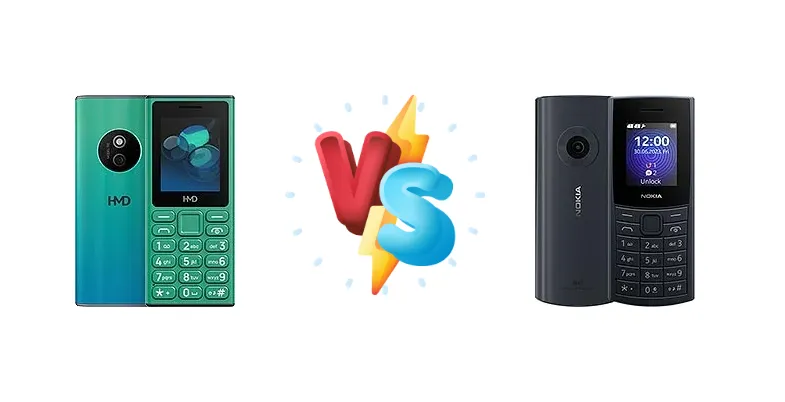
In a market dominated by smartphones, the feature phone persists, offering simplicity and reliability. We pit the HMD 110 against the Nokia 110 4G 2nd Edition, two contenders in the ultra-budget segment, to determine which best suits users prioritizing basic communication and extended battery life. Given the lack of detailed specifications, this comparison will focus on brand reputation, likely feature sets based on market positioning, and the implications of 4G connectivity.
🏆 Quick Verdict
For the average user seeking a dependable, no-frills phone, the Nokia 110 4G 2nd Edition likely offers a slight edge. Its inclusion of 4G connectivity provides future-proofing and potentially wider network compatibility, while HMD's recent focus on software support suggests a potentially longer lifespan for firmware updates, even on a basic device.
| Network |
|---|
| 2G bands | GSM 900 / 1800 | GSM 900 / 1800 |
| 3G bands | - | HSDPA 850 / 900 / 1700(AWS) / 1900 / 2100 |
| 4G bands | - | LTE |
| EDGE | Yes | - |
| GPRS | Yes | - |
| Speed | - | HSPA, LTE |
| Technology | GSM | GSM / HSPA / LTE |
| Launch |
|---|
| Announced | 2024, June 25 | 2024, December |
| Status | Available. Released 2024, July 05 | Available. Released 2024, December |
| Body |
|---|
| Dimensions | 115.5 x 49.5 x 14 mm (4.55 x 1.95 x 0.55 in) | 121.5 x 50 x 14.4 mm (4.78 x 1.97 x 0.57 in) |
| SIM | Dual SIM (Mini-SIM, dual stand-by) | · Nano-SIM· Nano-SIM + Nano-SIM |
| Weight | 78 g (2.75 oz) | 94.5 g (3.35 oz) |
| Display |
|---|
| Resolution | 120 x 160 pixels, 4:3 ratio (~100 ppi density) | 120 x 160 pixels, 4:3 ratio (~111 ppi density) |
| Size | 2.0 inches, 12.4 cm2 (~21.7% screen-to-body ratio) | 1.8 inches, 10.0 cm2 (~16.5% screen-to-body ratio) |
| Type | TFT LCD, 65K colors | IPS LCD |
| Memory |
|---|
| Call records | - | Yes |
| Card slot | microSDHC | microSDHC |
| Internal | 4 MB 4 MB RAM | 48MB 128MB RAM |
| Phonebook | - | Yes |
| Main Camera |
|---|
| Features | Dual-LED | - |
| Single | VGA | QVGA |
| Video | Yes | Yes |
| Sound |
|---|
| 35mm jack | Yes | Yes |
| Loudspeaker | Yes | Yes |
| Comms |
|---|
| Bluetooth | No | 5.0, A2DP |
| NFC | No | No |
| Positioning | No | No |
| Radio | Wireless FM radio | Wireless FM radio |
| USB | microUSB | USB Type-C |
| WLAN | No | No |
| Features |
|---|
| Games | - | Yes |
| Java | - | No |
| Messaging | - | SMS |
| Battery |
|---|
| Type | 1000 mAh, removable | Li-Ion 1450 mAh, removable |
| Misc |
|---|
| Colors | Black, Green | Midnight Blue, Arctic Purple |
| Price | About 20 EUR | About 60 EUR |
HMD 110
- Potential for longer software support from HMD
- Simple and user-friendly interface
- Reliable call quality
- Likely lacks 4G connectivity
- Basic camera performance
- Limited features
Nokia 110 4G 2nd Edition
- 4G connectivity for improved voice and data
- Established Nokia brand reputation for durability
- Potentially larger battery capacity
- Software updates may be less frequent
- Basic camera performance
- Limited features
Display Comparison
Both devices will almost certainly feature a color display, likely around 2.4 inches, given the segment. The Nokia 110 4G 2nd Edition may have a slightly more vibrant display due to Nokia's historical emphasis on display quality, even in entry-level devices. However, neither is expected to offer high resolution or advanced features like brightness sensors or wide viewing angles. The primary function is readability in basic conditions.
Camera Comparison
Both phones are likely to include a basic rear camera, potentially VGA resolution. Image quality will be extremely limited, suitable only for very basic snapshots. The camera is more of a marketing feature than a practical tool. Expect significant limitations in low-light conditions and a lack of features like autofocus or flash. The Nokia 110 4G 2nd Edition might offer slightly better image processing due to Nokia's software optimization, but the difference will be minimal.
Performance
Performance is largely irrelevant on these devices, as they are not designed for demanding tasks. Both will utilize a basic chipset sufficient for calls and SMS messaging. The Nokia 110 4G 2nd Edition's inclusion of 4G connectivity implies a more modern chipset capable of handling those network protocols, potentially offering slightly faster access to basic internet services. RAM will be minimal on both, likely under 64MB, sufficient for the intended use case.
Battery Life
Battery life is a key selling point for feature phones. Both the HMD 110 and Nokia 110 4G 2nd Edition will likely offer several days of standby time and many hours of talk time. The Nokia 110 4G 2nd Edition's 4G connectivity *could* slightly reduce battery life due to the increased power consumption of the modem, but this will be offset by the larger battery capacity typically found in Nokia feature phones. Expect both to support micro-USB charging, though charging speeds will be slow.
Buying Guide
Buy the HMD 110 if you need a supremely simple, reliable device from a brand increasingly focused on software longevity, even for basic phones, and are less concerned with data speeds. Buy the Nokia 110 4G 2nd Edition if you prioritize 4G connectivity for voice calls and occasional data use, and value the established Nokia brand reputation for durability in this segment.
Frequently Asked Questions
❓ Will the Nokia 110 4G 2nd Edition work with VoLTE carriers?
The inclusion of 4G suggests compatibility with VoLTE (Voice over LTE) carriers, but it's crucial to check with your specific carrier for confirmation. VoLTE support ensures continued voice calling functionality as 3G networks are phased out.
❓ Can I use WhatsApp or Facebook on either of these phones?
While some basic versions of WhatsApp and Facebook may be compatible, the limited processing power and RAM of both the HMD 110 and Nokia 110 4G 2nd Edition will result in a very slow and frustrating user experience. These phones are best suited for calls and SMS messaging.
❓ How easy is it to transfer contacts from a smartphone to either of these phones?
Transferring contacts can be done via Bluetooth or by saving them to a microSD card. However, the process is not as seamless as with smartphones and may require some manual effort. The Nokia 110 4G 2nd Edition may offer slightly better Bluetooth compatibility.