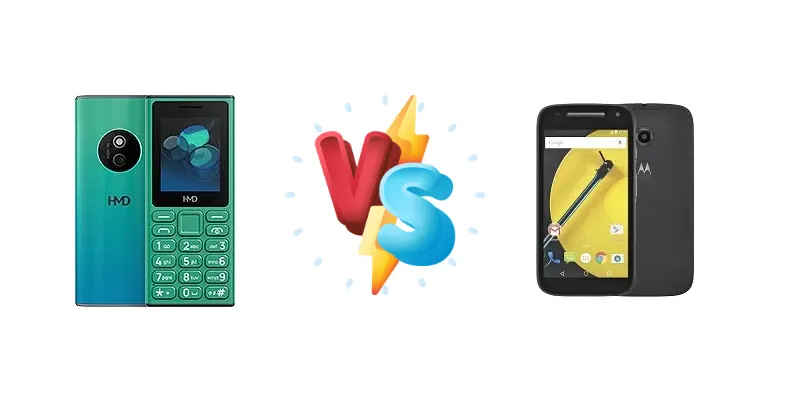
The smartphone market is flooded with options, but finding a reliable device under $150 can be challenging. We pit the relatively unknown HMD 110 against the well-established Motorola Moto E (2nd Gen) to determine which offers the best value for users prioritizing essential functionality and affordability. The Moto E, while older, provides a known baseline for performance and reliability.
🏆 Quick Verdict
For the average user, the Motorola Moto E (2nd Gen) is the safer bet. While the HMD 110's specifications are largely unknown, the Moto E's Snapdragon processor and 82-hour endurance rating provide a predictable and functional experience, making it a more reliable choice in this price bracket.
| Network |
|---|
| 2G bands | GSM 900 / 1800 | GSM 850 / 900 / 1800 / 1900 - all versions |
| 3G bands | - | HSDPA 850 / 1700(AWS) / 1900 - XT1527, XT1511 |
| 4G bands | - | 2, 4, 5, 7, 17 - XT1527 |
| EDGE | Yes | - |
| GPRS | Yes | - |
| Speed | - | HSPA, LTE |
| Technology | GSM | GSM / HSPA / LTE |
| | - | 1, 3, 7, 20 - XT1524 |
| Launch |
|---|
| Announced | 2024, June 25 | 2015, February. Released 2015, February |
| Status | Available. Released 2024, July 05 | Discontinued |
| Body |
|---|
| Dimensions | 115.5 x 49.5 x 14 mm (4.55 x 1.95 x 0.55 in) | 129.9 x 66.8 x 12.3 mm (5.11 x 2.63 x 0.48 in) |
| SIM | Dual SIM (Mini-SIM, dual stand-by) | Micro-SIM |
| Weight | 78 g (2.75 oz) | 145 g (5.11 oz) |
| Display |
|---|
| Protection | - | Corning Gorilla Glass 3, oleophobic coating |
| Resolution | 120 x 160 pixels, 4:3 ratio (~100 ppi density) | 540 x 960 pixels, 16:9 ratio (~245 ppi density) |
| Size | 2.0 inches, 12.4 cm2 (~21.7% screen-to-body ratio) | 4.5 inches, 55.8 cm2 (~64.3% screen-to-body ratio) |
| Type | TFT LCD, 65K colors | IPS LCD |
| Platform |
|---|
| CPU | - | Quad-core 1.2 GHz Cortex-A7 - 3G modelQuad-core 1.2 GHz Cortex-A53 - LTE model |
| Chipset | - | Qualcomm Snapdragon 200 (28 nm) - 3G modelQualcomm Snapdragon 410 (28 nm) - LTE model |
| GPU | - | Adreno 302 - 3G modelAdreno 306 - LTE model |
| OS | RTOS OS | Android 5.0/5.1 (Lollipop) - only XT1527, upgradable to 6.0 (Marshmallow) |
| Memory |
|---|
| Card slot | microSDHC | microSDHC (dedicated slot) |
| Internal | 4 MB 4 MB RAM | 8GB 1GB RAM |
| | - | eMMC 4.5 |
| Main Camera |
|---|
| Features | Dual-LED | Panorama, HDR |
| Single | VGA | 5 MP, f/2.2, AF |
| Video | Yes | 720p@30fps |
| Sound |
|---|
| 3.5mm jack | - | Yes |
| 35mm jack | Yes | Yes |
| Loudspeaker | Yes | Yes |
| Comms |
|---|
| Bluetooth | No | 4.0, LE, aptX |
| NFC | No | No |
| Positioning | No | GPS, GLONASS |
| Radio | Wireless FM radio | FM radio, RDS |
| USB | microUSB | microUSB 2.0, OTG |
| WLAN | No | Wi-Fi 802.11 b/g/n, Wi-Fi Direct, hotspot |
| Features |
|---|
| Sensors | - | Accelerometer, proximity |
| Battery |
|---|
| Type | 1000 mAh, removable | Li-Ion 2390 mAh, non-removable |
| Misc |
|---|
| Colors | Black, Green | Black, White |
| Models | - | XT1527, XT1511, XT1505, XT1524, XT1528, XT1526 |
| Price | About 20 EUR | About 130 EUR |
| SAR | - | 0.89 W/kg (head) 1.40 W/kg (body) |
| Tests |
|---|
| Battery life | - |
Endurance rating 82h
|
| Camera | - |
Photo / Video |
| Loudspeaker | - |
Voice 72dB / Noise 68dB / Ring 75dB
|
| Performance | - |
Basemark OS II 2.0: 546Basemark X: 1851 |
HMD 110
- Potentially very low price
- May offer basic smartphone functionality
- Could be a suitable secondary device
- Unknown specifications
- Uncertain performance and software support
- Potentially limited features
Motorola Moto E (2nd gen)
- Known Snapdragon processor (200 or 410)
- Excellent 82-hour battery life
- Reliable and established brand
- Older generation hardware
- Limited camera capabilities
- May not receive future software updates
Display Comparison
Details regarding the HMD 110's display are unavailable. The Motorola Moto E (2nd Gen) likely features a standard LCD panel common to its price point, prioritizing durability over advanced features like high refresh rates or OLED technology. Without knowing the HMD 110's resolution or panel type, it's difficult to assess its visual quality, but the Moto E's display is adequate for basic tasks.
Camera Comparison
Both devices offer basic photo and video capabilities. However, the specifics of the HMD 110's camera are unknown. The Motorola Moto E (2nd Gen) likely features a modest camera sensor, sufficient for casual snapshots in good lighting conditions. Given the budget nature of both phones, image quality will likely be limited in low-light environments. Focusing on sensor size or aperture is impossible without HMD 110 specs.
Performance
The Motorola Moto E (2nd Gen) comes in two variants: a 3G model with a quad-core 1.2 GHz Cortex-A7 processor and a Qualcomm Snapdragon 200 chipset, and an LTE model featuring a quad-core 1.2 GHz Cortex-A53 processor and a Qualcomm Snapdragon 410 chipset. The Cortex-A53 architecture in the Snapdragon 410 represents a significant improvement over the Cortex-A7, offering better performance and efficiency. The HMD 110's processor is unknown, but given its price point, it likely utilizes an even less powerful chipset, potentially impacting app loading times and multitasking capabilities. The Snapdragon 410's 28nm process node is also more mature, potentially leading to better thermal management than a newer, less refined chip.
Battery Life
The Motorola Moto E (2nd Gen) boasts an impressive endurance rating of 82 hours, indicating excellent battery life for its time. This suggests a well-optimized combination of battery capacity and power efficiency. The HMD 110's battery life is unknown, but it's reasonable to assume it will be comparable, potentially lower, given the lack of information and the device's likely lower price point. The Moto E's longevity is a significant advantage for users who prioritize minimizing charging frequency.
Buying Guide
Buy the HMD 110 if you need a basic, ultra-affordable phone and are willing to accept uncertainty regarding its performance and software support. It may appeal to those needing a secondary device or a very simple phone for calls and texts. Buy the Motorola Moto E (2nd gen) if you prioritize a known quantity, a dependable battery life of 82 hours, and a Qualcomm Snapdragon processor, even if it's an older generation, offering a more consistent user experience.
Frequently Asked Questions
❓ Is the Snapdragon 410 in the Moto E (LTE version) still capable of running modern apps?
While the Snapdragon 410 is an older processor, it can handle basic apps like social media, messaging, and web browsing. However, demanding games or resource-intensive applications may experience lag or slowdowns. It's sufficient for essential smartphone tasks but won't provide a high-performance experience.
❓ What kind of software support can I expect from the Motorola Moto E (2nd Gen) at this point?
The Motorola Moto E (2nd Gen) is unlikely to receive further software updates. It's likely running an older version of Android, and security patches may no longer be available. This is a common limitation with older budget smartphones.
❓ Given the lack of information on the HMD 110, what are the biggest risks of buying it?
The primary risk is uncertainty. You don't know the processor's performance, the screen quality, or the long-term software support. It could be a perfectly functional basic phone, but it could also be significantly slower or less reliable than the Moto E.