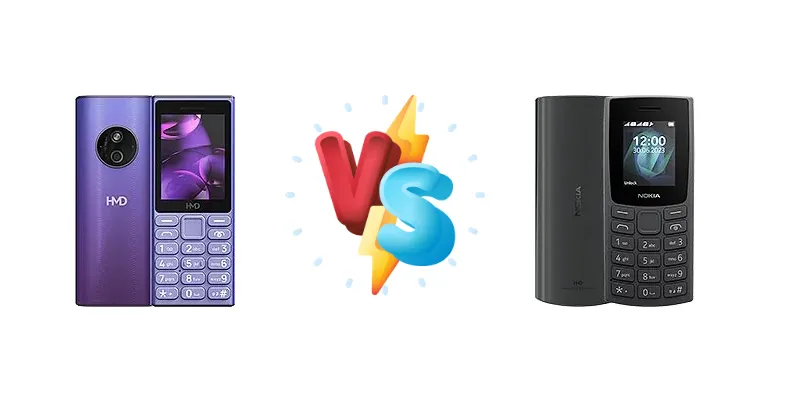
In the increasingly crowded ultra-budget phone market, the HMD 110 4G and Nokia 105 4G 2nd Edition represent compelling options for users prioritizing basic connectivity and long battery life. While both offer 4G capabilities, a closer look reveals a key architectural difference: the HMD 110 4G utilizes a Unisoc T127 chipset, while the Nokia 105 4G 2nd Edition's internal specifications remain largely undisclosed, relying on Nokia's established feature phone lineage.
🏆 Quick Verdict
For the average user seeking a reliable and slightly more capable 4G feature phone, the HMD 110 4G emerges as the winner. The inclusion of the Unisoc T127 chipset provides a demonstrable performance advantage, even within the constraints of a feature phone, offering a smoother user experience and potentially better app compatibility.
| Network |
|---|
| 2G bands | GSM 900 / 1800 | GSM 900 / 1800 |
| 3G bands | HSDPA 850 / 900 / 2100 | HSDPA 850 / 900 / 1700(AWS) / 1900 / 2100 |
| 4G bands | 1, 3, 5, 7, 8, 20 | LTE |
| Speed | HSPA, LTE | HSPA, LTE |
| Technology | GSM / HSPA / LTE | GSM / HSPA / LTE |
| Launch |
|---|
| Announced | 2024, September 13 | 2024, December |
| Status | Available. Released 2024, September 22 | Available. Released 2024, December |
| Body |
|---|
| Dimensions | - | 121.5 x 50 x 14.4 mm (4.78 x 1.97 x 0.57 in) |
| SIM | Nano-SIM + Nano-SIM | · Nano-SIM· Nano-SIM + Nano-SIM |
| Weight | 93.5 g (3.32 oz) | 93 g (3.28 oz) |
| Display |
|---|
| Resolution | 240 x 320 pixels, 4:3 ratio (~167 ppi density) | 120 x 160 pixels, 4:3 ratio (~111 ppi density) |
| Size | 2.4 inches, 17.8 cm2 (~28.0% screen-to-body ratio) | 1.8 inches, 10.0 cm2 (~16.5% screen-to-body ratio) |
| Type | TFT LCD, 65K colors | IPS LCD |
| Platform |
|---|
| Chipset | Unisoc T127 | - |
| Memory |
|---|
| Call records | Yes | Yes |
| Card slot | microSDHC | microSDHC |
| Internal | 64MB 128MB RAM | 48MB 128MB RAM |
| Phonebook | Yes | Yes |
| Main Camera |
|---|
| Single | QVGA | - |
| Video | Yes | - |
| Sound |
|---|
| 35mm jack | Yes | Yes |
| Loudspeaker | Yes | Yes |
| Comms |
|---|
| Bluetooth | 5.0, A2DP | 5.0, A2DP |
| NFC | No | No |
| Positioning | No | No |
| Radio | Wireless FM radio | Wireless FM radio |
| USB | USB Type-C | USB Type-C |
| WLAN | No | No |
| Features |
|---|
| Games | Yes | Yes |
| Java | No | No |
| Messaging | SMS | SMS |
| Battery |
|---|
| Type | Li-Ion 1450 mAh, removable | Li-Ion 1450 mAh, removable |
| Misc |
|---|
| Colors | Blue, Titanium | Charcoal |
| Price | - | About 50 EUR |
HMD 110 4G
- More powerful Unisoc T127 chipset
- Potential for smoother user experience
- Likely better app compatibility
- May be slightly more expensive than the Nokia 105 4G
- Brand recognition not as strong as Nokia
Nokia 105 4G 2nd Edition
- Strong brand reputation for durability
- Potentially simpler user interface
- Likely very affordable
- Undisclosed chipset and specifications
- Potentially slower performance
- Limited future software support
Display Comparison
Neither device is expected to boast a high-resolution or particularly vibrant display. Both likely utilize basic color LCD panels, prioritizing legibility and power efficiency over visual fidelity. Without specific details on the Nokia 105 4G 2nd Edition's display, it's reasonable to assume a similar specification to the HMD 110 4G, focusing on a functional, low-power screen for basic tasks like calls and SMS. Bezels are expected to be substantial on both devices, reflecting their focus on cost reduction.
Camera Comparison
Both devices are unlikely to excel in photography. Feature phones in this price range typically feature low-resolution cameras primarily intended for basic image capture. Any camera on the Nokia 105 4G 2nd Edition is likely to be a basic VGA sensor. The HMD 110 4G may include a slightly higher resolution sensor, but image quality will remain limited by the sensor size, lens quality, and lack of image processing capabilities. Focusing on camera performance for these devices is not a primary use case.
Performance
The Unisoc T127 chipset in the HMD 110 4G represents a significant differentiator. While not a powerhouse, the T127 is a quad-core processor designed for entry-level smartphones and feature phones, offering a noticeable performance boost over older, single-core chipsets commonly found in basic phones. The Nokia 105 4G 2nd Edition, lacking publicly available chipset information, likely relies on a less powerful, proprietary solution. This translates to potentially slower menu navigation, app loading times, and overall responsiveness on the Nokia device. The T127 also supports more modern codecs, potentially improving audio and video playback.
Battery Life
Both the HMD 110 4G and Nokia 105 4G 2nd Edition prioritize long battery life. The low-power chipsets and basic displays contribute to exceptional standby times. While specific battery capacities are not readily available, both devices are expected to offer days of usage on a single charge. The HMD 110 4G's more efficient Unisoc T127 chipset *could* translate to slightly longer battery life under moderate usage, but the difference is likely to be marginal. Charging times will be slow due to the use of micro-USB and low wattage chargers.
Buying Guide
Buy the HMD 110 4G if you need a feature phone with a modern chipset for slightly improved performance and potential future software updates. Buy the Nokia 105 4G 2nd Edition if you prioritize brand recognition, a potentially simpler user interface, and are comfortable with a device where internal specifications are not publicly available, relying on Nokia's reputation for durability in this segment.
Frequently Asked Questions
❓ Does the Unisoc T127 in the HMD 110 4G allow for any meaningful app usage beyond basic functions?
While not designed for demanding applications, the Unisoc T127 enables the HMD 110 4G to run lightweight apps like WhatsApp and Facebook with reasonable performance. The Nokia 105 4G 2nd Edition, with its undisclosed chipset, may struggle with even these basic applications.
❓ How does the Nokia 105 4G 2nd Edition maintain its reputation for durability without revealing its internal components?
Nokia's durability reputation stems from rigorous quality control, robust physical design, and a focus on reliable components, even if those components aren't cutting-edge. The 105 4G 2nd Edition likely benefits from Nokia's established manufacturing processes and material selection.
❓ Is 4G connectivity truly useful on a feature phone like these?
Yes, 4G connectivity significantly improves the browsing experience and enables faster access to online services like WhatsApp. While these phones aren't designed for streaming, 4G provides a more responsive and reliable connection compared to 2G or 3G.