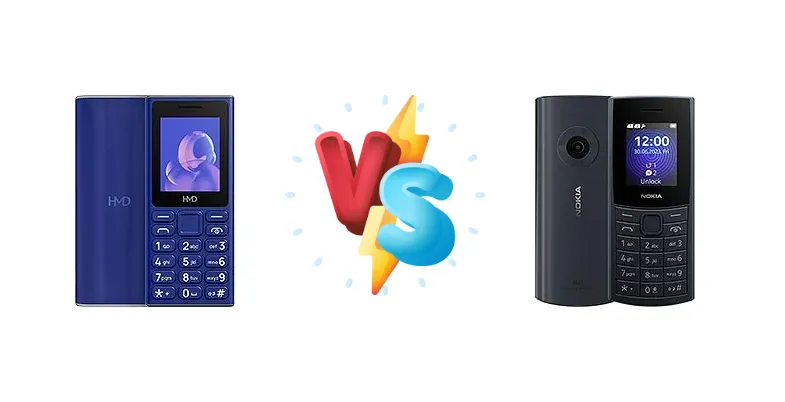
In a market saturated with smartphones, the basic feature phone remains a vital tool for many. We pit the HMD 105 against the Nokia 110 4G 2nd Edition, two contenders aiming to provide reliable communication at an incredibly affordable price point. This comparison focuses on the nuances that matter most to users prioritizing call quality, battery life, and basic functionality over advanced features.
🏆 Quick Verdict
For the average user needing a dependable, long-lasting basic phone with 4G connectivity, the Nokia 110 4G 2nd Edition is the stronger choice. Its established brand reputation for durability and the inclusion of 4G support for future-proofing outweigh the HMD 105’s unknown factors.
| Network |
|---|
| 2G bands | GSM 900 / 1800 | GSM 900 / 1800 |
| 3G bands | - | HSDPA 850 / 900 / 1700(AWS) / 1900 / 2100 |
| 4G bands | - | LTE |
| EDGE | Yes | - |
| GPRS | Yes | - |
| Speed | - | HSPA, LTE |
| Technology | GSM | GSM / HSPA / LTE |
| Launch |
|---|
| Announced | 2024, June 25 | 2024, December |
| Status | Available. Released 2024, July 08 | Available. Released 2024, December |
| Body |
|---|
| Dimensions | 115.5 x 49.5 x 14 mm (4.55 x 1.95 x 0.55 in) | 121.5 x 50 x 14.4 mm (4.78 x 1.97 x 0.57 in) |
| SIM | Dual SIM (Mini-SIM, dual stand-by) | · Nano-SIM· Nano-SIM + Nano-SIM |
| Weight | 77.5 g (2.75 oz) | 94.5 g (3.35 oz) |
| Display |
|---|
| Resolution | 120 x 160 pixels, 4:3 ratio (~100 ppi density) | 120 x 160 pixels, 4:3 ratio (~111 ppi density) |
| Size | 2.0 inches, 12.4 cm2 (~21.7% screen-to-body ratio) | 1.8 inches, 10.0 cm2 (~16.5% screen-to-body ratio) |
| Type | TFT LCD, 65K colors | IPS LCD |
| Memory |
|---|
| Call records | - | Yes |
| Card slot | microSDHC | microSDHC |
| Internal | 4 MB 4 MB RAM | 48MB 128MB RAM |
| Phonebook | - | Yes |
| Main Camera |
|---|
| Single | - | QVGA |
| Video | - | Yes |
| Sound |
|---|
| 35mm jack | Yes | Yes |
| Loudspeaker | Yes | Yes |
| Comms |
|---|
| Bluetooth | No | 5.0, A2DP |
| NFC | No | No |
| Positioning | No | No |
| Radio | Wireless FM radio | Wireless FM radio |
| USB | microUSB | USB Type-C |
| WLAN | No | No |
| Features |
|---|
| Games | - | Yes |
| Java | - | No |
| Messaging | - | SMS |
| Battery |
|---|
| Type | 1000 mAh, removable | Li-Ion 1450 mAh, removable |
| Misc |
|---|
| Colors | Black, Blue, Purple | Midnight Blue, Arctic Purple |
| Price | About 20 EUR | About 60 EUR |
HMD 105
- Potentially the lowest price point available.
- Simple and easy to use interface.
- Compact and lightweight design.
- Lack of 4G connectivity limits future compatibility.
- Unknown brand reliability and longevity.
- Unspecified hardware makes performance prediction difficult.
Nokia 110 4G 2nd Edition
- 4G connectivity for improved call quality and data access.
- Established Nokia brand reputation for durability.
- Long battery life with typical usage.
- Slightly higher price compared to the HMD 105.
- Basic camera performance.
- Limited functionality beyond core communication features.
Display Comparison
Given the nature of these devices, display quality is less critical. Both likely feature small, low-resolution color displays. However, Nokia historically uses slightly more durable display glass in its entry-level phones, potentially offering better scratch resistance. The HMD 105’s display specifications are unknown, making a direct comparison impossible, but we can assume it will be comparable to other phones in this segment.
Camera Comparison
Both devices likely feature a very basic camera, primarily for novelty. Image quality will be extremely limited, and these cameras should not be considered for anything beyond casual snapshots. The resolution is likely to be low on both, and image processing will be minimal. Focusing on camera performance is irrelevant in this segment.
Performance
Performance is dictated by the MediaTek chipset within the Nokia 110 4G 2nd Edition. While not powerful, it’s sufficient for basic calling, texting, and potentially light FM radio use. The HMD 105’s processor is unspecified, but given its price point, it’s likely a similarly basic chipset. The inclusion of 4G in the Nokia 110 4G 2nd Edition provides a significant advantage in call quality and potential data speeds compared to a 2G-only device, should the user require it.
Battery Life
Battery life is a key differentiator. Both phones are expected to offer excellent standby times due to their low-power components and lack of demanding features. The Nokia 110 4G 2nd Edition typically boasts a battery capacity of around 1450mAh, while the HMD 105’s capacity is unknown. However, the 4G connectivity of the Nokia 110 4G 2nd Edition will consume more power, but the larger battery should offset this, providing several days of use on a single charge for both devices.
Buying Guide
Buy the HMD 105 if you need an extremely basic phone for minimal use and are prioritizing the absolute lowest possible cost, accepting a potential trade-off in longevity and network compatibility. Buy the Nokia 110 4G 2nd Edition if you prefer a phone with 4G connectivity for clearer calls and potential data access, and value a brand known for building robust, reliable devices, even at this price point.
Frequently Asked Questions
❓ Will the Nokia 110 4G 2nd Edition work with my current carrier, even if they are phasing out 3G?
Yes, the Nokia 110 4G 2nd Edition’s 4G connectivity ensures compatibility with modern networks as carriers sunset their 3G services. This future-proofs the device, allowing for continued use for a longer period.
❓ Is the HMD 105 a good choice for someone who rarely uses a phone and just needs it for emergencies?
The HMD 105 could be suitable for emergency use, *if* the lowest possible price is the primary concern. However, the lack of 4G means it may not function optimally as networks evolve. The Nokia 110 4G 2nd Edition offers a more reliable solution for long-term emergency preparedness.
❓ Can I use WhatsApp or Facebook on either of these phones?
While some basic versions of WhatsApp and Facebook may function on the Nokia 110 4G 2nd Edition due to its limited 4G data capabilities, the experience will be extremely limited and slow. The HMD 105, lacking 4G, is unlikely to support these apps effectively.