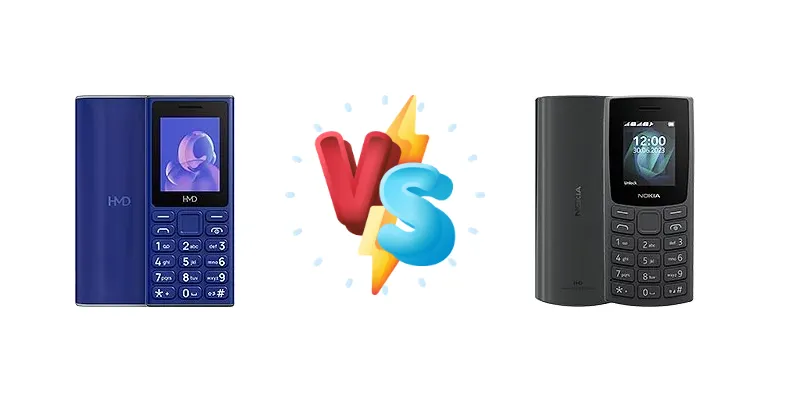
In a market saturated with smartphones, the HMD 105 and Nokia 105 4G 2nd Edition represent a return to simplicity. Both are ultra-budget feature phones aimed at users prioritizing call quality, text messaging, and extended battery life over advanced features. This comparison dissects the nuances between these two devices, focusing on what truly matters in this segment: reliability, connectivity, and value.
🏆 Quick Verdict
For the average user needing a dependable, long-lasting basic phone, the Nokia 105 4G 2nd Edition is the slightly better choice. Its inclusion of 4G connectivity provides future-proofing and potentially wider network compatibility, while the HMD 105 likely focuses on maximizing battery life through 2G/3G operation.
| Network |
|---|
| 2G bands | GSM 900 / 1800 | GSM 900 / 1800 |
| 3G bands | - | HSDPA 850 / 900 / 1700(AWS) / 1900 / 2100 |
| 4G bands | - | LTE |
| EDGE | Yes | - |
| GPRS | Yes | - |
| Speed | - | HSPA, LTE |
| Technology | GSM | GSM / HSPA / LTE |
| Launch |
|---|
| Announced | 2024, June 25 | 2024, December |
| Status | Available. Released 2024, July 08 | Available. Released 2024, December |
| Body |
|---|
| Dimensions | 115.5 x 49.5 x 14 mm (4.55 x 1.95 x 0.55 in) | 121.5 x 50 x 14.4 mm (4.78 x 1.97 x 0.57 in) |
| SIM | Dual SIM (Mini-SIM, dual stand-by) | · Nano-SIM· Nano-SIM + Nano-SIM |
| Weight | 77.5 g (2.75 oz) | 93 g (3.28 oz) |
| Display |
|---|
| Resolution | 120 x 160 pixels, 4:3 ratio (~100 ppi density) | 120 x 160 pixels, 4:3 ratio (~111 ppi density) |
| Size | 2.0 inches, 12.4 cm2 (~21.7% screen-to-body ratio) | 1.8 inches, 10.0 cm2 (~16.5% screen-to-body ratio) |
| Type | TFT LCD, 65K colors | IPS LCD |
| Memory |
|---|
| Call records | - | Yes |
| Card slot | microSDHC | microSDHC |
| Internal | 4 MB 4 MB RAM | 48MB 128MB RAM |
| Phonebook | - | Yes |
| Sound |
|---|
| 35mm jack | Yes | Yes |
| Loudspeaker | Yes | Yes |
| Comms |
|---|
| Bluetooth | No | 5.0, A2DP |
| NFC | No | No |
| Positioning | No | No |
| Radio | Wireless FM radio | Wireless FM radio |
| USB | microUSB | USB Type-C |
| WLAN | No | No |
| Features |
|---|
| Games | - | Yes |
| Java | - | No |
| Messaging | - | SMS |
| Battery |
|---|
| Type | 1000 mAh, removable | Li-Ion 1450 mAh, removable |
| Misc |
|---|
| Colors | Black, Blue, Purple | Charcoal |
| Price | About 20 EUR | About 50 EUR |
HMD 105
- Potentially superior battery life due to 2G/3G focus
- Simple and easy to use interface
- Durable build quality expected from HMD
- Lacks 4G connectivity, limiting future compatibility
- Limited functionality beyond basic calls and texts
Nokia 105 4G 2nd Edition
- 4G connectivity for faster data and clearer calls
- Larger battery capacity to offset 4G power consumption
- FM radio functionality for entertainment
- Battery life may be shorter than the HMD 105
- Slightly higher price point
Display Comparison
Given the target market, both devices likely feature similar low-resolution color displays, around 1.77 inches. The Nokia 105 4G 2nd Edition may benefit from slightly improved color reproduction due to newer manufacturing processes, but neither will challenge smartphone displays. Bezels are expected to be substantial on both, prioritizing durability and ease of use over aesthetics. The lack of detailed display specifications suggests neither phone is intended for media consumption.
Camera Comparison
Both phones likely include a basic VGA camera, primarily for capturing simple snapshots. Image quality will be extremely limited, and these cameras should not be considered a primary feature. The small sensor size and lack of image stabilization mean usability is restricted to well-lit conditions. Focusing on camera specs is irrelevant in this segment; these are for occasional, low-resolution documentation only.
Performance
Performance is dictated by the MediaTek 6580 or similar chipset in the Nokia 105 4G 2nd Edition, enabling 4G connectivity. The HMD 105 likely utilizes a simpler chipset optimized for 2G/3G, prioritizing power efficiency. RAM is minimal on both (likely 8MB or less), sufficient only for basic phone functions. The 4G capability of the Nokia model offers a significant advantage in areas with congested 2G/3G networks, providing faster data speeds and potentially clearer voice calls.
Battery Life
Battery life is a key differentiator. The Nokia 105 4G 2nd Edition, with its 4G radio, will consume more power than the HMD 105. However, the Nokia's larger battery capacity (likely around 1450mAh vs. the HMD's potentially smaller capacity) aims to offset this. The HMD 105, operating primarily on 2G/3G, could potentially achieve several days of standby time and hours of talk time, making it ideal for users who rarely charge their phones.
Buying Guide
Buy the HMD 105 if you absolutely prioritize maximum battery life and live in an area with strong 2G/3G coverage, and don't anticipate needing data connectivity. Buy the Nokia 105 4G 2nd Edition if you want the flexibility of 4G for occasional data use, improved call quality in congested networks, and a phone that will remain compatible as networks evolve.
Frequently Asked Questions
❓ Will the Nokia 105 4G 2nd Edition work with VoLTE carriers?
The inclusion of 4G suggests compatibility with VoLTE (Voice over LTE) carriers, but specific carrier support will vary. It's crucial to check with your mobile provider to confirm compatibility before purchasing.
❓ Can I use WhatsApp or Facebook on either of these phones?
While some basic versions of WhatsApp and Facebook may function on these phones, the limited processing power and memory will result in a slow and frustrating experience. These phones are not designed for running demanding applications.
❓ How durable are these phones? Are they resistant to drops?
Both the HMD 105 and Nokia 105 4G 2nd Edition are built with durability in mind, featuring robust plastic construction. However, they lack any official IP ratings for water or dust resistance, and significant drops could still cause damage.