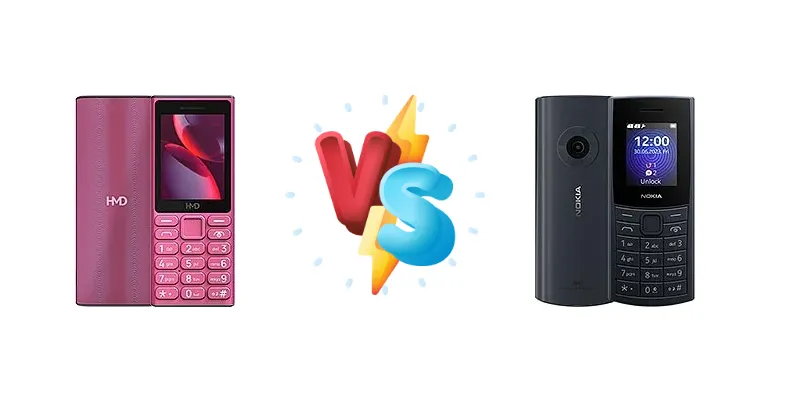
In a market saturated with smartphones, the basic feature phone isn't dead. The HMD 105 4G and Nokia 110 4G 2nd Edition represent the latest iterations of this enduring category, offering 4G connectivity at incredibly low price points. This comparison dissects their differences, focusing on the impact of the HMD 105 4G's Unisoc T127 chipset and the Nokia 110 4G's position as a streamlined, no-frills option.
🏆 Quick Verdict
For the average user prioritizing a slightly more responsive experience and confirmed chipset details, the HMD 105 4G emerges as the better choice. Its Unisoc T127 provides a tangible performance advantage over the Nokia 110 4G 2nd Edition, even within the constraints of a feature phone. However, the Nokia 110 4G 2nd Edition remains a viable option for those seeking the absolute lowest cost.
| Network |
|---|
| 2G bands | GSM 900 / 1800 | GSM 900 / 1800 |
| 3G bands | HSDPA 850 / 900 / 2100 | HSDPA 850 / 900 / 1700(AWS) / 1900 / 2100 |
| 4G bands | 1, 3, 5, 7, 8, 20 | LTE |
| Speed | HSPA, LTE | HSPA, LTE |
| Technology | GSM / HSPA / LTE | GSM / HSPA / LTE |
| Launch |
|---|
| Announced | 2024, September 13 | 2024, December |
| Status | Available. Released 2024, September 22 | Available. Released 2024, December |
| Body |
|---|
| Dimensions | - | 121.5 x 50 x 14.4 mm (4.78 x 1.97 x 0.57 in) |
| SIM | Nano-SIM + Nano-SIM | · Nano-SIM· Nano-SIM + Nano-SIM |
| Weight | 93 g (3.32 oz) | 94.5 g (3.35 oz) |
| Display |
|---|
| Resolution | 240 x 320 pixels, 4:3 ratio (~167 ppi density) | 120 x 160 pixels, 4:3 ratio (~111 ppi density) |
| Size | 2.4 inches, 17.8 cm2 (~28.0% screen-to-body ratio) | 1.8 inches, 10.0 cm2 (~16.5% screen-to-body ratio) |
| Type | TFT LCD, 65K colors | IPS LCD |
| Platform |
|---|
| Chipset | Unisoc T127 | - |
| Memory |
|---|
| Call records | Yes | Yes |
| Card slot | microSDHC | microSDHC |
| Internal | 64MB 128MB RAM | 48MB 128MB RAM |
| Phonebook | Yes | Yes |
| Main Camera |
|---|
| Single | - | QVGA |
| Video | - | Yes |
| Sound |
|---|
| 35mm jack | Yes | Yes |
| Loudspeaker | Yes | Yes |
| Comms |
|---|
| Bluetooth | 5.0, A2DP | 5.0, A2DP |
| NFC | No | No |
| Positioning | No | No |
| Radio | Wireless FM radio | Wireless FM radio |
| USB | USB Type-C | USB Type-C |
| WLAN | No | No |
| Features |
|---|
| Games | Yes | Yes |
| Java | No | No |
| Messaging | SMS | SMS |
| Battery |
|---|
| Type | Li-Ion 1450 mAh, removable | Li-Ion 1450 mAh, removable |
| Misc |
|---|
| Colors | Black, Pink, Cyan | Midnight Blue, Arctic Purple |
| Price | About 20 EUR | About 60 EUR |
HMD 105 4G
- Confirmed Unisoc T127 chipset for better performance
- Likely smoother 4G experience
- Potential for better app compatibility
- May have slightly shorter battery life due to chipset
- Higher price point than Nokia 110 4G 2nd Edition
Nokia 110 4G 2nd Edition
- Lowest possible price point
- Simple and durable design
- Excellent standby time
- Unknown chipset and potentially sluggish performance
- Limited 4G capabilities compared to HMD 105 4G
Display Comparison
Both devices likely feature similar, small-sized color displays, typical of feature phones. Given the price point, expect a low resolution and limited viewing angles on both. Neither device is expected to offer high brightness or color accuracy. The Nokia 110 4G 2nd Edition, historically, has focused on simplicity, potentially resulting in a slightly more durable, but less visually appealing, display compared to the HMD 105 4G.
Camera Comparison
Both devices likely include a basic rear camera, but image quality will be extremely limited. Given the target market, focusing on camera performance is irrelevant. Any camera present on either device should be considered for occasional snapshots only, and not for serious photography. The resolution is likely to be very low (VGA or 2MP), and image processing will be minimal.
Performance
The HMD 105 4G's Unisoc T127 chipset is the key differentiator here. While not a powerhouse, the T127 is a quad-core processor designed for entry-level smartphones and feature phones with 4G capabilities. This translates to a more responsive user interface and faster loading times for basic apps compared to the Nokia 110 4G 2nd Edition, which lacks publicly available chipset information. The Nokia 110 4G 2nd Edition likely utilizes a simpler, less powerful chipset, potentially leading to noticeable lag when accessing 4G services or using any pre-installed applications. The T127's architecture allows for better handling of VoLTE and VoWiFi calls, improving call quality on compatible networks.
Battery Life
Both the HMD 105 4G and Nokia 110 4G 2nd Edition prioritize long battery life. Expect several days of standby time and a reasonable number of hours of talk time on a single charge. The actual battery capacity is likely similar (around 1450mAh), but the Unisoc T127 in the HMD 105 4G may consume slightly more power due to its increased processing capabilities. However, this difference is unlikely to be significant in real-world usage, and both phones excel in battery endurance.
Buying Guide
Buy the HMD 105 4G if you need a feature phone with a confirmed chipset for smoother operation of 4G services and potentially better app compatibility. Buy the Nokia 110 4G 2nd Edition if you prioritize the absolute lowest possible price and require only basic calling and texting functionality, and are comfortable with a potentially less refined user experience due to the unknown chipset.
Frequently Asked Questions
❓ Will the HMD 105 4G's Unisoc T127 chipset allow me to use WhatsApp or Facebook?
While the Unisoc T127 is capable of running basic apps, WhatsApp and Facebook's performance will be limited. Expect slow loading times and a potentially unstable experience. These apps are not officially optimized for feature phones, and functionality may be restricted. It's best to manage expectations and consider these apps as secondary features.
❓ Does the Nokia 110 4G 2nd Edition support VoLTE and VoWiFi calling?
Support for VoLTE (Voice over LTE) and VoWiFi (Voice over Wi-Fi) depends on your carrier and region. The Nokia 110 4G 2nd Edition *may* support these features, but it's not guaranteed. Check with your mobile network operator to confirm compatibility before purchasing, as these technologies significantly improve call quality when 4G/Wi-Fi signal is weak.
❓ How much storage do these phones have for contacts and messages?
Both phones offer limited storage, typically around 8MB to 16MB. This is sufficient for storing a few hundred contacts and a limited number of SMS messages. However, you can expand storage using a microSD card (sold separately) to store more contacts, messages, and potentially a few low-resolution photos.