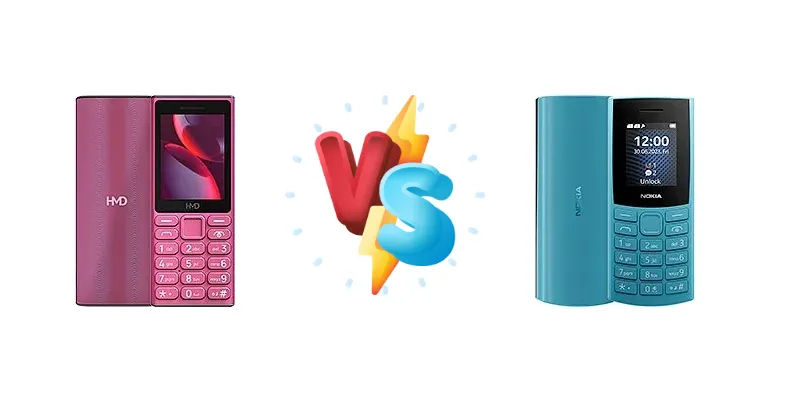
In a market saturated with expensive smartphones, the HMD 105 4G and the Nokia 106 4G (2023) represent a return to simplicity and affordability. Both devices cater to users needing reliable call functionality and basic features, but subtle differences in hardware and brand philosophy may sway your decision. This comparison dives deep into what sets these ultra-budget phones apart.
🏆 Quick Verdict
For the average user prioritizing a known chipset and readily available specifications, the HMD 105 4G emerges as the slightly better choice. Its Unisoc T127 processor provides a degree of performance transparency absent in the Nokia 106 4G, allowing for more informed expectations regarding usability.
| Network |
|---|
| 2G bands | GSM 900 / 1800 | GSM 900 / 1800 |
| 3G bands | HSDPA 850 / 900 / 2100 | HSDPA 850 / 900 / 2100 |
| 4G bands | 1, 3, 5, 7, 8, 20 | 1, 3, 5, 8 |
| Speed | HSPA, LTE | HSPA, LTE |
| Technology | GSM / HSPA / LTE | GSM / HSPA / LTE |
| Launch |
|---|
| Announced | 2024, September 13 | 2023, May 18 |
| Status | Available. Released 2024, September 22 | Available. Released 2023, May 18 |
| Body |
|---|
| Dimensions | - | 121.5 x 50 x 14.4 mm (4.78 x 1.97 x 0.57 in) |
| SIM | Nano-SIM + Nano-SIM | · Nano-SIM· Nano-SIM + Nano-SIM |
| Weight | 93 g (3.32 oz) | 93 g (3.28 oz) |
| Display |
|---|
| Resolution | 240 x 320 pixels, 4:3 ratio (~167 ppi density) | 120 x 160 pixels, 4:3 ratio (~111 ppi density) |
| Size | 2.4 inches, 17.8 cm2 (~28.0% screen-to-body ratio) | 1.8 inches, 10.0 cm2 (~16.5% screen-to-body ratio) |
| Type | TFT LCD, 65K colors | IPS LCD |
| Platform |
|---|
| Chipset | Unisoc T127 | - |
| Memory |
|---|
| Call records | Yes | Yes |
| Card slot | microSDHC | microSDHC |
| Internal | 64MB 128MB RAM | Unspecified storage |
| Phonebook | Yes | Yes |
| Sound |
|---|
| 35mm jack | Yes | Yes |
| Loudspeaker | Yes | Yes |
| Comms |
|---|
| Bluetooth | 5.0, A2DP | 5.0, A2DP |
| NFC | No | No |
| Positioning | No | No |
| Radio | Wireless FM radio | Wireless FM radio |
| USB | USB Type-C | microUSB 2.0 |
| WLAN | No | No |
| Features |
|---|
| Games | Yes | Yes |
| Java | No | No |
| Messaging | SMS | SMS |
| Battery |
|---|
| Type | Li-Ion 1450 mAh, removable | Li-Ion 1450 mAh, removable |
| Misc |
|---|
| Colors | Black, Pink, Cyan | Charcoal, Ocean Blue |
| Price | About 20 EUR | About 30 EUR |
HMD 105 4G
- Known Unisoc T127 chipset provides performance transparency.
- Reliable battery life for basic usage.
- Affordable price point.
- Basic display quality.
- Limited functionality compared to smartphones.
Nokia 106 4G (2023)
- Strong Nokia brand reputation for reliability.
- Potentially simpler user interface.
- Affordable price point.
- Lack of publicly available hardware specifications.
- Performance is unknown and difficult to predict.
Display Comparison
Neither device is expected to boast a high-resolution or particularly vibrant display. Given the price point, both likely utilize basic LCD panels. However, the lack of specific display details for the Nokia 106 4G makes direct comparison impossible. The HMD 105 4G's display, while basic, benefits from the transparency of knowing it's designed for functional readability rather than media consumption. Expect similar viewing angles and color reproduction on both, prioritizing legibility over visual fidelity.
Camera Comparison
Both devices are unlikely to excel in photography. Feature phones in this price range typically include basic cameras for occasional snapshots. Given the lack of specifications for the Nokia 106 4G, it's reasonable to assume its camera is comparable to, or slightly below, the HMD 105 4G's capabilities. Users should not expect detailed images or advanced features from either device; the cameras are primarily for functional documentation rather than artistic expression.
Performance
The HMD 105 4G is powered by the Unisoc T127 chipset, a quad-core processor designed for entry-level smartphones and feature phones. This provides a baseline level of performance for calls, texts, and basic applications. The Nokia 106 4G (2023) lacks publicly available chipset information. This absence is significant; without knowing the processor, assessing its performance relative to the Unisoc T127 is speculative. The Unisoc T127, while not powerful, offers a known quantity, allowing users to manage expectations regarding app responsiveness and multitasking. The Nokia's performance remains an unknown.
Battery Life
Both the HMD 105 4G and Nokia 106 4G (2023) are designed for exceptional battery life. The focus on basic functionality and low-power chipsets translates to days of standby time and hours of talk time. Without specific battery capacity details for the Nokia 106 4G, it's difficult to make a direct comparison. However, the HMD 105 4G's efficiency, coupled with its known chipset, suggests comparable or potentially superior battery performance, especially during periods of low usage.
Buying Guide
Buy the HMD 105 4G if you need a phone with a documented chipset for predictable performance and are comfortable with a slightly more technical understanding of its capabilities. Buy the Nokia 106 4G (2023) if you prioritize brand recognition and a potentially simpler user experience, accepting that detailed hardware information is currently limited and relying on Nokia's established reputation for ease of use in basic phones.
Frequently Asked Questions
❓ What kind of apps can I run on the HMD 105 4G?
The HMD 105 4G, powered by the Unisoc T127, can handle basic applications like FM radio, a limited selection of pre-installed games, and potentially some lightweight Java-based apps. However, it's not designed for demanding apps like social media or streaming services.
❓ Does the Nokia 106 4G (2023) support VoLTE calling?
While Nokia typically includes VoLTE support in its 4G feature phones, confirmation for the 106 4G (2023) is currently unavailable due to the lack of detailed specifications. Users should verify compatibility with their carrier before purchasing.
❓ How much storage does the HMD 105 4G have for contacts and messages?
The HMD 105 4G offers sufficient storage for a substantial number of contacts and SMS messages, typical for a feature phone. While the exact capacity isn't high in absolute terms (likely in the megabyte range), it's more than adequate for its intended use case.