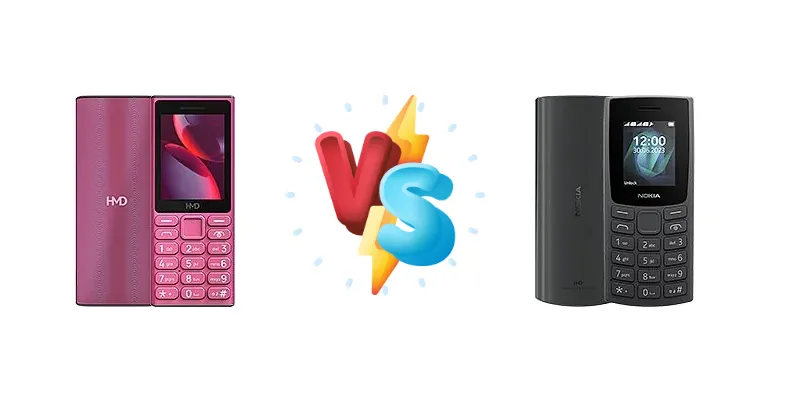
The ultra-budget 4G feature phone market is surprisingly competitive. Both the HMD 105 4G and the Nokia 105 4G 2nd Edition aim to provide basic connectivity at the lowest possible price point. However, a key difference emerges with the HMD 105 4G’s specified Unisoc T127 chipset, while the Nokia 105 4G 2nd Edition remains largely a mystery in terms of internal components. This comparison aims to dissect what little we know and infer the likely user experience.
🏆 Quick Verdict
For the average user prioritizing a slightly more modern chipset and potential for future software updates (even on a feature phone), the HMD 105 4G is the better choice. The Unisoc T127 offers a known quantity, while the Nokia 105 4G 2nd Edition relies on brand recognition without concrete specifications.
| Network |
|---|
| 2G bands | GSM 900 / 1800 | GSM 900 / 1800 |
| 3G bands | HSDPA 850 / 900 / 2100 | HSDPA 850 / 900 / 1700(AWS) / 1900 / 2100 |
| 4G bands | 1, 3, 5, 7, 8, 20 | LTE |
| Speed | HSPA, LTE | HSPA, LTE |
| Technology | GSM / HSPA / LTE | GSM / HSPA / LTE |
| Launch |
|---|
| Announced | 2024, September 13 | 2024, December |
| Status | Available. Released 2024, September 22 | Available. Released 2024, December |
| Body |
|---|
| Dimensions | - | 121.5 x 50 x 14.4 mm (4.78 x 1.97 x 0.57 in) |
| SIM | Nano-SIM + Nano-SIM | · Nano-SIM· Nano-SIM + Nano-SIM |
| Weight | 93 g (3.32 oz) | 93 g (3.28 oz) |
| Display |
|---|
| Resolution | 240 x 320 pixels, 4:3 ratio (~167 ppi density) | 120 x 160 pixels, 4:3 ratio (~111 ppi density) |
| Size | 2.4 inches, 17.8 cm2 (~28.0% screen-to-body ratio) | 1.8 inches, 10.0 cm2 (~16.5% screen-to-body ratio) |
| Type | TFT LCD, 65K colors | IPS LCD |
| Platform |
|---|
| Chipset | Unisoc T127 | - |
| Memory |
|---|
| Call records | Yes | Yes |
| Card slot | microSDHC | microSDHC |
| Internal | 64MB 128MB RAM | 48MB 128MB RAM |
| Phonebook | Yes | Yes |
| Sound |
|---|
| 35mm jack | Yes | Yes |
| Loudspeaker | Yes | Yes |
| Comms |
|---|
| Bluetooth | 5.0, A2DP | 5.0, A2DP |
| NFC | No | No |
| Positioning | No | No |
| Radio | Wireless FM radio | Wireless FM radio |
| USB | USB Type-C | USB Type-C |
| WLAN | No | No |
| Features |
|---|
| Games | Yes | Yes |
| Java | No | No |
| Messaging | SMS | SMS |
| Battery |
|---|
| Type | Li-Ion 1450 mAh, removable | Li-Ion 1450 mAh, removable |
| Misc |
|---|
| Colors | Black, Pink, Cyan | Charcoal |
| Price | About 20 EUR | About 50 EUR |
HMD 105 4G
- Known Unisoc T127 chipset provides a performance baseline.
- Potential for minor software optimizations.
- Likely slightly better battery efficiency due to chipset.
- Still a very basic feature phone.
- Limited app support.
Nokia 105 4G 2nd Edition
- Strong Nokia brand recognition.
- Potentially lower price point (depending on retailer).
- Simple and easy to use.
- Unknown chipset and performance characteristics.
- Lack of transparency regarding specifications.
Display Comparison
Neither device is expected to boast a high-resolution or particularly vibrant display. Both likely utilize basic color LCD panels. Without specific details on the Nokia 105 4G 2nd Edition, we can assume it follows the standard for feature phones in this price bracket – a 2.4-inch display with a resolution around 320x240. The HMD 105 4G, while also likely similar, benefits from the potential for software optimizations driven by the Unisoc T127 chipset to improve display rendering, however marginally. Bezels will be substantial on both.
Camera Comparison
Both devices are unlikely to offer a compelling camera experience. Feature phones in this price range typically include a basic VGA camera primarily for capturing quick snapshots. Image quality will be low, and these cameras are not intended for serious photography. The absence of detailed specifications for the Nokia 105 4G 2nd Edition suggests it likely adheres to this standard. Any claims of megapixel count beyond VGA should be viewed with skepticism.
Performance
This is where the most significant difference lies. The HMD 105 4G is powered by the Unisoc T127, a quad-core chipset designed for entry-level smartphones and feature phones. This provides a known baseline for performance, allowing for smoother operation of basic apps like FM radio, and potentially even limited web browsing. The Nokia 105 4G 2nd Edition lacks publicly available chipset information. Given its positioning, it likely uses an older or less powerful chipset, potentially impacting responsiveness and app loading times. The Unisoc T127’s architecture, while not cutting-edge, offers a more modern foundation than what is typically found in similarly priced Nokia feature phones.
Battery Life
Both phones will likely offer excellent battery life, typical of feature phones. The low-power chipsets and basic displays contribute to days of standby time and hours of talk time. While the exact mAh capacity of both devices is unknown, the HMD 105 4G’s Unisoc T127 chipset, being more efficient than older alternatives, *could* translate to slightly longer battery life under similar usage conditions. However, the difference is unlikely to be substantial enough to be a deciding factor for most users.
Buying Guide
Buy the HMD 105 4G if you need a feature phone with a known chipset for potential future software tweaks and a slightly more modern architecture. Buy the Nokia 105 4G 2nd Edition if you are a loyal Nokia customer and prioritize brand familiarity above all else, accepting that detailed specifications are unavailable and performance is largely unknown.
Frequently Asked Questions
❓ What kind of apps can I run on the HMD 105 4G compared to the Nokia 105 4G 2nd Edition?
Both phones support basic Java apps, but the HMD 105 4G’s Unisoc T127 chipset is more likely to handle these apps with slightly better responsiveness. Expect limited app availability on both, primarily focused on utilities like FM radio, simple games, and basic web browsing.
❓ Is the 4G connectivity on either phone reliable for making calls and sending texts?
Yes, both phones support 4G VoLTE, ensuring reliable voice calls and text messaging on compatible networks. However, actual performance will depend on network coverage in your area. The Unisoc T127 in the HMD 105 4G may offer slightly better modem performance, but the difference is unlikely to be noticeable in everyday use.
❓ Can I use WhatsApp on either of these phones?
While older versions of WhatsApp were compatible with some feature phones, current versions generally require a smartphone operating system. It's highly unlikely that either the HMD 105 4G or the Nokia 105 4G 2nd Edition can run the latest version of WhatsApp.