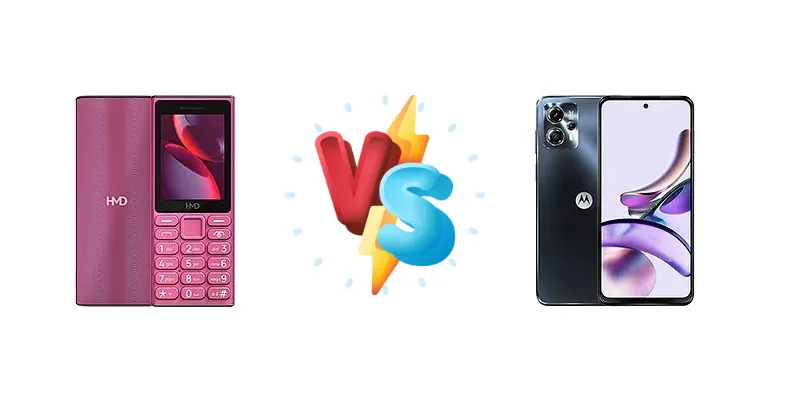
The HMD 105 4G and Motorola Moto G13 represent opposite ends of the budget smartphone spectrum. The HMD 105 4G focuses on essential connectivity and durability, while the Moto G13 aims to deliver a more modern smartphone experience with a larger display and more powerful processor. This comparison dissects their key differences to help you choose the right device for your needs.
🏆 Quick Verdict
For the average user seeking a basic, reliable 4G phone, the HMD 105 4G offers excellent value. However, the Motorola Moto G13 is the clear winner for those prioritizing performance and a more feature-rich smartphone experience, thanks to its significantly more capable Mediatek Helio G85 chipset.
| Network |
|---|
| 2G bands | GSM 900 / 1800 | GSM 850 / 900 / 1800 / 1900 |
| 3G bands | HSDPA 850 / 900 / 2100 | HSDPA 850 / 900 / 1900 / 2100 |
| 4G bands | 1, 3, 5, 7, 8, 20 | 1, 2, 3, 5, 7, 8, 20, 38, 40, 41 |
| Speed | HSPA, LTE | HSPA, LTE |
| Technology | GSM / HSPA / LTE | GSM / HSPA / LTE |
| Launch |
|---|
| Announced | 2024, September 13 | 2023, January 24 |
| Status | Available. Released 2024, September 22 | Available. Released 2023, January 24 |
| Body |
|---|
| Build | - | Glass front, plastic frame, plastic back |
| Dimensions | - | 162.7 x 74.7 x 8.2 mm (6.41 x 2.94 x 0.32 in) |
| SIM | Nano-SIM + Nano-SIM | · Nano-SIM· Nano-SIM + Nano-SIM |
| Weight | 93 g (3.32 oz) | 183.5 g (6.49 oz) |
| | - | Water-resistant design |
| Display |
|---|
| Protection | - | Panda glass |
| Resolution | 240 x 320 pixels, 4:3 ratio (~167 ppi density) | 720 x 1600 pixels, 20:9 ratio (~270 ppi density) |
| Size | 2.4 inches, 17.8 cm2 (~28.0% screen-to-body ratio) | 6.5 inches, 102.0 cm2 (~83.9% screen-to-body ratio) |
| Type | TFT LCD, 65K colors | IPS LCD, 90Hz, 400 nits (peak) |
| Platform |
|---|
| CPU | - | Octa-core (2x2.0 GHz Cortex-A75 & 6x1.8 GHz Cortex-A55) |
| Chipset | Unisoc T127 | Mediatek MT6769Z Helio G85 (12 nm) |
| GPU | - | Mali-G52 MC2 |
| OS | - | Android 13 |
| Memory |
|---|
| Call records | Yes | - |
| Card slot | microSDHC | microSDXC (dedicated slot) |
| Internal | 64MB 128MB RAM | 64GB 4GB RAM, 128GB 4GB RAM |
| Phonebook | Yes | - |
| Main Camera |
|---|
| Features | - | LED flash, HDR, panorama |
| Triple | - | 50 MP, f/1.8, (wide), 0.64µm, PDAF
2 MP (macro)
Auxiliary lens |
| Video | - | 1080p@30fps |
| Selfie camera |
|---|
| Single | - | 8 MP, f/2.0, (wide), 1/4.0", 1.12µm |
| Video | - | 1080p@30fps |
| Sound |
|---|
| 3.5mm jack | - | Yes |
| 35mm jack | Yes | Yes |
| Loudspeaker | Yes | Yes, with stereo speakers |
| Comms |
|---|
| Bluetooth | 5.0, A2DP | 5.1, A2DP, LE |
| NFC | No | Yes (market/region dependent) |
| Positioning | No | GPS, GLONASS, GALILEO |
| Radio | Wireless FM radio | Unspecified |
| USB | USB Type-C | USB Type-C 2.0 |
| WLAN | No | Wi-Fi 802.11 a/b/g/n/ac, dual-band |
| Features |
|---|
| Games | Yes | - |
| Java | No | - |
| Messaging | SMS | - |
| Sensors | - | Fingerprint (side-mounted), accelerometer, gyro, proximity |
| Battery |
|---|
| Charging | - | 20W or 10W wired |
| Type | Li-Ion 1450 mAh, removable | Li-Po 5000 mAh |
| Misc |
|---|
| Colors | Black, Pink, Cyan | Matte Charcoal, Blue Lavender, Rose Gold |
| Price | About 20 EUR | About 160 EUR |
HMD 105 4G
- Exceptional battery life due to low-power chipset
- Durable and reliable build quality
- Simple and easy-to-use interface
- Limited performance for demanding tasks
- Basic camera capabilities
- Small display size
Motorola Moto G13
- Significantly faster performance with Helio G85
- Larger display for better media consumption
- Faster charging capabilities (20W/10W)
- Shorter battery life compared to HMD 105 4G
- More complex software experience
- Potentially less durable build
Display Comparison
The HMD 105 4G’s display specifications are not publicly available, but based on its market positioning, it likely features a basic LCD panel with a low resolution. In contrast, the Motorola Moto G13 boasts a larger display, though details on its brightness and color accuracy are limited. The Moto G13’s larger screen size will be more comfortable for media consumption and general use, while the HMD 105 4G prioritizes compactness and simplicity. The absence of detailed display specs for the HMD 105 4G suggests a focus on cost reduction rather than visual fidelity.
Camera Comparison
Camera details for the HMD 105 4G are scarce, but it likely features a single, low-resolution camera suitable for basic snapshots. The Motorola Moto G13’s camera specifications are also limited in available data, but it’s reasonable to assume a multi-camera setup, potentially including a main sensor and a depth sensor. While the exact megapixel counts are unknown, the Moto G13’s likely multi-camera system offers greater versatility and potentially better image quality in various lighting conditions. The HMD 105 4G’s camera is purely functional, while the Moto G13 aims for a more comprehensive, though still budget-focused, photography experience.
Performance
The core difference lies in the chipsets. The HMD 105 4G utilizes the Unisoc T127, a basic processor designed for essential smartphone functions. The Motorola Moto G13, however, is powered by the Mediatek MT6769Z Helio G85 (12 nm). This Helio G85 features an octa-core configuration – 2x2.0 GHz Cortex-A75 and 6x1.8 GHz Cortex-A55 – offering a substantial performance advantage over the Unisoc T127. This translates to smoother app launches, faster multitasking, and the ability to handle more demanding games. The 12nm process node of the Helio G85 also suggests better power efficiency compared to potentially older nodes used in the Unisoc T127, though this is dependent on specific implementations. Users who play mobile games or frequently switch between apps will significantly benefit from the Moto G13’s superior processing power.
Battery Life
Battery capacity for both devices is not explicitly stated. However, the HMD 105 4G, with its simpler feature set and less powerful processor, is likely to offer longer battery life on a single charge. The Motorola Moto G13, with its more demanding Helio G85 chipset and larger display, will consume more power. The Moto G13 supports 20W or 10W wired charging, offering faster replenishment compared to the HMD 105 4G, which likely has slower charging capabilities. The trade-off is between longevity (HMD 105 4G) and quicker top-ups (Moto G13).
Buying Guide
Buy the HMD 105 4G if you need a simple, durable phone primarily for calls and texts, with a long-lasting battery and minimal software overhead. It’s ideal for users who prioritize reliability over advanced features. Buy the Motorola Moto G13 if you prefer a larger display, smoother multitasking, and the ability to run more demanding apps and games, even if it means slightly shorter battery life and a more complex software experience.
Frequently Asked Questions
❓ Will the Motorola Moto G13 struggle with popular social media apps like Facebook and Instagram?
The Helio G85 in the Moto G13 is capable of running social media apps smoothly, but expect some occasional slowdowns when multitasking or using resource-intensive features within those apps. The Unisoc T127 in the HMD 105 4G will handle these apps, but with noticeably slower loading times and less responsiveness.
❓ Is the 20W charging on the Moto G13 a significant advantage over the likely slower charging on the HMD 105 4G?
Yes, 20W charging will significantly reduce the time it takes to fully charge the Moto G13 compared to the HMD 105 4G. While exact charging times are unknown for the HMD 105 4G, it will likely take several hours to reach a full charge, whereas the Moto G13 could potentially reach 100% in under two hours.
❓ Can the Motorola Moto G13 handle basic mobile games like Candy Crush or Subway Surfers?
The Motorola Moto G13, with its Helio G85 chipset, can comfortably handle casual mobile games like Candy Crush and Subway Surfers without significant performance issues. The HMD 105 4G will be able to run these games, but with lower frame rates and potentially longer loading times.