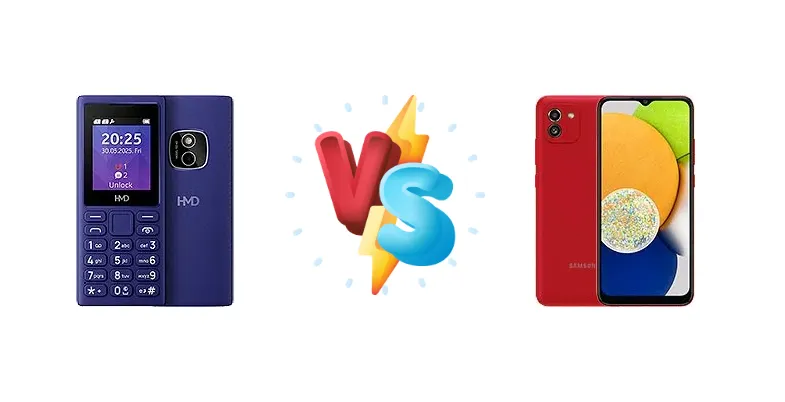
Both the HMD 102 4G and the Samsung Galaxy A03 occupy the ultra-budget smartphone segment, targeting first-time smartphone buyers or those needing a reliable secondary device. The core difference lies in their SoCs: the HMD 102 4G utilizes the Unisoc 8910 FF-S, while the Galaxy A03 features the Unisoc T606. This comparison will dissect these chipsets to determine which phone delivers a superior user experience.
🏆 Quick Verdict
For the average user prioritizing multi-tasking and a slightly smoother experience, the Samsung Galaxy A03 emerges as the better choice. Its Unisoc T606, with its Cortex-A75 cores, offers a noticeable performance advantage over the HMD 102 4G’s Unisoc 8910 FF-S, despite both being entry-level options.
| Network |
|---|
| 2G bands | GSM 900 / 1800 | GSM 850 / 900 / 1800 / 1900 |
| 3G bands | HSDPA 2100 | HSDPA 850 / 900 / 2100 |
| 4G bands | 1, 3, 5, 8, 28, 38, 39, 40, 41 | 1, 3, 5, 7, 8, 20, 28, 38, 40, 41 |
| Speed | HSPA, LTE | HSPA 42.2/5.76 Mbps, LTE Cat4 150/50 Mbps |
| Technology | GSM / HSPA / LTE | GSM / HSPA / LTE |
| Launch |
|---|
| Announced | 2025, September 11 | 2021, November 26 |
| Status | Available. Released 2025, September 11 | Available. Released 2022, January 21 |
| Body |
|---|
| Build | - | Glass front, plastic back, plastic frame |
| Dimensions | 118.2 x 50.2 x 14.3 mm (4.65 x 1.98 x 0.56 in) | 164.2 x 75.9 x 9.1 mm (6.46 x 2.99 x 0.36 in) |
| SIM | Nano-SIM + Nano-SIM | · Nano-SIM· Nano-SIM + Nano-SIM |
| Weight | 84.2 g (2.96 oz) | 196 g (6.91 oz) |
| Display |
|---|
| Resolution | 120 x 160 pixels, 4:3 ratio (~100 ppi density) | 720 x 1600 pixels, 20:9 ratio (~270 ppi density) |
| Size | 2.0 inches, 12.4 cm2 (~20.9% screen-to-body ratio) | 6.5 inches, 102.0 cm2 (~81.8% screen-to-body ratio) |
| Type | TFT | PLS LCD |
| Platform |
|---|
| CPU | - | Octa-core (2x1.6 GHz Cortex-A75 & 6x1.6 GHz Cortex-A55) |
| Chipset | Unisoc 8910 FF-S | Unisoc T606 (12 nm) |
| GPU | - | Mali-G57 MP1 |
| OS | - | Android 11, upgradable to Android 13, One UI core 5 |
| Memory |
|---|
| Call records | Yes | - |
| Card slot | microSDHC | microSDXC (dedicated slot) |
| Internal | 24MB | 32GB 2GB RAM, 32GB 3GB RAM, 32GB 4GB RAM, 64GB 4GB RAM, 64GB 3GB RAM, 128GB 4GB RAM |
| Phonebook | Yes | - |
| | - | eMMC 5.1 |
| Main Camera |
|---|
| Dual | - | 48 MP, f/1.8, (wide), AF
Auxiliary lens |
| Features | LED flash | LED flash |
| Single | QVGA | 5 MP, f/2.2 |
| Video | No | 1080p@30fps |
| Selfie camera |
|---|
| Single | - | 5 MP, f/2.2 |
| Video | - | Yes |
| Sound |
|---|
| 3.5mm jack | - | Yes |
| 35mm jack | Yes | Yes |
| Loudspeaker | Yes | Yes |
| Comms |
|---|
| Bluetooth | 4.2 | 5.0, A2DP, LE |
| NFC | No | No |
| Positioning | No | GPS |
| Radio | Unspecified | Unspecified |
| USB | USB Type-C | microUSB 2.0 |
| WLAN | No | Wi-Fi 802.11 a/b/g/n/ac, dual-band, Wi-Fi Direct |
| Features |
|---|
| Games | Yes | - |
| Java | No | - |
| Messaging | SMS | - |
| Sensors | - | Accelerometer, proximity |
| Battery |
|---|
| Type | Li-Ion 1000 mAh, removable | Li-Po 5000 mAh |
| Misc |
|---|
| Colors | Dark Blue, Red, Purple | Black, Blue, Red |
| Models | - | SM-A035F, SM-A035F/DS, SM-A035M, SM-A035G |
| Price | About 20 EUR | € 119.90 / £ 88.00 / ₹ 11,990 |
| SAR EU | - | 0.20 W/kg (head) 1.35 W/kg (body) |
HMD 102 4G
- Potentially lower price point
- Simple and straightforward user experience
- Reliable for basic communication tasks
- Significantly weaker performance compared to the Galaxy A03
- Likely inferior camera quality
- May struggle with multitasking
Samsung Galaxy A03
- More powerful Unisoc T606 chipset
- Better multitasking capabilities
- Likely improved camera performance
- Slightly higher price
- May still struggle with graphically intensive games
- Charging speed likely remains slow
Display Comparison
Neither device is expected to boast a high-end display. Given the price bracket, both likely feature LCD panels with 720p+ resolution. However, display quality beyond resolution isn't specified. The Galaxy A03's slightly larger screen size (typically 6.6 inches vs. the HMD 102 4G's likely smaller size) may offer a more immersive viewing experience, but without knowing the peak brightness or color gamut coverage, it's difficult to definitively declare a winner. Expect both to have adequate, but not exceptional, viewing angles and color reproduction.
Camera Comparison
Both phones are likely to feature basic camera setups. Without specific sensor details, it's safe to assume both will rely on a primary sensor paired with auxiliary lenses (often 2MP macro or depth sensors). The Galaxy A03, given Samsung’s image processing expertise, will likely deliver more pleasing and consistently good photos, even with a similar sensor. The HMD 102 4G’s image quality will likely be more dependent on lighting conditions and may exhibit more noise and less dynamic range. The presence of OIS (Optical Image Stabilization) is unlikely on either device.
Performance
The core of this comparison rests on the chipsets. The Unisoc T606 in the Galaxy A03 is a clear step up. Its octa-core configuration, featuring two Cortex-A75 cores clocked at 1.6 GHz and six Cortex-A55 cores, provides a significant advantage in CPU-intensive tasks compared to the Unisoc 8910 FF-S. The 8910 FF-S is likely to utilize a homogenous core setup, meaning all cores are less powerful A55 equivalents. This translates to slower app loading times and less responsive multitasking on the HMD 102 4G. The T606’s 12nm process node, while not cutting-edge, is also more efficient than whatever process node the 8910 FF-S uses, potentially leading to slightly better battery life under load. The Galaxy A03 will handle more demanding apps and games with greater ease.
Battery Life
Battery capacity is not specified for either device. However, given the target market, both will likely feature batteries in the 4000-5000 mAh range. The Unisoc T606’s slightly more efficient 12nm process could give the Galaxy A03 a marginal edge in battery life. Charging wattage is also unknown, but both are likely to ship with 10W or 15W chargers, resulting in relatively slow charging times – expect several hours to reach a full charge.
Buying Guide
Buy the HMD 102 4G if you need a basic, extremely affordable phone for calls, texts, and light app usage, and prioritize simplicity. Buy the Samsung Galaxy A03 if you prefer a phone capable of handling more demanding tasks like social media browsing, occasional gaming, and running multiple apps simultaneously, even if it comes at a slightly higher price point.
Frequently Asked Questions
❓ Will the Samsung Galaxy A03 handle popular social media apps like TikTok and Instagram smoothly?
Yes, the Unisoc T606 chipset in the Galaxy A03 is sufficiently powerful to run TikTok and Instagram without significant lag or stuttering. While it won't offer a high-end experience, it will provide a usable and enjoyable social media experience.
❓ Is the HMD 102 4G suitable for someone who primarily uses their phone for calls and texts?
Absolutely. The HMD 102 4G is perfectly adequate for basic communication tasks like making calls and sending texts. Its simpler chipset and software will prioritize battery life and reliability for these core functions.
❓ Can the Samsung Galaxy A03 run PUBG Mobile, and if so, at what settings?
The Galaxy A03 can run PUBG Mobile, but you'll need to lower the graphics settings to the lowest possible levels and likely reduce the frame rate to achieve playable performance. Expect frame drops and occasional stuttering, even with optimized settings.
❓ Does either phone support fast charging?
Neither phone is expected to support fast charging. Both will likely ship with a standard 10W or 15W charger, resulting in relatively slow charging times – typically 2-3 hours for a full charge.