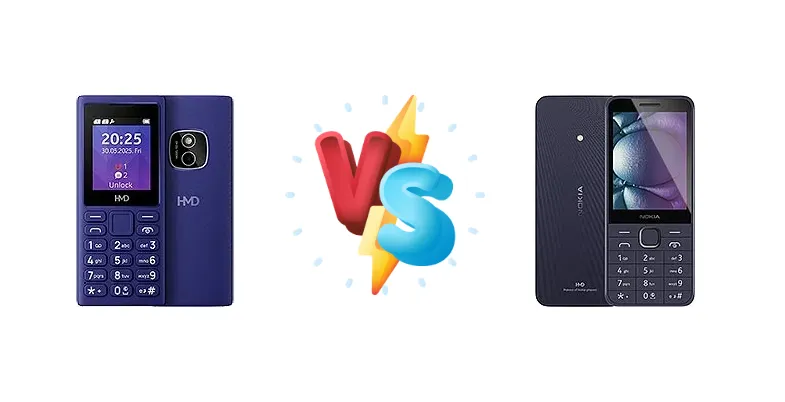
The HMD 102 4G and the Nokia 215 4G (2024) represent the continuing demand for affordable, reliable 4G connectivity. Both devices target users prioritizing essential communication features, but they differ significantly under the hood, particularly in their chipset choices. This comparison dissects those differences to determine which phone offers the best value for users needing a simple, connected experience.
🏆 Quick Verdict
For the average user seeking a dependable 4G feature phone, the Nokia 215 4G (2024) emerges as the slightly better choice. While the HMD 102 4G’s Unisoc 8910 FF-S offers a potentially more modern architecture, the Nokia’s Unisoc T107, coupled with its Cortex-A7 CPU, provides a balanced experience for basic tasks and likely better optimized power efficiency in this class of device.
| Network |
|---|
| 2G bands | GSM 900 / 1800 | GSM 850 / 900 / 1800 / 1900 |
| 3G bands | HSDPA 2100 | HSDPA 850 / 900 / 2100 |
| 4G bands | 1, 3, 5, 8, 28, 38, 39, 40, 41 | 1, 3, 5, 7, 8, 20, 28, 38, 40, 41 - EU, EMEA, APAC |
| Speed | HSPA, LTE | HSPA, LTE |
| Technology | GSM / HSPA / LTE | GSM / HSPA / LTE |
| Launch |
|---|
| Announced | 2025, September 11 | 2024, April 30 |
| Status | Available. Released 2025, September 11 | Available. Released 2024, May |
| Body |
|---|
| Dimensions | 118.2 x 50.2 x 14.3 mm (4.65 x 1.98 x 0.56 in) | 127.3 x 54.2 x 11.6 mm (5.01 x 2.13 x 0.46 in) |
| SIM | Nano-SIM + Nano-SIM | Nano-SIM + Nano-SIM |
| Weight | 84.2 g (2.96 oz) | - |
| Display |
|---|
| Resolution | 120 x 160 pixels, 4:3 ratio (~100 ppi density) | 240 x 320 pixels, 4:3 ratio (~143 ppi density) |
| Size | 2.0 inches, 12.4 cm2 (~20.9% screen-to-body ratio) | 2.8 inches, 24.3 cm2 (~35.2% screen-to-body ratio) |
| Type | TFT | TFT LCD |
| Platform |
|---|
| CPU | - | 1.0 GHz Cortex-A7 |
| Chipset | Unisoc 8910 FF-S | Unisoc T107 (22 nm) |
| Memory |
|---|
| Call records | Yes | Yes |
| Card slot | microSDHC | microSDHC |
| Internal | 24MB | 128MB 64MB RAM |
| Phonebook | Yes | Yes |
| Main Camera |
|---|
| Features | LED flash | - |
| Single | QVGA | - |
| Video | No | - |
| Sound |
|---|
| 35mm jack | Yes | Yes |
| Loudspeaker | Yes | Yes |
| Comms |
|---|
| Bluetooth | 4.2 | 5.0, A2DP, LE |
| NFC | No | No |
| Positioning | No | No |
| Radio | Unspecified | Wireless FM radio |
| USB | USB Type-C | USB Type-C |
| WLAN | No | No |
| Features |
|---|
| Games | Yes | Yes |
| Java | No | No |
| Messaging | SMS | SMS |
| Sensors | - | No |
| Battery |
|---|
| Type | Li-Ion 1000 mAh, removable | Li-Ion 1450 mAh, removable |
| Misc |
|---|
| Colors | Dark Blue, Red, Purple | Peach, Black, Dark Blue |
| Price | About 20 EUR | - |
HMD 102 4G
- Potentially more modern chipset architecture (Unisoc 8910 FF-S)
- May offer slightly better future-proofing for software updates
- Could handle slightly more demanding tasks (though limited by the device class)
- Likely higher power consumption due to potentially larger node process
- Performance gains may be negligible for typical use cases
- Lack of detailed specifications hinders accurate assessment
Nokia 215 4G (2024)
- Proven and reliable Unisoc T107 chipset
- Excellent power efficiency due to 22nm process
- Likely longer battery life for basic usage
- Optimized for core communication features
- Older chipset architecture
- Limited processing power for demanding tasks
- May not receive as many future software updates
Display Comparison
Neither device is expected to boast a high-resolution or particularly vibrant display. Given the target market, both likely utilize basic LCD panels. However, the absence of detailed display specifications for either phone makes a direct comparison impossible. The focus here is on functionality, not visual fidelity. Bezels are likely substantial on both, maximizing screen real estate within a compact form factor.
Camera Comparison
Both devices are unlikely to excel in photography. Given the market segment, camera quality is secondary. It's reasonable to assume both feature basic rear cameras, but detailed specifications are unavailable. Any comparison would be speculative without knowing sensor sizes or lens apertures. The focus is on capturing simple snapshots, not high-quality images.
Performance
The core difference lies in the chipsets. The Nokia 215 4G (2024) utilizes the Unisoc T107, a 22nm processor with a 1.0 GHz Cortex-A7 CPU. This is a well-established, power-efficient architecture designed for basic smartphone functionality. The HMD 102 4G, conversely, features the Unisoc 8910 FF-S. While the 'FF-S' designation suggests a more recent iteration, the lack of specific core counts or clock speeds makes a direct performance assessment difficult. The 22nm process of the T107 generally translates to lower power consumption compared to potentially larger node processes used in the 8910 FF-S, which could benefit battery life. Users prioritizing responsiveness for simple tasks like calling and texting will likely find the Nokia’s T107 sufficient, while the HMD 102 4G *might* offer a slight edge in future-proofing.
Battery Life
Battery capacity details are missing for both devices. However, the Unisoc T107’s 22nm process and lower clock speed in the Nokia 215 4G (2024) suggest potentially superior battery life compared to the HMD 102 4G. Lower power consumption translates directly to longer talk time and standby duration. Charging wattage is also unknown, but given the price point, slow charging is expected on both devices.
Buying Guide
Buy the HMD 102 4G if you anticipate needing slightly more processing power for future software updates or potential app compatibility. Buy the Nokia 215 4G (2024) if you prioritize a proven, reliable experience for core communication features – calls, texts, and basic internet browsing – and potentially longer battery life due to the more mature chipset and lower clock speed.
Frequently Asked Questions
❓ Will the Nokia 215 4G (2024) be able to run WhatsApp or Facebook?
The Nokia 215 4G (2024), powered by the Unisoc T107, is designed to support basic internet connectivity and applications. While WhatsApp and Facebook Lite versions *may* function, performance will be limited. Expect slow loading times and a simplified user experience. It's crucial to check app compatibility before relying on these services.
❓ Is the Unisoc 8910 FF-S in the HMD 102 4G significantly faster than the Unisoc T107?
While the Unisoc 8910 FF-S is a more recent chipset, the performance difference compared to the Unisoc T107 is unlikely to be substantial in the context of these feature phones. The T107 is well-optimized for basic tasks, and the HMD 102 4G’s chipset may be limited by other factors, such as RAM and software optimization. The real-world impact will likely be minimal for everyday use.
❓ Which phone is better for making and receiving calls?
Both phones are primarily designed for voice communication, and call quality should be comparable. The Nokia 215 4G (2024)'s optimized power efficiency might translate to slightly longer talk time on a single charge, but the difference is unlikely to be significant.