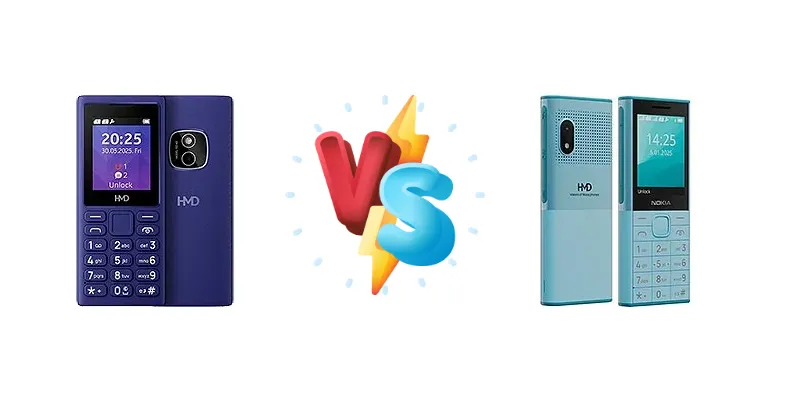
In the realm of ultra-affordable mobile connectivity, the HMD 102 4G and Nokia 150 Music represent compelling options for users prioritizing basic communication and entertainment. While both cater to the feature phone segment, they diverge in their underlying chipsets, impacting performance and connectivity. This comparison dissects the key differences between the Unisoc 8910 FF-S powering the HMD 102 4G and the Unisoc 6531F in the Nokia 150 Music, revealing which device best suits your needs.
🏆 Quick Verdict
For users needing reliable 4G connectivity and a slightly more responsive experience, the HMD 102 4G emerges as the better choice. The Unisoc 8910 FF-S offers a performance edge over the 6531F, translating to faster web browsing and app loading, even within the constraints of a feature phone. However, the Nokia 150 Music remains a strong contender for those prioritizing dedicated music playback features.
| Network |
|---|
| 2G bands | GSM 900 / 1800 | GSM 900 / 1800 |
| 3G bands | HSDPA 2100 | - |
| 4G bands | 1, 3, 5, 8, 28, 38, 39, 40, 41 | - |
| EDGE | - | No |
| GPRS | - | No |
| Speed | HSPA, LTE | - |
| Technology | GSM / HSPA / LTE | GSM |
| Launch |
|---|
| Announced | 2025, September 11 | 2025, March 02 |
| Status | Available. Released 2025, September 11 | Available. Released 2025, March |
| Body |
|---|
| Dimensions | 118.2 x 50.2 x 14.3 mm (4.65 x 1.98 x 0.56 in) | 130.5 x 52.9 x 14.8 mm (5.14 x 2.08 x 0.58 in) |
| SIM | Nano-SIM + Nano-SIM | Dual SIM (Mini-SIM, dual stand-by) |
| Weight | 84.2 g (2.96 oz) | 83.1 g (2.93 oz) |
| Display |
|---|
| Resolution | 120 x 160 pixels, 4:3 ratio (~100 ppi density) | 240 x 320 pixels, 4:3 ratio (~167 ppi density) |
| Size | 2.0 inches, 12.4 cm2 (~20.9% screen-to-body ratio) | 2.4 inches, 17.8 cm2 (~25.8% screen-to-body ratio) |
| Type | TFT | TN TFT |
| Platform |
|---|
| Chipset | Unisoc 8910 FF-S | Unisoc 6531F |
| Memory |
|---|
| Call records | Yes | Yes |
| Card slot | microSDHC | microSDHC |
| Internal | 24MB | 8MB 8MB RAM |
| Phonebook | Yes | Yes |
| Main Camera |
|---|
| Features | LED flash | LED flash |
| Single | QVGA | QVGA |
| Video | No | Yes |
| Sound |
|---|
| 35mm jack | Yes | Yes |
| Loudspeaker | Yes | Yes |
| Comms |
|---|
| Bluetooth | 4.2 | 5.0, A2DP |
| NFC | No | No |
| Positioning | No | No |
| Radio | Unspecified | Unspecified |
| USB | USB Type-C | USB Type-C 1.1 |
| WLAN | No | No |
| Features |
|---|
| Games | Yes | Yes |
| Java | No | No |
| Messaging | SMS | SMS |
| Sensors | - | No |
| Battery |
|---|
| Type | Li-Ion 1000 mAh, removable | 2500 mAh, removable |
| Misc |
|---|
| Colors | Dark Blue, Red, Purple | Blue, Gray, Violet |
| Price | About 20 EUR | - |
HMD 102 4G
- Faster 4G connectivity with Unisoc 8910 FF-S
- More responsive user interface
- Potentially better app performance
- May have slightly shorter battery life during 4G use
- Likely a higher price point than the Nokia 150 Music
Nokia 150 Music
- Dedicated music player features (MP3, FM radio)
- Potentially longer standby battery life
- Lower price point
- Slower 4G connectivity with Unisoc 6531F
- Less responsive user interface
- Limited app performance
Display Comparison
Both devices likely feature basic color displays, typical of the feature phone segment. Specifics like resolution and panel type are not provided, but the focus isn't on visual fidelity. The HMD 102 4G’s slightly more powerful chipset *could* translate to faster UI rendering on the display, but the difference will be minimal. Bezels are expected to be substantial on both models, prioritizing durability and cost-effectiveness over a modern, edge-to-edge design.
Camera Comparison
Given the feature phone category, camera capabilities are minimal on both devices. Details regarding sensor size and resolution are not available, but it’s safe to assume they are low-resolution and primarily intended for basic image capture. Image quality will be heavily dependent on lighting conditions, and neither phone is expected to deliver impressive photographic results. The focus is on functionality, not photography.
Performance
The core difference lies in the chipsets. The HMD 102 4G utilizes the Unisoc 8910 FF-S, a more recent and capable processor compared to the Nokia 150 Music’s Unisoc 6531F. While neither chipset is designed for demanding tasks, the 8910 FF-S benefits from a more modern architecture, resulting in faster processing speeds and improved responsiveness. This translates to quicker app launch times and smoother web browsing, particularly noticeable when using 4G data. The 6531F, while adequate for basic calls and texts, will exhibit more lag when handling data-intensive operations.
Battery Life
Both phones prioritize long battery life, a key selling point for feature phones. While specific battery capacities are not provided, the less powerful Unisoc 6531F in the Nokia 150 Music likely contributes to slightly longer standby times. However, the HMD 102 4G’s more efficient chipset *could* offset this difference during active 4G usage. Charging times will be slow on both devices, as they likely utilize micro-USB and lack fast charging capabilities. The Nokia 150 Music’s dedicated music player functionality may result in faster battery drain during prolonged audio playback.
Buying Guide
Buy the HMD 102 4G if you need dependable 4G data access for occasional browsing, WhatsApp, or social media updates, and value a slightly smoother user interface. Buy the Nokia 150 Music if you primarily intend to use the device as a dedicated MP3 player with FM radio, and 4G connectivity is a secondary concern. The Nokia 150 Music’s focus on audio features makes it ideal for users with extensive music libraries.
Frequently Asked Questions
❓ Will the HMD 102 4G handle WhatsApp reliably?
Yes, the Unisoc 8910 FF-S chipset provides sufficient processing power for basic WhatsApp functionality, including text messaging, image sharing, and voice calls, over a 4G connection. However, expect slower loading times compared to a smartphone.
❓ Can the Nokia 150 Music play MP3 files from a microSD card?
Absolutely. The Nokia 150 Music is specifically designed for music playback and supports MP3 files via a microSD card slot. This allows users to load their own music libraries onto the device for offline listening.
❓ How much faster is the 4G on the HMD 102 4G compared to 2G on the Nokia 150 Music?
4G speeds on the HMD 102 4G will be significantly faster than 2G on the Nokia 150 Music – potentially 10-20x faster in ideal conditions. This translates to quicker web page loading, faster app updates, and a more responsive online experience.