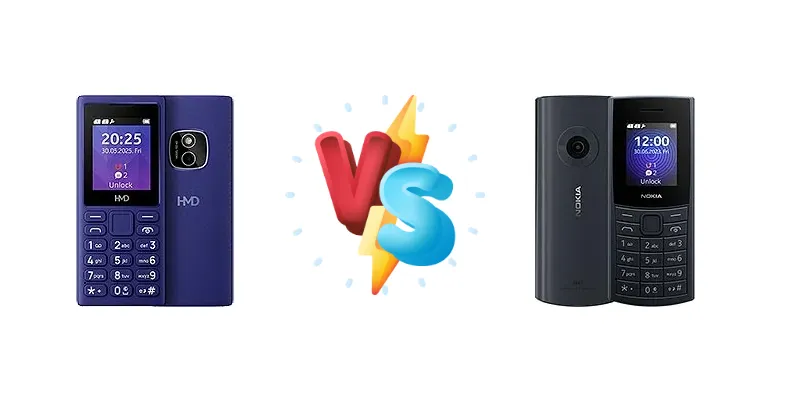
In a market saturated with smartphones, the feature phone remains a relevant choice for users prioritizing simplicity, battery life, and affordability. We pit the HMD 102 4G, powered by the Unisoc 8910 FF-S chipset, against the Nokia 110 4G 2nd Edition, a popular entry-level 4G device, to determine which offers the best value for those seeking a no-frills mobile experience.
🏆 Quick Verdict
For users needing a slight performance edge and confirmed 4G connectivity, the HMD 102 4G is the better choice, thanks to its Unisoc 8910 FF-S chipset. However, if brand loyalty to Nokia and a potentially lower price point are paramount, the 110 4G 2nd Edition remains a viable option, despite limited publicly available specifications.
| Network |
|---|
| 2G bands | GSM 900 / 1800 | GSM 900 / 1800 |
| 3G bands | HSDPA 2100 | HSDPA 850 / 900 / 1700(AWS) / 1900 / 2100 |
| 4G bands | 1, 3, 5, 8, 28, 38, 39, 40, 41 | LTE |
| Speed | HSPA, LTE | HSPA, LTE |
| Technology | GSM / HSPA / LTE | GSM / HSPA / LTE |
| Launch |
|---|
| Announced | 2025, September 11 | 2024, December |
| Status | Available. Released 2025, September 11 | Available. Released 2024, December |
| Body |
|---|
| Dimensions | 118.2 x 50.2 x 14.3 mm (4.65 x 1.98 x 0.56 in) | 121.5 x 50 x 14.4 mm (4.78 x 1.97 x 0.57 in) |
| SIM | Nano-SIM + Nano-SIM | · Nano-SIM· Nano-SIM + Nano-SIM |
| Weight | 84.2 g (2.96 oz) | 94.5 g (3.35 oz) |
| Display |
|---|
| Resolution | 120 x 160 pixels, 4:3 ratio (~100 ppi density) | 120 x 160 pixels, 4:3 ratio (~111 ppi density) |
| Size | 2.0 inches, 12.4 cm2 (~20.9% screen-to-body ratio) | 1.8 inches, 10.0 cm2 (~16.5% screen-to-body ratio) |
| Type | TFT | IPS LCD |
| Platform |
|---|
| Chipset | Unisoc 8910 FF-S | - |
| Memory |
|---|
| Call records | Yes | Yes |
| Card slot | microSDHC | microSDHC |
| Internal | 24MB | 48MB 128MB RAM |
| Phonebook | Yes | Yes |
| Main Camera |
|---|
| Features | LED flash | - |
| Single | QVGA | QVGA |
| Video | No | Yes |
| Sound |
|---|
| 35mm jack | Yes | Yes |
| Loudspeaker | Yes | Yes |
| Comms |
|---|
| Bluetooth | 4.2 | 5.0, A2DP |
| NFC | No | No |
| Positioning | No | No |
| Radio | Unspecified | Wireless FM radio |
| USB | USB Type-C | USB Type-C |
| WLAN | No | No |
| Features |
|---|
| Games | Yes | Yes |
| Java | No | No |
| Messaging | SMS | SMS |
| Battery |
|---|
| Type | Li-Ion 1000 mAh, removable | Li-Ion 1450 mAh, removable |
| Misc |
|---|
| Colors | Dark Blue, Red, Purple | Midnight Blue, Arctic Purple |
| Price | About 20 EUR | About 60 EUR |
HMD 102 4G
- Known chipset (Unisoc 8910 FF-S) provides performance predictability.
- Reliable 4G connectivity for basic data tasks.
- Potentially better app responsiveness compared to the Nokia 110 4G.
- Limited detailed specifications available.
- Basic camera performance.
Nokia 110 4G 2nd Edition
- Strong brand recognition and reputation for durability.
- Potentially lower price point.
- Long standby time (estimated).
- Unspecified chipset hinders performance assessment.
- Limited information available regarding display quality.
Display Comparison
Detailed display specifications for the Nokia 110 4G 2nd Edition are scarce. The HMD 102 4G, while also lacking detailed display data, benefits from the Unisoc 8910 FF-S chipset’s ability to drive a reasonable interface. Both devices likely utilize LCD panels given their price point, and users should expect limited viewing angles and color accuracy. The absence of detailed specs for the Nokia 110 4G makes a direct comparison impossible, but it's reasonable to assume similar limitations.
Camera Comparison
Neither device is positioned as a photography leader. Both likely feature basic VGA or 2MP cameras suitable for very limited use. Image quality will be poor in all but the most ideal lighting conditions. Focusing on camera performance for either device is a misallocation of expectations; these phones are designed for communication, not photography.
Performance
The HMD 102 4G’s Unisoc 8910 FF-S chipset is the defining performance differentiator. This chipset, while not a powerhouse, provides a significant step up from older feature phone platforms, enabling smoother operation of 4G connectivity and basic applications. The Nokia 110 4G 2nd Edition’s chipset remains unspecified, but given its positioning, it likely utilizes a less powerful, older platform. This translates to potentially slower app loading times and a less responsive user experience on the Nokia device, particularly when utilizing 4G data.
Battery Life
Both the HMD 102 4G and Nokia 110 4G 2nd Edition prioritize battery life. The HMD 102 4G’s Unisoc 8910 FF-S chipset is relatively power-efficient, contributing to extended standby times. The Nokia 110 4G 2nd Edition, with its potentially less demanding chipset, may offer comparable or slightly better standby life. However, active 4G usage will significantly impact battery drain on both devices, and neither supports fast charging.
Buying Guide
Buy the HMD 102 4G if you need reliable 4G performance for basic tasks like WhatsApp and occasional web browsing, and appreciate knowing the specific chipset powering your device. Buy the Nokia 110 4G 2nd Edition if you prioritize brand recognition, potentially lower upfront cost, and are comfortable with a device where detailed specifications are less readily available, relying on Nokia's established reputation for durability in this segment.
Frequently Asked Questions
❓ Does the Unisoc 8910 FF-S in the HMD 102 4G support VoLTE and Wi-Fi calling?
Yes, the Unisoc 8910 FF-S chipset generally supports VoLTE (Voice over LTE) and Wi-Fi calling, enabling higher-quality voice calls and improved network coverage. However, carrier compatibility is crucial; ensure your carrier supports these features on the HMD 102 4G.
❓ What kind of apps can I realistically expect to run on the Nokia 110 4G 2nd Edition?
The Nokia 110 4G 2nd Edition is best suited for basic applications like WhatsApp, Opera Mini (for web browsing), and FM radio. More demanding apps are unlikely to function smoothly due to the limited processing power and RAM. Expect a simplified mobile experience focused on core communication features.
❓ How does the 4G performance of the HMD 102 4G compare to a basic smartphone?
While the HMD 102 4G offers 4G connectivity, its performance will be significantly slower than a modern smartphone. Expect slower download and upload speeds, and a less responsive browsing experience. It's suitable for basic data tasks, but not for streaming high-resolution video or playing online games.