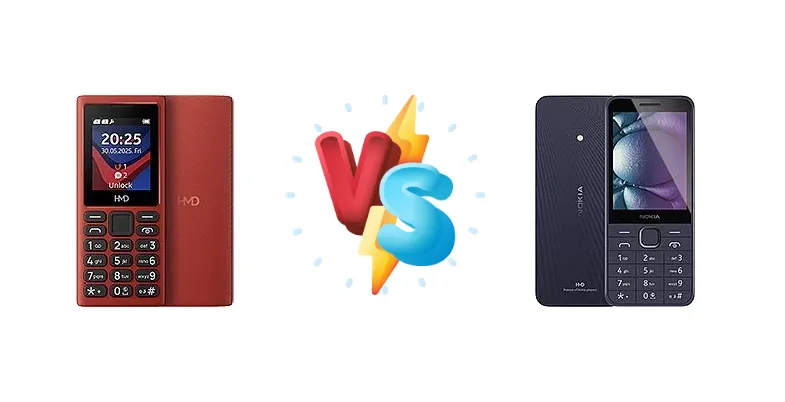
The HMD 101 4G and the Nokia 215 4G (2024) represent the lower end of the smartphone spectrum, catering to users prioritizing basic connectivity and affordability. While both offer 4G capabilities, they differ significantly in their underlying hardware, specifically their Unisoc chipsets. This comparison dissects these differences to determine which device provides the best value for users needing a reliable, no-frills mobile experience.
🏆 Quick Verdict
For the average user seeking a dependable 4G feature phone, the Nokia 215 4G (2024) offers a slight edge. Its Unisoc T107, while slower on paper, is fabricated on a 22nm process, potentially offering better power efficiency for extended battery life in a device category where longevity is paramount. The HMD 101 4G's Unisoc 8910 FF-S doesn't offer a compelling performance advantage to justify any potential battery life trade-offs.
| Network |
|---|
| 2G bands | GSM 900 / 1800 | GSM 850 / 900 / 1800 / 1900 |
| 3G bands | HSDPA 2100 | HSDPA 850 / 900 / 2100 |
| 4G bands | 1, 3, 5, 8, 28, 38, 39, 40, 41 | 1, 3, 5, 7, 8, 20, 28, 38, 40, 41 - EU, EMEA, APAC |
| Speed | HSPA, LTE | HSPA, LTE |
| Technology | GSM / HSPA / LTE | GSM / HSPA / LTE |
| Launch |
|---|
| Announced | 2025, September 11 | 2024, April 30 |
| Status | Available. Released 2025, September 11 | Available. Released 2024, May |
| Body |
|---|
| Dimensions | 118.2 x 50.2 x 14.3 mm (4.65 x 1.98 x 0.56 in) | 127.3 x 54.2 x 11.6 mm (5.01 x 2.13 x 0.46 in) |
| SIM | Nano-SIM + Nano-SIM | Nano-SIM + Nano-SIM |
| Weight | 83.5 g (2.96 oz) | - |
| Display |
|---|
| Resolution | 120 x 160 pixels, 4:3 ratio (~100 ppi density) | 240 x 320 pixels, 4:3 ratio (~143 ppi density) |
| Size | 2.0 inches, 12.4 cm2 (~20.9% screen-to-body ratio) | 2.8 inches, 24.3 cm2 (~35.2% screen-to-body ratio) |
| Type | TFT | TFT LCD |
| Platform |
|---|
| CPU | - | 1.0 GHz Cortex-A7 |
| Chipset | Unisoc 8910 FF-S | Unisoc T107 (22 nm) |
| Memory |
|---|
| Call records | Yes | Yes |
| Card slot | microSDHC | microSDHC |
| Internal | 24MB | 128MB 64MB RAM |
| Phonebook | Yes | Yes |
| Sound |
|---|
| 35mm jack | Yes | Yes |
| Loudspeaker | Yes | Yes |
| Comms |
|---|
| Bluetooth | 4.2 | 5.0, A2DP, LE |
| NFC | No | No |
| Positioning | No | No |
| Radio | Unspecified | Wireless FM radio |
| USB | USB Type-C | USB Type-C |
| WLAN | No | No |
| Features |
|---|
| Games | Yes | Yes |
| Java | No | No |
| Messaging | SMS | SMS |
| Sensors | - | No |
| Battery |
|---|
| Type | Li-Ion 1000 mAh, removable | Li-Ion 1450 mAh, removable |
| Misc |
|---|
| Colors | Dark Blue, Blue, Red | Peach, Black, Dark Blue |
| Price | About 20 EUR | - |
HMD 101 4G
- Potentially slightly faster UI responsiveness due to the Unisoc 8910 FF-S.
- May support slightly more demanding applications (though limited by RAM).
- HMD's software support is generally reliable.
- Likely shorter battery life compared to the Nokia 215 4G (2024).
- Potential for more heat generation under load.
- No significant performance advantage to justify potential drawbacks.
Nokia 215 4G (2024)
- Superior battery life thanks to the power-efficient Unisoc T107 and 22nm process.
- Lower heat generation, contributing to device stability.
- Nokia's reputation for durability and reliability.
- Slower CPU performance compared to the HMD 101 4G.
- May exhibit slight lag when navigating the UI.
- Limited app compatibility due to lower processing power.
Display Comparison
Neither device is expected to boast a high-resolution or particularly vibrant display. Given the target market, both likely utilize basic LCD panels. However, the absence of detailed display specifications necessitates focusing on the chipset impact on UI responsiveness. A smoother UI experience, even on a low-resolution screen, is more valuable than a higher pixel count.
Camera Comparison
Both devices are unlikely to excel in photography. Given the market segment, camera quality is secondary to core functionality. Any camera specifications beyond basic VGA or 2MP sensors would be surprising. Image quality should be considered adequate for basic documentation, but not for serious photography.
Performance
The core difference lies in the chipsets. The HMD 101 4G utilizes the Unisoc 8910 FF-S, while the Nokia 215 4G (2024) features the Unisoc T107. The T107, with its 1.0 GHz Cortex-A7 CPU, is geared towards ultra-low power consumption. The 8910 FF-S's specifications are less readily available, but its presence suggests a slightly more ambitious performance target. However, the 22nm fabrication process of the T107 is a significant advantage, potentially leading to lower heat generation and improved battery efficiency compared to the 8910 FF-S. This is crucial for a device where battery life is a key selling point.
Battery Life
Battery life is a critical factor. While specific mAh ratings are unavailable, the Unisoc T107's 22nm process in the Nokia 215 4G (2024) strongly suggests superior power efficiency. This translates to longer talk time, standby time, and overall usage between charges. The HMD 101 4G, with its potentially more powerful but less efficient chipset, may require more frequent charging.
Buying Guide
Buy the HMD 101 4G if you anticipate needing slightly faster responsiveness for basic app usage, even at the cost of potentially shorter battery life. Buy the Nokia 215 4G (2024) if maximizing battery endurance and reliable call quality are your primary concerns, and you prioritize a longer-lasting device between charges. Both are ideal for users needing a secondary phone or a simple mobile solution for essential communication.
Frequently Asked Questions
❓ Will the Nokia 215 4G (2024) last a full day on a single charge with moderate use (calls, texts, and occasional radio)?
The Nokia 215 4G (2024)'s Unisoc T107 chipset, built on a 22nm process, is specifically designed for low power consumption. With moderate use, including calls, texts, and occasional FM radio listening, it's highly likely to last a full day, and potentially even longer, on a single charge. This is a key advantage over the HMD 101 4G.
❓ Can either phone run WhatsApp or Facebook?
While both phones support 4G connectivity, running applications like WhatsApp or Facebook is heavily dependent on the available RAM and processing power. The Unisoc T107 in the Nokia 215 4G (2024) and the Unisoc 8910 FF-S in the HMD 101 4G are both relatively low-powered. WhatsApp *might* function with limited features, but Facebook is unlikely to run smoothly, if at all. These phones are best suited for basic communication.
❓ Is the Nokia 215 4G (2024) dual SIM capable?
Yes, the Nokia 215 4G (2024) supports dual SIM functionality. This allows you to use two separate SIM cards simultaneously, which is a useful feature for managing personal and work contacts or taking advantage of different carrier plans. The HMD 101 4G also supports dual SIM.