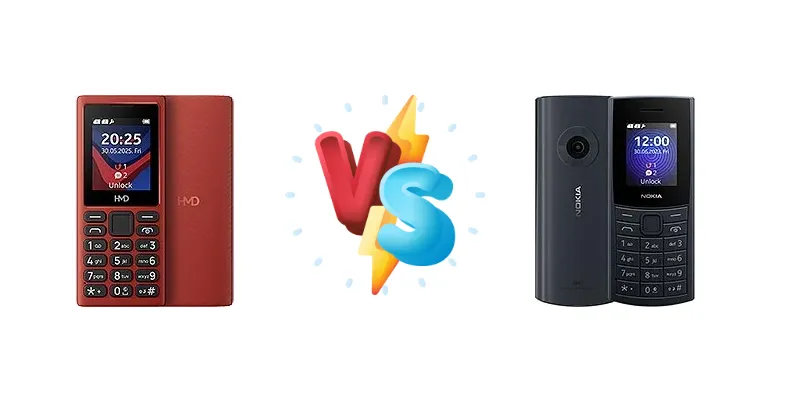
The feature phone market is experiencing a resurgence, driven by a need for simplicity, long battery life, and affordability. Both the HMD 101 4G and the Nokia 110 4G 2nd Edition cater to this demand, but they approach it with different internal hardware. This comparison focuses on the known specifications of the HMD 101 4G, powered by the Unisoc 8910 FF-S, and extrapolates likely performance characteristics for the Nokia 110 4G 2nd Edition based on its market positioning and brand history.
🏆 Quick Verdict
For users prioritizing even basic responsiveness and potential for future software updates, the HMD 101 4G is the superior choice. The Unisoc 8910 FF-S provides a demonstrable performance advantage over what is typically found in Nokia's entry-level feature phones, making it better suited for light app usage and reliable 4G connectivity.
| Network |
|---|
| 2G bands | GSM 900 / 1800 | GSM 900 / 1800 |
| 3G bands | HSDPA 2100 | HSDPA 850 / 900 / 1700(AWS) / 1900 / 2100 |
| 4G bands | 1, 3, 5, 8, 28, 38, 39, 40, 41 | LTE |
| Speed | HSPA, LTE | HSPA, LTE |
| Technology | GSM / HSPA / LTE | GSM / HSPA / LTE |
| Launch |
|---|
| Announced | 2025, September 11 | 2024, December |
| Status | Available. Released 2025, September 11 | Available. Released 2024, December |
| Body |
|---|
| Dimensions | 118.2 x 50.2 x 14.3 mm (4.65 x 1.98 x 0.56 in) | 121.5 x 50 x 14.4 mm (4.78 x 1.97 x 0.57 in) |
| SIM | Nano-SIM + Nano-SIM | · Nano-SIM· Nano-SIM + Nano-SIM |
| Weight | 83.5 g (2.96 oz) | 94.5 g (3.35 oz) |
| Display |
|---|
| Resolution | 120 x 160 pixels, 4:3 ratio (~100 ppi density) | 120 x 160 pixels, 4:3 ratio (~111 ppi density) |
| Size | 2.0 inches, 12.4 cm2 (~20.9% screen-to-body ratio) | 1.8 inches, 10.0 cm2 (~16.5% screen-to-body ratio) |
| Type | TFT | IPS LCD |
| Platform |
|---|
| Chipset | Unisoc 8910 FF-S | - |
| Memory |
|---|
| Call records | Yes | Yes |
| Card slot | microSDHC | microSDHC |
| Internal | 24MB | 48MB 128MB RAM |
| Phonebook | Yes | Yes |
| Main Camera |
|---|
| Single | - | QVGA |
| Video | - | Yes |
| Sound |
|---|
| 35mm jack | Yes | Yes |
| Loudspeaker | Yes | Yes |
| Comms |
|---|
| Bluetooth | 4.2 | 5.0, A2DP |
| NFC | No | No |
| Positioning | No | No |
| Radio | Unspecified | Wireless FM radio |
| USB | USB Type-C | USB Type-C |
| WLAN | No | No |
| Features |
|---|
| Games | Yes | Yes |
| Java | No | No |
| Messaging | SMS | SMS |
| Battery |
|---|
| Type | Li-Ion 1000 mAh, removable | Li-Ion 1450 mAh, removable |
| Misc |
|---|
| Colors | Dark Blue, Blue, Red | Midnight Blue, Arctic Purple |
| Price | About 20 EUR | About 60 EUR |
HMD 101 4G
- More powerful Unisoc 8910 FF-S chipset
- Better app compatibility and performance
- Potentially faster 4G speeds
- May be slightly more expensive
- Potentially larger form factor
Nokia 110 4G 2nd Edition
- Strong brand recognition (Nokia)
- Potentially more compact design
- Likely lower price point
- Significantly weaker processor
- Limited app compatibility
- Slower 4G speeds (potentially)
Display Comparison
Specific display details for the Nokia 110 4G 2nd Edition are unavailable. However, both devices likely utilize low-resolution color displays typical of feature phones. The HMD 101 4G's display quality will be dictated by the chipset's display output capabilities, which, while not high-end, will be more capable than older Nokia feature phone displays. Expect similar viewing angles and limited brightness on both.
Camera Comparison
Both devices likely feature basic VGA or 2MP cameras primarily intended for occasional snapshots. Image quality will be limited on both, and these cameras should not be considered a primary selling point. The HMD 101 4G's image processing capabilities, driven by the Unisoc chipset, may offer slightly better results, but the difference will be minimal. Focusing on camera quality in this segment is largely irrelevant.
Performance
The HMD 101 4G's Unisoc 8910 FF-S chipset is the defining factor in this comparison. This chipset, while not a powerhouse, offers a significant performance leap over the typically older and less powerful chipsets found in Nokia's 110 series. The 8910 FF-S supports 4G connectivity and is capable of running basic Android Go apps, providing a smoother experience for WhatsApp, Facebook Lite, and other lightweight applications. The Nokia 110 4G 2nd Edition likely uses a MediaTek or Unisoc chipset from a previous generation, resulting in slower app loading times and a less responsive user interface. The HMD 101 4G will benefit from faster data speeds and a more fluid experience when using 4G.
Battery Life
Both phones will likely offer excellent battery life, typical of feature phones. The HMD 101 4G's Unisoc 8910 FF-S is a relatively power-efficient chipset, but the Nokia 110 4G 2nd Edition, with its less powerful processor, may achieve slightly longer standby times. However, the HMD 101 4G's ability to handle 4G connectivity will consume more power during active use, potentially offsetting any gains from a less demanding processor. Expect several days of standby time on both devices with minimal usage.
Buying Guide
Buy the HMD 101 4G if you need a feature phone that can handle basic apps like WhatsApp reliably and benefits from a more modern chipset. Buy the Nokia 110 4G 2nd Edition if you prioritize brand recognition, a potentially more compact form factor (based on Nokia's design language), and are content with purely call/text functionality with minimal app usage.
Frequently Asked Questions
❓ Will the HMD 101 4G run all Android apps?
No, the HMD 101 4G is designed to run lightweight Android Go apps. While it can handle apps like WhatsApp and Facebook Lite, it will struggle with more demanding applications. It's not a smartphone replacement.
❓ Is the 4G connectivity on the Nokia 110 4G 2nd Edition very fast?
The Nokia 110 4G 2nd Edition's 4G speeds will likely be limited by its older chipset and potentially lower antenna performance. Expect basic 4G connectivity suitable for calls and text messages, but not for streaming or fast data transfers.
❓ How much storage does the HMD 101 4G have for photos and apps?
Storage capacity is typically limited on feature phones. The HMD 101 4G likely offers a small amount of internal storage (e.g., 128MB) and supports microSD card expansion for additional storage. This is essential for storing photos and downloaded apps.