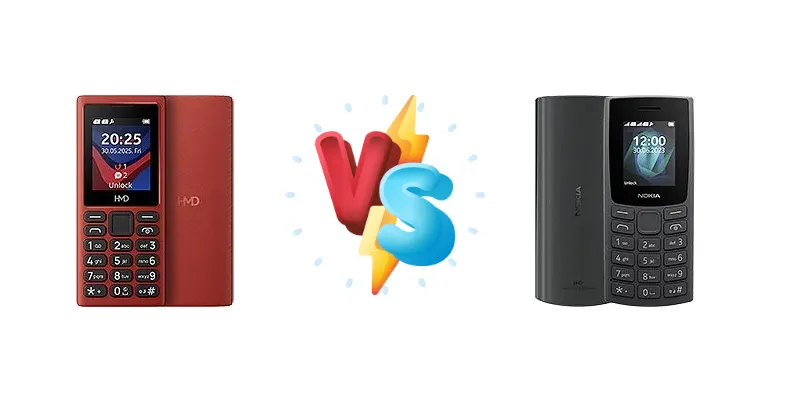
In a market saturated with smartphones, the demand for simple, reliable 4G feature phones persists. The HMD 101 4G and Nokia 105 4G 2nd Edition represent two of the most accessible options, catering to users prioritizing call quality, long battery life, and basic connectivity. This comparison dissects their differences, focusing on the HMD 101 4G's known Unisoc chipset and the Nokia 105 4G's position as a widely available, no-frills alternative.
🏆 Quick Verdict
For users needing a slight performance edge and a known chipset, the HMD 101 4G is the better choice. Its Unisoc 8910 FF-S offers a more modern architecture than what's typically found in the Nokia 105 4G, potentially leading to smoother operation of 4G connectivity and basic apps. However, the Nokia 105 4G 2nd Edition remains a viable option for those prioritizing brand recognition and widespread availability.
| Network |
|---|
| 2G bands | GSM 900 / 1800 | GSM 900 / 1800 |
| 3G bands | HSDPA 2100 | HSDPA 850 / 900 / 1700(AWS) / 1900 / 2100 |
| 4G bands | 1, 3, 5, 8, 28, 38, 39, 40, 41 | LTE |
| Speed | HSPA, LTE | HSPA, LTE |
| Technology | GSM / HSPA / LTE | GSM / HSPA / LTE |
| Launch |
|---|
| Announced | 2025, September 11 | 2024, December |
| Status | Available. Released 2025, September 11 | Available. Released 2024, December |
| Body |
|---|
| Dimensions | 118.2 x 50.2 x 14.3 mm (4.65 x 1.98 x 0.56 in) | 121.5 x 50 x 14.4 mm (4.78 x 1.97 x 0.57 in) |
| SIM | Nano-SIM + Nano-SIM | · Nano-SIM· Nano-SIM + Nano-SIM |
| Weight | 83.5 g (2.96 oz) | 93 g (3.28 oz) |
| Display |
|---|
| Resolution | 120 x 160 pixels, 4:3 ratio (~100 ppi density) | 120 x 160 pixels, 4:3 ratio (~111 ppi density) |
| Size | 2.0 inches, 12.4 cm2 (~20.9% screen-to-body ratio) | 1.8 inches, 10.0 cm2 (~16.5% screen-to-body ratio) |
| Type | TFT | IPS LCD |
| Platform |
|---|
| Chipset | Unisoc 8910 FF-S | - |
| Memory |
|---|
| Call records | Yes | Yes |
| Card slot | microSDHC | microSDHC |
| Internal | 24MB | 48MB 128MB RAM |
| Phonebook | Yes | Yes |
| Sound |
|---|
| 35mm jack | Yes | Yes |
| Loudspeaker | Yes | Yes |
| Comms |
|---|
| Bluetooth | 4.2 | 5.0, A2DP |
| NFC | No | No |
| Positioning | No | No |
| Radio | Unspecified | Wireless FM radio |
| USB | USB Type-C | USB Type-C |
| WLAN | No | No |
| Features |
|---|
| Games | Yes | Yes |
| Java | No | No |
| Messaging | SMS | SMS |
| Battery |
|---|
| Type | Li-Ion 1000 mAh, removable | Li-Ion 1450 mAh, removable |
| Misc |
|---|
| Colors | Dark Blue, Blue, Red | Charcoal |
| Price | About 20 EUR | About 50 EUR |
HMD 101 4G
- More modern Unisoc 8910 FF-S chipset
- Potentially better 4G performance
- Likely improved power efficiency
- Less brand recognition than Nokia
- May be harder to find in certain markets
Nokia 105 4G 2nd Edition
- Strong brand recognition and trust
- Widespread availability through carriers
- Proven durability and reliability
- Likely older, less efficient chipset
- Potentially slower 4G speeds
- Limited future software support
Display Comparison
Neither device is expected to boast a high-resolution or particularly vibrant display. Both likely utilize basic color LCD panels. However, the HMD 101 4G, being a slightly newer device, *may* benefit from minor improvements in panel quality or viewing angles, though this is speculative. The Nokia 105 4G 2nd Edition's display is likely optimized for maximum legibility in direct sunlight, a common design choice for feature phones.
Camera Comparison
Both devices are unlikely to feature cameras worth discussing in detail. Any camera present on either phone will be low-resolution and primarily intended for basic photo capture. Image quality will be limited by the sensor size, lens quality, and lack of image processing capabilities. Focusing on camera performance is not a relevant factor when comparing these devices.
Performance
The core difference lies in the chipset. The HMD 101 4G is powered by the Unisoc 8910 FF-S. While not a powerhouse, this chipset offers a more modern architecture compared to the likely older, proprietary solution found in the Nokia 105 4G 2nd Edition. The Unisoc 8910 FF-S supports VoLTE and potentially faster 4G data speeds, crucial for modern network compatibility. The Nokia 105 4G 2nd Edition will likely suffice for calls and SMS, but may struggle with more demanding tasks like web browsing or app usage.
Battery Life
Both phones prioritize battery life. The HMD 101 4G and Nokia 105 4G 2nd Edition likely feature batteries in the 1000-1500 mAh range. The Unisoc 8910 FF-S in the HMD 101 4G *may* offer slightly better power efficiency, but the difference will likely be minimal. Both devices should easily provide several days of standby time and a full day of talk time on a single charge. Charging will likely be via Micro-USB, with slow charging speeds.
Buying Guide
Buy the HMD 101 4G if you need a feature phone with a slightly more capable chipset for reliable 4G performance and potential future software updates. Buy the Nokia 105 4G 2nd Edition if you prioritize brand familiarity, widespread availability through carrier partnerships, and a proven track record of durability in a basic feature phone.
Frequently Asked Questions
❓ Will the HMD 101 4G receive software updates, and will it support future 4G network changes?
While feature phones typically receive limited software support, the HMD 101 4G's Unisoc 8910 FF-S chipset *may* allow for over-the-air (OTA) updates to address network compatibility issues or security vulnerabilities. This is more likely than with the Nokia 105 4G 2nd Edition, which likely relies on an older, less adaptable platform.
❓ Is the Nokia 105 4G 2nd Edition compatible with all 4G carriers, and will VoLTE work reliably?
The Nokia 105 4G 2nd Edition's 4G compatibility depends on the specific carrier and its network configuration. While it supports 4G, VoLTE (Voice over LTE) support may be limited or unreliable on some networks due to the phone's older chipset and software. Check with your carrier for compatibility before purchasing.
❓ Can I use WhatsApp or Facebook on either of these phones?
Basic versions of WhatsApp and Facebook Lite *may* be usable on the HMD 101 4G due to the Unisoc chipset's slightly better processing power. However, performance will be slow and limited. The Nokia 105 4G 2nd Edition is unlikely to run these apps smoothly, if at all, due to its less capable hardware.