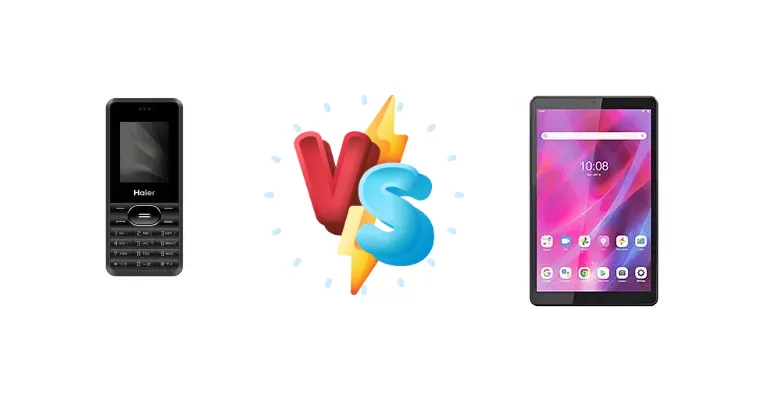
The budget tablet market is fiercely competitive, with options like the Haier M320+ and Lenovo Tab M8 (3rd Gen) vying for attention. While both aim to deliver an affordable Android experience, they approach it with different strengths. The Lenovo Tab M8 (3rd Gen) boasts a known chipset, while the Haier M320+ remains largely a mystery in terms of detailed specifications, forcing us to analyze it based on brand positioning and typical features within its price bracket.
🏆 Quick Verdict
For the average user prioritizing consistent performance and a known quantity, the Lenovo Tab M8 (3rd Gen) is the better choice. Its Mediatek MT8768T Helio P22T chipset provides a reliable experience for everyday tasks, streaming, and light gaming, something the Haier M320+ likely struggles to match given its lack of published specs.
| Network |
|---|
| 2G bands | GSM 900 / 1800 | GSM 850 / 900 / 1800 / 1900 |
| 3G bands | - | HSDPA 850 / 900 / 1700(AWS) / 1900 / 2100 - International |
| 4G bands | - | 1, 2, 3, 4, 5, 19, 7, 8, 20, 26, 28, 38, 40, 41 - International |
| EDGE | No | - |
| GPRS | Class 10 | - |
| Speed | - | HSPA, LTE - cellular model only |
| Technology | GSM | GSM / CDMA / HSPA / LTE |
| | - | 1, 3, 5, 7, 8, 34, 38, 39, 40, 41 - China |
| Launch |
|---|
| Announced | 2010. Released 2010 | 2021, June 28 |
| Status | Discontinued | Available. Released 2022, February |
| Body |
|---|
| Build | - | Glass front, aluminum back, aluminum frame |
| Dimensions | 108.2 x 45.6 x 12 mm (4.26 x 1.80 x 0.47 in) | 199.1 x 121.8 x 8.2 mm (7.84 x 4.80 x 0.32 in) |
| SIM | Dual SIM (Mini-SIM, no dual stand-by) | Nano-SIM (cellular model only) |
| Weight | - | 305 g (10.76 oz) |
| Display |
|---|
| Resolution | - | 800 x 1280 pixels, 16:10 ratio (~189 ppi density) |
| Size | 1.8 inches | 8.0 inches, 185.6 cm2 (~76.5% screen-to-body ratio) |
| Type | TFT, 65K colors | TDDI IPS LCD, 350 nits (typ) |
| Platform |
|---|
| CPU | - | Octa-core (4x2.3 GHz Cortex-A53 & 4x1.8 GHz Cortex-A53) |
| Chipset | - | Mediatek MT8768T Helio P22T (12 nm) |
| GPU | - | PowerVR GE8320 |
| OS | - | Android 11 (Go edition) - 2 GB RAM versionAndroid 11 - 3 GB RAM version |
| Memory |
|---|
| Call records | Yes | - |
| Card slot | microSD (dedicated slot) | microSDXC (dedicated slot) |
| Internal | - | 32GB 2GB RAM, 32GB 3GB RAM |
| Phonebook | Yes | - |
| | - | eMMC 5.1 |
| Main Camera |
|---|
| Single | Yes | 5 MP, AF |
| Video | No | 1080p |
| Selfie camera |
|---|
| Single | - | 2 MP |
| Video | - | 720p |
| Sound |
|---|
| 3.5mm jack | - | Yes |
| 35mm jack | No | Yes |
| Loudspeaker | Yes | Yes |
| Comms |
|---|
| Bluetooth | No | 5.0, A2DP, LE |
| NFC | - | No |
| Positioning | No | GPS, GLONASS, BDS - cellular model only |
| Radio | FM radio | FM radio |
| USB | No | USB Type-C 2.0, OTG |
| WLAN | No | Wi-Fi 802.11 a/b/g/n, dual-band, Wi-Fi Direct |
| Features |
|---|
| Browser | WAP 2.0/xHTML | - |
| Games | No | - |
| Java | No | - |
| Messaging | SMS, MMS | - |
| Sensors | - | Accelerometer, proximity |
| Battery |
|---|
| Type | Removable Li-Ion 1000 mAh battery | Li-Po 5100 mAh |
| Misc |
|---|
| Colors | Black | Iron Grey, Platinum Grey |
Haier M320+
- Potentially lower price point
- May offer a larger display size (speculation)
- Simple and straightforward Android experience
- Unknown chipset and performance
- Likely inferior build quality
- Limited software support
Lenovo Tab M8 (3rd Gen)
- Known and reliable Mediatek MT8768T chipset
- Better performance for everyday tasks
- Established brand reputation and support
- Limited storage options
- Basic camera performance
- May be slightly more expensive than Haier
Display Comparison
Without specific display details for the Haier M320+, we can only assume it utilizes a standard IPS LCD panel common in this price range. The Lenovo Tab M8 (3rd Gen) also features an IPS LCD, but its quality is likely superior due to Lenovo's more established manufacturing processes. Expect the Lenovo to offer slightly better color accuracy and viewing angles. Both tablets likely feature similar resolutions (around 1280x800), but the Haier's panel may exhibit lower peak brightness and contrast. The absence of information regarding PWM dimming on the Haier M320+ raises concerns for users sensitive to flicker, while the Lenovo's PWM frequency is not publicly available but is generally adequate for most users.
Camera Comparison
Camera performance is unlikely to be a strong suit for either tablet. However, the Lenovo Tab M8 (3rd Gen) likely has a slight edge due to its more established software processing. Given the typical camera configurations in this segment, both tablets likely feature a basic rear camera and a front-facing camera for video calls. The Haier M320+'s camera specs are unknown, but it's reasonable to assume they are comparable or inferior to the Lenovo's. Focusing on camera quality for these devices is not recommended; they are primarily intended for basic photo capture.
Performance
The Lenovo Tab M8 (3rd Gen) is powered by the Mediatek MT8768T Helio P22T (12 nm). This octa-core processor, with its Cortex-A53 cores clocked up to 2.3 GHz, provides a noticeable performance boost over the likely entry-level chipset found in the Haier M320+. The MT8768T's architecture allows for smoother multitasking and faster app loading times. While not a gaming powerhouse, it can handle less demanding titles. The Haier M320+, lacking published specs, likely uses a significantly less powerful processor, resulting in slower performance and potential lag during everyday tasks. The 12nm process node of the MT8768T also suggests better power efficiency compared to older, larger node chipsets potentially found in the Haier.
Battery Life
Battery life will depend heavily on usage patterns. Without specific battery capacity information for the Haier M320+, it's difficult to make a direct comparison. However, the Lenovo Tab M8 (3rd Gen) typically offers around 7-8 hours of mixed usage. The Mediatek MT8768T's 12nm process contributes to reasonable power efficiency. Charging speeds are also likely to be similar, with both tablets supporting standard 5W charging. The Haier M320+ may have a slightly larger battery to compensate for a less efficient processor, but this is speculative.
Buying Guide
Buy the Haier M320+ if you need a very basic tablet for static tasks like reading ebooks or displaying photos, and your budget is extremely limited. It's likely positioned as a 'good enough' option for minimal usage. Buy the Lenovo Tab M8 (3rd Gen) if you prefer a more responsive experience for browsing, streaming video, social media, and occasional light gaming. The MT8768T chipset offers a tangible performance advantage for these common use cases.
Frequently Asked Questions
❓ Is the Mediatek MT8768T in the Lenovo Tab M8 (3rd Gen) capable of running popular games like PUBG Mobile?
While the MT8768T isn't a high-end gaming chip, it can run PUBG Mobile at lower graphics settings and frame rates. Expect playable performance at around 30fps with reduced visual details. It's suitable for casual gaming but won't provide a flagship gaming experience.
❓ What kind of storage options does the Lenovo Tab M8 (3rd Gen) offer, and can it be expanded?
The Lenovo Tab M8 (3rd Gen) typically comes with 32GB or 64GB of internal storage. Thankfully, it includes a microSD card slot, allowing you to expand the storage up to 128GB. This is crucial for storing photos, videos, and apps.
❓ Given the lack of detailed specs for the Haier M320+, how can I be sure it will meet my needs?
If you're considering the Haier M320+, it's best suited for very basic tasks like reading ebooks, browsing simple websites, and displaying photos. If you plan on doing anything more demanding, such as streaming video or playing games, the Lenovo Tab M8 (3rd Gen) is a significantly better choice.