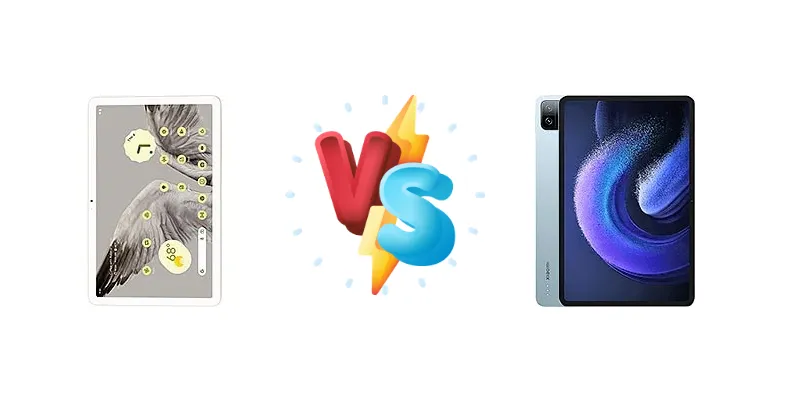
The tablet market is heating up! Google's Pixel Tablet offers seamless integration with the Google ecosystem, while the Xiaomi Pad 6 delivers impressive specs and value. But which one is right for you? Let's dive into a detailed comparison to help you decide.
🏆 Quick Verdict
The Xiaomi Pad 6 takes the crown for raw performance and value, boasting a Snapdragon 870 and faster charging. However, the Pixel Tablet's unique charging dock and Google integration make it a compelling choice for those deeply invested in the Google ecosystem. It's a close call!
| Network |
|---|
| 2G bands | N/A | N/A |
| 3G bands | N/A | N/A |
| 4G bands | N/A | - |
| EDGE | No | N/A |
| GPRS | No | N/A |
| Technology | No cellular connectivity | No cellular connectivity |
| Launch |
|---|
| Announced | 2023, May 10 | 2023, April 18 |
| Status | Available. Released 2023, June 20 | Available. Released 2023, April 18 |
| Body |
|---|
| Build | Glass front, aluminum frame, aluminum back | Glass front (Gorilla Glass 3), aluminum frame, aluminum back |
| Dimensions | 258 x 169 x 8.1 mm (10.16 x 6.65 x 0.32 in) | 254 x 165.2 x 6.5 mm (10.0 x 6.50 x 0.26 in) |
| SIM | No | No |
| Weight | 493 g (1.09 lb) | 490 g (1.08 lb) |
| | Stylus support | Stylus support (magnetic) |
| Display |
|---|
| Protection | - | Corning Gorilla Glass 3 |
| Resolution | 1600 x 2560 pixels, 16:10 ratio (~276 ppi density) | 1800 x 2880 pixels, 16:10 ratio (~309 ppi density) |
| Size | 10.95 inches, 347.7 cm2 (~79.7% screen-to-body ratio) | 11.0 inches, 350.9 cm2 (~83.6% screen-to-body ratio) |
| Type | IPS LCD | IPS LCD, 1B colors, 144Hz, HDR10, Dolby Vision, 550 nits |
| Platform |
|---|
| CPU | Octa-core (2x2.85 GHz Cortex-X1 & 2x2.35 GHz Cortex-A78 & 4x1.80 GHz Cortex-A55) | Octa-core (1x3.2 GHz Kryo 585 & 3x2.42 GHz Kryo 585 & 4x1.80 GHz Kryo 585) |
| Chipset | Google Tensor G2 (5 nm) | Qualcomm SM8250-AC Snapdragon 870 5G (7 nm) |
| GPU | Mali-G710 MP7 | Adreno 650 |
| OS | Android 13, upgradable to Android 15 | Android 13, MIUI Pad 14 |
| Memory |
|---|
| Card slot | No | No |
| Internal | 128GB 8GB RAM, 256GB 8GB RAM | 128GB 6GB RAM, 128GB 8GB RAM, 256GB 8GB RAM |
| | UFS 3.1 | UFS 3.1 |
| Main Camera |
|---|
| Features | HDR, panorama | Dual-LED flash, HDR, panorama |
| Single | 8 MP, f/2.0, 24mm (wide), 1/4.0", 1.12µm | 13 MP, f/2.2, PDAF |
| Video | 1080p@30fps | 4K@30fps, 1080p@30/60fps |
| Selfie camera |
|---|
| Features | HDR, panorama | - |
| Single | 8 MP, f/2.0, 24mm (wide), 1/4.0", 1.12µm | 8 MP, f/2.2, 1/4.0", 1.12µm |
| Video | 1080p@30fps | 1080p@30fps |
| Sound |
|---|
| 3.5mm jack | No | No |
| 35mm jack | No | No |
| Loudspeaker | Yes, with stereo speakers (4 speakers) | Yes, with stereo speakers (4 speakers) |
| | - | 24-bit/192kHz audio |
| Comms |
|---|
| Bluetooth | 5.2, A2DP, LE | 5.2, A2DP, LE |
| NFC | No | No |
| Positioning | No | Unspecified |
| Radio | No | No |
| USB | USB Type-C 3.2 (Gen 1), magnetic connector | USB Type-C 3.2, accessory connector |
| WLAN | Wi-Fi 802.11 a/b/g/n/ac/6, dual-band | Wi-Fi 802.11 a/b/g/n/a/6, dual-band, Wi-Fi Direct |
| Features |
|---|
| Sensors | Accelerometer, gyro, compass, proximity (accessories only) | Accelerometer, gyro, proximity (accessories only) |
| | Ultra Wideband (UWB) support | - |
| Battery |
|---|
| Charging | 15W wired | 33W wired, PD3.0, QC4 |
| Type | Li-Po 7020 mAh (27 Wh) | Li-Po 8840 mAh |
| Misc |
|---|
| Colors | Porcelain, Hazel, Rose | Black, Blue, Gold |
| Models | GA06156-EU, GA06157-EU, GA06158-EU | 23043RP34C, 23043RP34G, 23043RP34I |
| Price | About 670 EUR | About 400 EUR |
Google Pixel Tablet
- Seamless Google ecosystem integration
- Unique charging dock for desktop-like use
- Clean Android experience
- Good build quality
- Slower performance compared to Xiaomi Pad 6
- 15W charging is slow
- Higher price point
Xiaomi Pad 6
- Excellent performance for the price
- Vibrant and bright display
- Long battery life
- Fast 33W charging
- Less integrated Google services experience
- MIUI software can be divisive
- Design is less premium than Pixel Tablet
Display Comparison
The Xiaomi Pad 6 boasts a stunning 1060:1 contrast ratio and 500 nits brightness, offering a more vibrant and immersive viewing experience. The Pixel Tablet's display is good, but lacks the same punch. Xiaomi wins here.
Camera Comparison
Camera quality is generally not a primary concern for tablets. The Pixel Tablet likely offers slightly better image processing thanks to Google's algorithms, but both are adequate for casual use. It's a draw.
Performance
The Xiaomi Pad 6's Snapdragon 870 is noticeably faster than the Pixel Tablet's Tensor G2, especially in demanding games and multitasking. While the Tensor G2 is capable, the Snapdragon 870 provides a smoother, more responsive experience. Xiaomi takes the lead.
Battery Life
The Xiaomi Pad 6 shines with its exceptional battery life, achieving nearly 10 hours of active use. The Pixel Tablet's battery life is respectable, but falls short of the Xiaomi's endurance. Xiaomi wins this round.
Buying Guide
Buy the Google Pixel Tablet if you prioritize Google services integration, a unique charging dock experience, and a clean Android experience. Buy the Xiaomi Pad 6 if you want the best performance for the price, a vibrant display, and longer battery life.
Frequently Asked Questions
❓ Is the Pixel Tablet worth the extra cost?
If you're heavily invested in the Google ecosystem and value the charging dock functionality, then yes. Otherwise, the Xiaomi Pad 6 offers better value for money.
❓ Which tablet is better for gaming?
The Xiaomi Pad 6 is the clear winner for gaming due to its more powerful Snapdragon 870 chipset.