
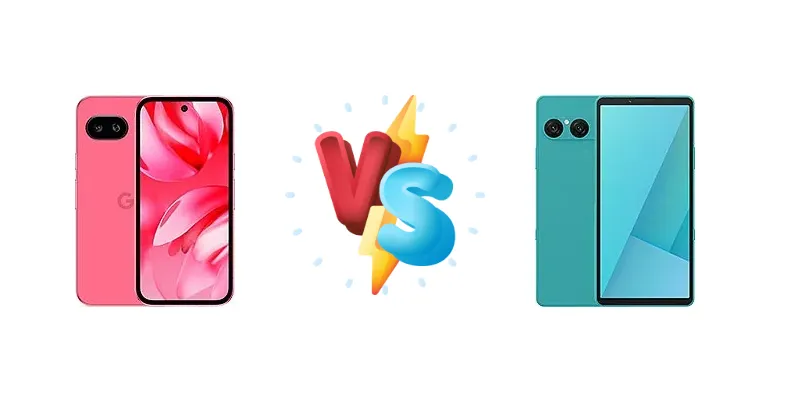
Google Pixel 9a vs. Sony Xperia 10 VII: A Deep Dive Comparison
| Phones Images | |||||
|---|---|---|---|---|---|
|
🏆 Quick Verdict
For the average user prioritizing smart features and a streamlined experience, the Google Pixel 9a emerges as the winner. Its Tensor G4 chip offers a more responsive experience, and Google’s software enhancements provide unique value. However, the Sony Xperia 10 VII is a compelling choice for those who value battery life above all else.
| PHONES | ||
|---|---|---|
| Phone Names | Google Pixel 9a | Sony Xperia 10 VII |
| Network | ||
|---|---|---|
| 2G bands | GSM 850 / 900 / 1800 / 1900 | GSM 850 / 900 / 1800 / 1900 |
| 3G bands | HSDPA 800 / 850 / 900 / 1700(AWS) / 1900 / 2100 | HSDPA 850 / 900 / 1700(AWS) / 2100 |
| 4G bands | 1, 2, 3, 4, 5, 7, 8, 12, 14, 17, 18, 19, 20, 21, 26, 28, 32, 38, 39, 40, 41, 42, 66, 75 - International | 1, 3, 4, 5, 7, 8, 20, 28, 38, 39, 40, 41 |
| 5G bands | 1, 2, 3, 5, 7, 8, 12, 20, 26, 28, 38, 40, 41, 66, 75, 77, 78, 79 SA/NSA/Sub6 - International | 1, 3, 5, 7, 8, 20, 28, 38, 40, 41, 77, 78, 79 SA/NSA/Sub6 |
| Speed | HSPA, LTE, 5G | HSPA, LTE, 5G |
| Technology | GSM / HSPA / LTE / 5G | GSM / HSPA / LTE / 5G |
| Launch | ||
|---|---|---|
| Announced | 2025, March 19 | 2025, September 12 |
| Status | Available. Released 2025, April 10 | Available. Released 2025, September 19 |
| Body | ||
|---|---|---|
| Build | Glass front (Gorilla Glass 3), aluminum frame, plastic back | Glass front (Gorilla Glass Victus 2), plastic frame, plastic back |
| Dimensions | 154.7 x 73.3 x 8.9 mm (6.09 x 2.89 x 0.35 in) | 153 x 72 x 8.3 mm (6.02 x 2.83 x 0.33 in) |
| SIM | Nano-SIM + eSIM | · Nano-SIM + eSIM· Nano-SIM + Nano-SIM |
| Weight | 186 g (6.56 oz) | 168 g (5.93 oz) |
| Display | ||
|---|---|---|
| Protection | Corning Gorilla Glass 3, Mohs level 4 | Corning Gorilla Glass Victus 2, Mohs level 5 |
| Resolution | 1080 x 2424 pixels, 20:9 ratio (~422 ppi density) | 1080 x 2340 pixels, 19.5:9 ratio (~422 ppi density) |
| Size | 6.3 inches, 94.7 cm2 (~83.5% screen-to-body ratio) | 6.1 inches, 91.3 cm2 (~82.9% screen-to-body ratio) |
| Type | P-OLED, HDR, 120Hz, 1800 nits (HBM), 2700 nits (peak) | OLED, 1B colors, 120Hz, HDR |
| Platform | ||
|---|---|---|
| CPU | Octa-core (1x3.1 GHz Cortex-X4 & 3x2.6 GHz Cortex-A720 & 4x1.9 GHz Cortex-A520) | Octa-core (4x2.4 GHz Cortex-A78 & 4x1.8 GHz Cortex-A55) |
| Chipset | Google Tensor G4 (4 nm) | Qualcomm SM6475-AB Snapdragon 6 Gen 3 (4 nm) |
| GPU | Mali-G715 MP7 | Adreno 710 |
| OS | Android 15, upgradable to Android 16, up to 7 major Android upgrades | Android 15, upgradable to Android 16, up to 4 major Android upgrades |
| Memory | ||
|---|---|---|
| Card slot | No | microSDXC (uses shared SIM slot) |
| Internal | 128GB 8GB RAM, 256GB 8GB RAM | 128GB 8GB RAM |
| Main Camera | ||
|---|---|---|
| Dual | 48 MP, f/1.7, 25mm (wide), 1/2.0", 0.8µm, dual pixel PDAF, OIS 13 MP, f/2.2, 120˚ (ultrawide), 1/3.1", 1.12µm | 50 MP, f/1.9, 24mm (wide), 1/1.56", PDAF, OIS 13 MP, f/2.4, 16mm, 123˚ (ultrawide), 1/3.0" |
| Features | Dual-LED flash, Pixel Shift, Ultra HDR, panorama, Best Take | LED flash, HDR, panorama |
| Video | 4K@30/60fps, 1080p@30/60/120/240fps, gyro-EIS, OIS | 4K@30fps, 1080p@30/60/120fps, gyro-EIS, OIS |
| Selfie camera | ||
|---|---|---|
| Features | HDR, panorama | HDR |
| Single | 13 MP, f/2.2, 20mm (ultrawide), 1/3.1", 1.12µm | 8 MP, f/2.0, 26mm (wide), 1/4.0", 1.12µm |
| Video | 4K@30fps, 1080p@30fps | 1080p@30fps |
| Sound | ||
|---|---|---|
| 35mm jack | No | Yes |
| Loudspeaker | Yes, with stereo speakers | Yes, with stereo speakers |
| Comms | ||
|---|---|---|
| Bluetooth | 5.3, A2DP, LE | 5.4, A2DP, LE |
| NFC | Yes | Yes |
| Positioning | GPS (L1+L5), GLONASS, GALILEO, BDS, QZSS, NavIC | GPS, GLONASS, GALILEO, BDS, QZSS |
| Radio | No | No |
| USB | USB Type-C 3.2 | USB Type-C 2.0, OTG |
| WLAN | Wi-Fi 802.11 a/b/g/n/ac/6e, dual/tri-band (market/region dependent) | Wi-Fi 802.11 a/b/g/n/ac/6e, tri-band |
| Features | ||
|---|---|---|
| Sensors | Fingerprint (under display, optical), accelerometer, gyro, proximity, compass, barometer | Fingerprint (side-mounted), accelerometer, gyro, proximity, compass |
| Battery | ||
|---|---|---|
| Charging | 23W wired, PD3.0 7.5W wireless Bypass charging | Wired, PD, QC |
| Type | Li-Po 5100 mAh | 5000 mAh |
| Misc | ||
|---|---|---|
| Colors | Obsidian, Porcelain, Iris, Peony | White, Turquoise, Charcoal |
| Models | GXQ96, GTF7P, G3Y12 | XQ-FE54, XQZ-CBFE, xqfe54eukcl.gc, xqfe54eukcw.gc, xqfe54eukcb.gc |
| Price | $ 348.12 / C$ 479.99 / £ 345.00 / € 381.99 / ₹ 41,990 | $ 459.99 / £ 329.00 / € 379.00 |
| SAR EU | 0.99 W/kg (head) 1.39 W/kg (body) | - |
| EU LABEL | ||
|---|---|---|
| Battery | 52:19h endurance, 1000 cycles | 48:10h endurance, 1400 cycles |
| Energy | Class B | Class B |
| Free fall | Class A (270 falls) | Class C (90 falls) |
| Repairability | Class B | Class D |
Google Pixel 9a
- More powerful processor for demanding tasks
- Superior AI and software features
- Faster wired and wireless charging
- Lower battery cycle count
- Potentially less battery endurance in real-world use
- May experience more thermal throttling under sustained load
Sony Xperia 10 VII
- Exceptional battery life and longevity (1400 cycles)
- Brighter display for outdoor visibility
- Efficient processor for sustained performance
- Less powerful processor for demanding tasks
- Slower charging speeds
- Less advanced camera software
Display Comparison
The Sony Xperia 10 VII boasts a significantly brighter display, reaching a measured 1064 nits, making it far more usable in direct sunlight than the Pixel 9a (brightness data unavailable, but typically lower for Pixel 'a' series). While the Pixel 9a’s panel quality is likely good, Sony’s brightness advantage is substantial. Both devices likely utilize OLED panels, but the Xperia 10 VII’s higher peak brightness is a clear advantage for outdoor visibility. Bezels are expected to be comparable, typical of this price segment, but the Xperia’s focus on media consumption benefits from the brighter screen.
Camera Comparison
Without detailed camera specs, it’s difficult to make a definitive judgment. However, Google’s Pixel phones are renowned for their computational photography prowess, leveraging AI to enhance image quality. The Tensor G4’s image signal processor (ISP) likely provides superior noise reduction and dynamic range compared to the Snapdragon 6 Gen 3. While the Xperia 10 VII may offer a more versatile camera system with potentially more lenses, the Pixel 9a is expected to deliver consistently excellent photos, particularly in challenging lighting conditions. We anticipate the Pixel 9a to excel in portrait mode and low-light photography due to Google’s software optimizations.
Performance
The Google Pixel 9a’s Tensor G4 (4nm) chip is architecturally more advanced than the Xperia 10 VII’s Snapdragon 6 Gen 3 (4nm). The Tensor G4’s Cortex-X4 prime core (3.1 GHz) offers a performance boost over the Xperia’s Cortex-A78 cores (2.4 GHz), translating to snappier app launches and smoother multitasking. However, the Snapdragon 6 Gen 3 is known for its efficiency. While the Tensor G4 excels in AI tasks, the Snapdragon 6 Gen 3 provides a balanced performance profile. The Pixel 9a’s CPU configuration (1x3.1GHz, 3x2.6GHz, 4x1.9GHz) suggests a focus on peak performance, while the Xperia 10 VII’s (4x2.4GHz, 4x1.8GHz) prioritizes sustained performance and power efficiency.
Battery Life
The Sony Xperia 10 VII takes a clear lead in battery endurance, offering 48:10h of endurance and 1400 charge cycles compared to the Pixel 9a’s 52:19h endurance and 1000 cycles. While the Pixel 9a has a slightly longer active use score (12:42h vs 12:57h), the Xperia 10 VII’s significantly higher cycle count suggests greater long-term battery health. The Pixel 9a supports faster wired charging (23W with PD3.0) and wireless charging (7.5W), while the Xperia 10 VII offers wired charging with PD and QC. The Xperia’s superior cycle count indicates a more robust battery management system and potentially a more durable battery cell.
Buying Guide
Buy the Google Pixel 9a if you need a phone with intelligent features, excellent software support, and a generally smoother user experience. It’s ideal for users heavily invested in the Google ecosystem and those who appreciate computational photography. Buy the Sony Xperia 10 VII if you prioritize exceptional battery life, a bright and easily viewable display, and a more traditional Android experience without heavy customization. It’s perfect for travelers, commuters, or anyone who frequently finds themselves away from a charger.