
Google Pixel 9a vs Samsung Galaxy S24 FE: Which Mid-Range Champion Reigns Supreme?
| Phones Images | |||||
|---|---|---|---|---|---|
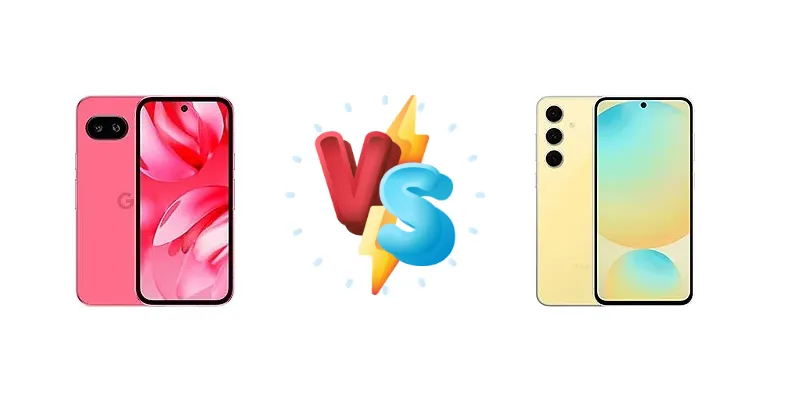
|
🏆 Quick Verdict
For the average user prioritizing long-term battery health and a streamlined software experience, the Google Pixel 9a emerges as the winner. Its superior battery endurance (52:19h) and 1000 charge cycles offer peace of mind, despite the S24 FE’s faster charging and brighter screen.
| PHONES | ||
|---|---|---|
| Phone Names | Google Pixel 9a | Samsung Galaxy S24 FE |
| Network | ||
|---|---|---|
| 2G bands | GSM 850 / 900 / 1800 / 1900 | GSM 850 / 900 / 1800 / 1900 |
| 3G bands | HSDPA 800 / 850 / 900 / 1700(AWS) / 1900 / 2100 | HSDPA 850 / 900 / 1700(AWS) / 1900 / 2100 |
| 4G bands | 1, 2, 3, 4, 5, 7, 8, 12, 14, 17, 18, 19, 20, 21, 26, 28, 32, 38, 39, 40, 41, 42, 66, 75 - International | 1, 2, 3, 4, 5, 7, 8, 12, 17, 18, 19, 20, 25, 26, 28, 32, 38, 40, 41, 66 - International |
| 5G bands | 1, 2, 3, 5, 7, 8, 12, 20, 26, 28, 38, 40, 41, 66, 75, 77, 78, 79 SA/NSA/Sub6 - International | 1, 2, 3, 5, 7, 8, 12, 20, 25, 26, 28, 38, 40, 41, 66, 75, 77, 78 SA/NSA/Sub6 - International |
| Speed | HSPA, LTE, 5G | HSPA, LTE, 5G |
| Technology | GSM / HSPA / LTE / 5G | GSM / HSPA / LTE / 5G |
| Launch | ||
|---|---|---|
| Announced | 2025, March 19 | 2024, September 26 |
| Status | Available. Released 2025, April 10 | Available. Released 2024, October 03 |
| Body | ||
|---|---|---|
| Build | Glass front (Gorilla Glass 3), aluminum frame, plastic back | Glass front (Gorilla Glass Victus+), glass back (Gorilla Glass Victus+), aluminum frame |
| Dimensions | 154.7 x 73.3 x 8.9 mm (6.09 x 2.89 x 0.35 in) | 162 x 77.3 x 8 mm (6.38 x 3.04 x 0.31 in) |
| SIM | Nano-SIM + eSIM | · Nano-SIM· Nano-SIM + Nano-SIM· Nano-SIM + eSIM· eSIM + eSIM |
| Weight | 186 g (6.56 oz) | 213 g (7.51 oz) |
| Display | ||
|---|---|---|
| Protection | Corning Gorilla Glass 3, Mohs level 4 | Corning Gorilla Glass Victus+, Mohs level 5 |
| Resolution | 1080 x 2424 pixels, 20:9 ratio (~422 ppi density) | 1080 x 2340 pixels, 19.5:9 ratio (~385 ppi density) |
| Size | 6.3 inches, 94.7 cm2 (~83.5% screen-to-body ratio) | 6.7 inches, 110.2 cm2 (~88.0% screen-to-body ratio) |
| Type | P-OLED, HDR, 120Hz, 1800 nits (HBM), 2700 nits (peak) | Dynamic AMOLED 2X, 120Hz, HDR10+, 1900 nits (peak) |
| Platform | ||
|---|---|---|
| CPU | Octa-core (1x3.1 GHz Cortex-X4 & 3x2.6 GHz Cortex-A720 & 4x1.9 GHz Cortex-A520) | 10-core (1x3.1 GHz + 2x2.9 GHz + 3x2.6 GHz + 4x1.95 GHz) |
| Chipset | Google Tensor G4 (4 nm) | Exynos 2400e (4 nm) |
| GPU | Mali-G715 MP7 | Xclipse 940 |
| OS | Android 15, upgradable to Android 16, up to 7 major Android upgrades | Android 14, up to 7 major Android upgrades, One UI 8.0 |
| Memory | ||
|---|---|---|
| Card slot | No | No |
| Internal | 128GB 8GB RAM, 256GB 8GB RAM | 128GB 8GB RAM, 256GB 8GB RAM, 512GB 8GB RAM |
| Main Camera | ||
|---|---|---|
| Dual | 48 MP, f/1.7, 25mm (wide), 1/2.0", 0.8µm, dual pixel PDAF, OIS 13 MP, f/2.2, 120˚ (ultrawide), 1/3.1", 1.12µm | - |
| Features | Dual-LED flash, Pixel Shift, Ultra HDR, panorama, Best Take | LED flash, HDR, panorama |
| Triple | - | 50 MP, f/1.8, 24mm (wide), 1/1.57", 1.0µm, dual pixel PDAF, OIS 8 MP, f/2.4, 75mm (telephoto), 1/4.4", 1.0µm, PDAF, OIS, 3x optical zoom 12 MP, f/2.2, 13mm, 123˚ (ultrawide), 1/3.0", 1.12µm |
| Video | 4K@30/60fps, 1080p@30/60/120/240fps, gyro-EIS, OIS | 8K@30fps, 4K@30/60/120fps, 1080p@30/60/120/240fps |
| Selfie camera | ||
|---|---|---|
| Features | HDR, panorama | - |
| Single | 13 MP, f/2.2, 20mm (ultrawide), 1/3.1", 1.12µm | 10 MP, f/2.4, 26mm (wide), 1/3.0", 1.22µm |
| Video | 4K@30fps, 1080p@30fps | 4K@30/60fps, 1080p@30/60fps; gyro-EIS |
| Sound | ||
|---|---|---|
| 35mm jack | No | No |
| Loudspeaker | Yes, with stereo speakers | Yes, with stereo speakers |
| Comms | ||
|---|---|---|
| Bluetooth | 5.3, A2DP, LE | 5.3, A2DP, LE |
| NFC | Yes | Yes |
| Positioning | GPS (L1+L5), GLONASS, GALILEO, BDS, QZSS, NavIC | GPS, GLONASS, GALILEO, BDS |
| Radio | No | Unspecified |
| USB | USB Type-C 3.2 | USB Type-C 3.2, OTG |
| WLAN | Wi-Fi 802.11 a/b/g/n/ac/6e, dual/tri-band (market/region dependent) | Wi-Fi 802.11 a/b/g/n/ac/6e, dual-band or tri-band (market/region dependent), Wi-Fi Direct |
| Features | ||
|---|---|---|
| Sensors | Fingerprint (under display, optical), accelerometer, gyro, proximity, compass, barometer | Fingerprint (under display, optical), accelerometer, gyro, compass |
| Battery | ||
|---|---|---|
| Charging | 23W wired, PD3.0 7.5W wireless Bypass charging | 25W wired, PD, QC2, 50% in 30 min 15W wireless Reverse wireless |
| Type | Li-Po 5100 mAh | 4700 mAh |
| Misc | ||
|---|---|---|
| Colors | Obsidian, Porcelain, Iris, Peony | Blue, Graphite, Gray, Mint, Yellow |
| Models | GXQ96, GTF7P, G3Y12 | SM-S721B, SM-S721B/DS, SM-S721U1, SM-S721U, SM-S721W, SM-S7210, SM-S721N |
| Price | $ 348.12 / C$ 479.99 / £ 345.00 / € 381.99 / ₹ 41,990 | $ 249.74 / C$ 498.99 / £ 335.00 / € 387.00 / ₹ 34,180 |
| SAR | - | 0.94 W/kg (head) 0.71 W/kg (body) |
| SAR EU | 0.99 W/kg (head) 1.39 W/kg (body) | 0.86 W/kg (head) 1.29 W/kg (body) |
| EU LABEL | ||
|---|---|---|
| Battery | 52:19h endurance, 1000 cycles | 42:00h endurance, 2000 cycles |
| Energy | Class B | Class B |
| Free fall | Class A (270 falls) | Class A (270 falls) |
| Repairability | Class B | Class C |
Google Pixel 9a
- Exceptional battery life (52:19h endurance)
- 1000 charge cycles for long-term battery health
- Bypass charging minimizes battery degradation
- Display specs unknown, potentially less bright than S24 FE
- Camera details limited, making a direct comparison difficult
Samsung Galaxy S24 FE
- Bright 1372 nit display for excellent outdoor visibility
- Faster 25W wired charging (50% in 30 min)
- Reverse wireless charging for accessories
- Shorter battery life (42:00h endurance)
- 2000 charge cycles are good, but less than Pixel 9a's 1000
Display Comparison
The Samsung Galaxy S24 FE boasts a significantly brighter display, reaching a measured 1372 nits, making it ideal for outdoor visibility. While the Pixel 9a’s display specs are not provided, Samsung’s panel technology typically prioritizes color vibrancy and peak brightness. The S24 FE’s brightness advantage is particularly noticeable for users who frequently consume HDR content or use their phones in direct sunlight. However, without knowing the Pixel 9a’s panel type or refresh rate, a complete assessment is difficult, but the S24 FE clearly leads in raw luminance.
Camera Comparison
Without detailed camera specifications for the Pixel 9a, it’s challenging to make a definitive comparison. However, Google’s computational photography prowess is well-established. The S24 FE’s camera system is likely to focus on versatility, potentially offering a wider range of shooting modes and zoom capabilities. Pixel phones traditionally excel in low-light photography and portrait mode, leveraging Google’s image processing algorithms. The absence of information regarding sensor sizes and apertures on the Pixel 9a makes a direct comparison impossible, but the Pixel’s software optimization is a significant advantage.
Performance
Both phones utilize a 4nm process, but their chipsets differ significantly. The Google Pixel 9a features the Google Tensor G4, an octa-core processor with a Cortex-X4 prime core clocked at 3.1 GHz, designed for AI and machine learning tasks. The Samsung Galaxy S24 FE employs the Exynos 2400e, a 10-core processor with a more complex core configuration. While the Exynos has more cores, the Tensor G4’s specialized cores may offer advantages in specific Google applications. The Exynos 2400e’s performance will likely be stronger in sustained multi-threaded workloads, but the Tensor G4’s efficiency could translate to better thermal management and battery life. The S24 FE’s core count suggests a potential edge in demanding gaming scenarios, but real-world performance will depend on software optimization.
Battery Life
The Google Pixel 9a demonstrates superior battery endurance with a measured 52:19 hours, significantly outperforming the Samsung Galaxy S24 FE’s 42:00 hours. This difference is substantial, suggesting the Tensor G4’s efficiency plays a key role. While the S24 FE offers faster charging at 25W (50% in 30 minutes) and includes reverse wireless charging, the Pixel 9a’s longer battery life and 1000 charge cycles provide greater long-term value. The Pixel 9a also supports bypass charging, which minimizes battery degradation during charging, further extending its lifespan. The S24 FE’s 15W wireless charging is slower than the Pixel 9a’s 7.5W, but the faster wired charging mitigates this somewhat.
Buying Guide
Buy the Google Pixel 9a if you need exceptional battery life, a clean Android experience with guaranteed updates, and prioritize software features like call screening and Magic Eraser. Buy the Samsung Galaxy S24 FE if you prefer a brighter, more vibrant display for media consumption, faster charging speeds, and the broader ecosystem of Samsung features like DeX and reverse wireless charging.