
Google Pixel 9a vs Samsung Galaxy A55: A Deep Dive into Mid-Range Excellence
| Phones Images | |||||
|---|---|---|---|---|---|
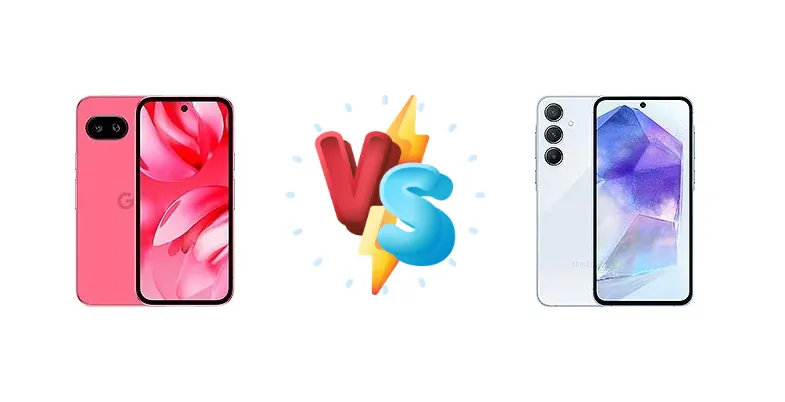
|
🏆 Quick Verdict
For the average user prioritizing software experience and computational photography, the Google Pixel 9a emerges as the winner. Its Tensor G4 chip, coupled with Google’s AI features, delivers a smoother, more intelligent experience. However, the Samsung Galaxy A55’s brighter display and slightly longer active use battery life make it a compelling alternative for media consumers.
| PHONES | ||
|---|---|---|
| Phone Names | Google Pixel 9a | Samsung Galaxy A55 |
| Network | ||
|---|---|---|
| 2G bands | GSM 850 / 900 / 1800 / 1900 | GSM 850 / 900 / 1800 / 1900 |
| 3G bands | HSDPA 800 / 850 / 900 / 1700(AWS) / 1900 / 2100 | HSDPA 850 / 900 / 1700(AWS) / 1900 / 2100 |
| 4G bands | 1, 2, 3, 4, 5, 7, 8, 12, 14, 17, 18, 19, 20, 21, 26, 28, 32, 38, 39, 40, 41, 42, 66, 75 - International | 1, 2, 3, 4, 5, 7, 8, 12, 17, 20, 25, 26, 28, 32, 38, 40, 41, 66 |
| 5G bands | 1, 2, 3, 5, 7, 8, 12, 20, 26, 28, 38, 40, 41, 66, 75, 77, 78, 79 SA/NSA/Sub6 - International | 1, 3, 5, 7, 8, 20, 28, 38, 40, 41, 66, 77, 78 SA/NSA/Sub6 |
| Speed | HSPA, LTE, 5G | HSPA, LTE, 5G |
| Technology | GSM / HSPA / LTE / 5G | GSM / HSPA / LTE / 5G |
| Launch | ||
|---|---|---|
| Announced | 2025, March 19 | 2024, March 11 |
| Status | Available. Released 2025, April 10 | Available. Released 2024, March 15 |
| Body | ||
|---|---|---|
| Build | Glass front (Gorilla Glass 3), aluminum frame, plastic back | Glass front (Gorilla Glass Victus+), glass back (Gorilla Glass), aluminum frame |
| Dimensions | 154.7 x 73.3 x 8.9 mm (6.09 x 2.89 x 0.35 in) | 161.1 x 77.4 x 8.2 mm (6.34 x 3.05 x 0.32 in) |
| SIM | Nano-SIM + eSIM | · Nano-SIM· Nano-SIM + eSIM· Nano-SIM + Nano-SIM· Nano-SIM + Nano-SIM + eSIM (max 2 at a time) |
| Weight | 186 g (6.56 oz) | 213 g (7.51 oz) |
| Display | ||
|---|---|---|
| Protection | Corning Gorilla Glass 3, Mohs level 4 | Corning Gorilla Glass Victus+ |
| Resolution | 1080 x 2424 pixels, 20:9 ratio (~422 ppi density) | 1080 x 2340 pixels, 19.5:9 ratio (~390 ppi density) |
| Size | 6.3 inches, 94.7 cm2 (~83.5% screen-to-body ratio) | 6.6 inches, 106.9 cm2 (~85.8% screen-to-body ratio) |
| Type | P-OLED, HDR, 120Hz, 1800 nits (HBM), 2700 nits (peak) | Super AMOLED, 120Hz, HDR10+, 1000 nits (HBM) |
| Platform | ||
|---|---|---|
| CPU | Octa-core (1x3.1 GHz Cortex-X4 & 3x2.6 GHz Cortex-A720 & 4x1.9 GHz Cortex-A520) | Octa-core (4x2.75 GHz Cortex-A78 & 4x2.0 GHz Cortex-A55) |
| Chipset | Google Tensor G4 (4 nm) | Exynos 1480 (4 nm) |
| GPU | Mali-G715 MP7 | Xclipse 530 |
| OS | Android 15, upgradable to Android 16, up to 7 major Android upgrades | Android 14, up to 4 major Android upgrades, One UI 6.1 |
| Memory | ||
|---|---|---|
| Card slot | No | microSDXC (uses shared SIM slot) |
| Internal | 128GB 8GB RAM, 256GB 8GB RAM | 128GB 6GB RAM, 128GB 8GB RAM, 256GB 6GB RAM, 256GB 8GB RAM, 256GB 12GB RAM |
| Main Camera | ||
|---|---|---|
| Dual | 48 MP, f/1.7, 25mm (wide), 1/2.0", 0.8µm, dual pixel PDAF, OIS 13 MP, f/2.2, 120˚ (ultrawide), 1/3.1", 1.12µm | - |
| Features | Dual-LED flash, Pixel Shift, Ultra HDR, panorama, Best Take | LED flash, panorama, HDR |
| Triple | - | 50 MP, f/1.8, (wide), 1/1.56", 1.0µm, PDAF, OIS 12 MP, f/2.2, 123˚ (ultrawide), 1/3.06", 1.12µm 5 MP (macro) |
| Video | 4K@30/60fps, 1080p@30/60/120/240fps, gyro-EIS, OIS | 4K@30fps, 1080p@30/60fps, gyro-EIS |
| Selfie camera | ||
|---|---|---|
| Features | HDR, panorama | - |
| Single | 13 MP, f/2.2, 20mm (ultrawide), 1/3.1", 1.12µm | 32 MP, f/2.2, 26mm (wide), 1/2.74", 0.8µm |
| Video | 4K@30fps, 1080p@30fps | 4K@30fps, 1080p@30/60fps |
| Sound | ||
|---|---|---|
| 35mm jack | No | No |
| Loudspeaker | Yes, with stereo speakers | Yes, with stereo speakers |
| Comms | ||
|---|---|---|
| Bluetooth | 5.3, A2DP, LE | 5.3, A2DP, LE |
| NFC | Yes | Yes (market/region dependent) |
| Positioning | GPS (L1+L5), GLONASS, GALILEO, BDS, QZSS, NavIC | GPS, GALILEO, GLONASS, BDS, QZSS |
| Radio | No | No |
| USB | USB Type-C 3.2 | USB Type-C 2.0, OTG |
| WLAN | Wi-Fi 802.11 a/b/g/n/ac/6e, dual/tri-band (market/region dependent) | Wi-Fi 802.11 a/b/g/n/ac/6, dual-band, Wi-Fi Direct |
| Features | ||
|---|---|---|
| Sensors | Fingerprint (under display, optical), accelerometer, gyro, proximity, compass, barometer | Fingerprint (under display, optical), accelerometer, gyro, compass |
| Battery | ||
|---|---|---|
| Charging | 23W wired, PD3.0 7.5W wireless Bypass charging | 25W wired |
| Type | Li-Po 5100 mAh | Li-Ion 5000 mAh |
| Misc | ||
|---|---|---|
| Colors | Obsidian, Porcelain, Iris, Peony | Iceblue, Lilac, Navy, Lemon |
| Models | GXQ96, GTF7P, G3Y12 | SM-A556V, SM-A556B, SM-A556B/DS, SM-A556E, SM-A556E/DS, SM-A5560 |
| Price | $ 348.12 / C$ 479.99 / £ 345.00 / € 381.99 / ₹ 41,990 | $ 324.99 / £ 251.50 / € 319.99 / ₹ 23,998 |
| SAR EU | 0.99 W/kg (head) 1.39 W/kg (body) | 0.68 W/kg (head) 1.04 W/kg (body) |
| EU LABEL | ||
|---|---|---|
| Battery | 52:19h endurance, 1000 cycles | - |
| Energy | Class B | - |
| Free fall | Class A (270 falls) | - |
| Repairability | Class B | - |
Google Pixel 9a
- Superior AI-powered camera experience
- Clean and bloatware-free Android software
- Long-term battery health with 1000 charge cycles
- Likely lower peak display brightness
- Potentially less raw processing power for demanding games
Samsung Galaxy A55
- Brighter and more vibrant display
- Slightly longer active use battery life
- Samsung’s One UI offers extensive customization
- Software experience can be cluttered with pre-installed apps
- Battery lifespan may be shorter than the Pixel 9a
Display Comparison
The Samsung Galaxy A55 immediately stands out with its 1010 nits of peak brightness, offering significantly better visibility outdoors compared to the Pixel 9a (brightness data unavailable, but expected to be lower based on Pixel A-series history). While the Pixel 9a’s display quality is likely to be good, Samsung’s Super AMOLED panel provides richer colors and deeper blacks. Neither device is confirmed to use LTPO technology, suggesting both will likely employ a standard refresh rate, impacting power consumption during dynamic content. Bezels are expected to be comparable, with both aiming for a modern, immersive viewing experience.
Camera Comparison
The Pixel 9a is expected to excel in computational photography, leveraging the Tensor G4’s processing power to deliver stunning images, even in challenging lighting conditions. While specific sensor details are unavailable, Google’s history suggests a focus on software algorithms to enhance image quality. The Galaxy A55’s camera system is likely to prioritize versatility, but may not match the Pixel’s low-light performance. Ignoring the typical 2MP macro lens found on both devices, the quality will hinge on the main sensor and image processing. The Pixel’s strength lies in its ability to extract detail and dynamic range through software, while Samsung often aims for more vibrant, saturated colors.
Performance
The core of the performance difference lies in the chipsets. The Google Pixel 9a utilizes the 4nm Google Tensor G4, featuring a Cortex-X4 prime core clocked at 3.1 GHz, designed for demanding tasks. The Samsung Galaxy A55 employs the 4nm Exynos 1480, with a Cortex-A78 configuration peaking at 2.75 GHz. While clock speed isn’t everything, the Tensor G4’s architecture suggests a stronger focus on AI and machine learning tasks, potentially leading to faster image processing and smarter assistant features. The A55’s Exynos 1480 is a capable performer, but may show more strain under sustained heavy loads. Both devices are expected to ship with ample RAM, but the Pixel’s software optimization could provide a smoother overall experience.
Battery Life
The Samsung Galaxy A55 boasts a 13:27h active use score, slightly exceeding the Pixel 9a’s 12:42h. However, the Pixel 9a compensates with a claimed 52:19h endurance and 1000 charge cycles, suggesting a longer overall battery lifespan. The A55 supports 25W wired charging, while the Pixel 9a offers 23W with PD3.0, 7.5W wireless charging, and bypass charging. Bypass charging allows the phone to power directly from the charger, reducing heat buildup during gaming or intensive tasks. While the charging speeds are similar, the Pixel 9a’s additional wireless charging and bypass charging features offer added convenience.
Buying Guide
Buy the Google Pixel 9a if you need a phone with exceptional software support, a superior camera experience driven by AI, and prioritize a clean, bloatware-free Android experience. Buy the Samsung Galaxy A55 if you prefer a brighter, more vivid display for media consumption, value a slightly longer active use battery life, and appreciate Samsung’s One UI customization options.