
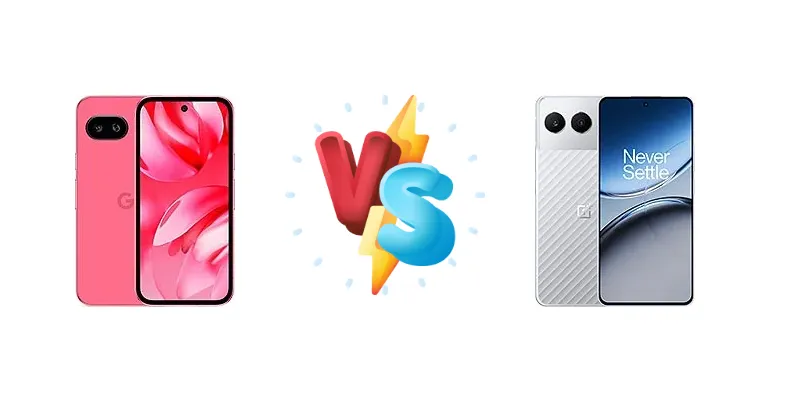
Google Pixel 9a vs. OnePlus Nord 4: Which Mid-Range Champion Reigns Supreme?
| Phones Images | |||||
|---|---|---|---|---|---|
|
🏆 Quick Verdict
For the average user prioritizing rapid charging and a brighter display, the OnePlus Nord 4 is the stronger choice. Its 100W charging and 1163 nits peak brightness are significant advantages. However, the Pixel 9a’s Google Tensor G4 offers a unique software experience and AI capabilities that may appeal to Pixel enthusiasts.
| PHONES | ||
|---|---|---|
| Phone Names | Google Pixel 9a | OnePlus Nord 4 |
| Network | ||
|---|---|---|
| 2G bands | GSM 850 / 900 / 1800 / 1900 | GSM 850 / 900 / 1800 / 1900 |
| 3G bands | HSDPA 800 / 850 / 900 / 1700(AWS) / 1900 / 2100 | HSDPA 800 / 850 / 900 / 1700(AWS) / 1800 / 1900 / 2100 - International |
| 4G bands | 1, 2, 3, 4, 5, 7, 8, 12, 14, 17, 18, 19, 20, 21, 26, 28, 32, 38, 39, 40, 41, 42, 66, 75 - International | 1, 2, 3, 4, 5, 7, 8, 12, 17, 18, 19, 20, 26, 28, 38, 39, 40, 41, 66 - International |
| 5G bands | 1, 2, 3, 5, 7, 8, 12, 20, 26, 28, 38, 40, 41, 66, 75, 77, 78, 79 SA/NSA/Sub6 - International | 1, 2, 3, 5, 7, 8, 12, 20, 28, 38, 40, 41, 66, 77, 78 SA/NSA - International |
| Speed | HSPA, LTE, 5G | HSPA, LTE, 5G |
| Technology | GSM / HSPA / LTE / 5G | GSM / HSPA / LTE / 5G |
| Launch | ||
|---|---|---|
| Announced | 2025, March 19 | 2024, July 16 |
| Status | Available. Released 2025, April 10 | Available. Released 2024, August 08 |
| Body | ||
|---|---|---|
| Build | Glass front (Gorilla Glass 3), aluminum frame, plastic back | Glass front, aluminum back, aluminum frame |
| Dimensions | 154.7 x 73.3 x 8.9 mm (6.09 x 2.89 x 0.35 in) | 162.6 x 75 x 8 mm (6.40 x 2.95 x 0.31 in) |
| SIM | Nano-SIM + eSIM | Nano-SIM + Nano-SIM |
| Weight | 186 g (6.56 oz) | 199.5 g (7.05 oz) |
| Display | ||
|---|---|---|
| Protection | Corning Gorilla Glass 3, Mohs level 4 | - |
| Resolution | 1080 x 2424 pixels, 20:9 ratio (~422 ppi density) | 1240 x 2772 pixels, 20:9 ratio (~450 ppi density) |
| Size | 6.3 inches, 94.7 cm2 (~83.5% screen-to-body ratio) | 6.74 inches, 109.7 cm2 (~90.0% screen-to-body ratio) |
| Type | P-OLED, HDR, 120Hz, 1800 nits (HBM), 2700 nits (peak) | Fluid AMOLED, 1B colors, 120Hz, HDR10+, 2150 nits (peak) |
| Platform | ||
|---|---|---|
| CPU | Octa-core (1x3.1 GHz Cortex-X4 & 3x2.6 GHz Cortex-A720 & 4x1.9 GHz Cortex-A520) | Octa-core (1x2.8 GHz Cortex-X4 & 4x2.6 GHz Cortex-A720 & 3x1.9 GHz Cortex-A520) |
| Chipset | Google Tensor G4 (4 nm) | Qualcomm SM7675 Snapdragon 7+ Gen 3 (4 nm) |
| GPU | Mali-G715 MP7 | Adreno 732 |
| OS | Android 15, upgradable to Android 16, up to 7 major Android upgrades | Android 14, up to 4 major Android upgrades, OxygenOS 15 |
| Memory | ||
|---|---|---|
| Card slot | No | No |
| Internal | 128GB 8GB RAM, 256GB 8GB RAM | 128GB 8GB RAM, 256GB 8GB RAM, 256GB 12GB RAM, 512GB 16GB RAM |
| Main Camera | ||
|---|---|---|
| Dual | 48 MP, f/1.7, 25mm (wide), 1/2.0", 0.8µm, dual pixel PDAF, OIS 13 MP, f/2.2, 120˚ (ultrawide), 1/3.1", 1.12µm | 50 MP, f/1.8, 25mm (wide), 1/1.95", 0.8µm, PDAF, OIS 8 MP, f/2.2, 112˚ (ultrawide), 1/4.0", 1.12µm |
| Features | Dual-LED flash, Pixel Shift, Ultra HDR, panorama, Best Take | Dual-LED flash, HDR, panorama |
| Video | 4K@30/60fps, 1080p@30/60/120/240fps, gyro-EIS, OIS | 4K@30/60fps, 1080p@30/60/120fps, gyro-EIS |
| Selfie camera | ||
|---|---|---|
| Features | HDR, panorama | Panorama |
| Single | 13 MP, f/2.2, 20mm (ultrawide), 1/3.1", 1.12µm | 16 MP, f/2.4, 24mm (wide), 1.0µm |
| Video | 4K@30fps, 1080p@30fps | 1080p@30fps |
| Sound | ||
|---|---|---|
| 35mm jack | No | No |
| Loudspeaker | Yes, with stereo speakers | Yes, with stereo speakers |
| Comms | ||
|---|---|---|
| Bluetooth | 5.3, A2DP, LE | 5.4, A2DP, LE, aptX HD, LHDC |
| Infrared port | - | Yes |
| NFC | Yes | Yes |
| Positioning | GPS (L1+L5), GLONASS, GALILEO, BDS, QZSS, NavIC | GPS, GALILEO, GLONASS, BDS, QZSS |
| Radio | No | No |
| USB | USB Type-C 3.2 | USB Type-C 2.0 |
| WLAN | Wi-Fi 802.11 a/b/g/n/ac/6e, dual/tri-band (market/region dependent) | Wi-Fi 802.11 a/b/g/n/ac/6, dual-band, Wi-Fi Direct |
| Features | ||
|---|---|---|
| Sensors | Fingerprint (under display, optical), accelerometer, gyro, proximity, compass, barometer | Fingerprint (under display, optical), accelerometer, gyro, proximity, compass |
| Battery | ||
|---|---|---|
| Charging | 23W wired, PD3.0 7.5W wireless Bypass charging | 100W wired, PPS, 100% in 28 min |
| Type | Li-Po 5100 mAh | 5500 mAh |
| Misc | ||
|---|---|---|
| Colors | Obsidian, Porcelain, Iris, Peony | Obsidian Midnight, Mercurial Silver, Oasis Green |
| Models | GXQ96, GTF7P, G3Y12 | CPH2663, CPH2661 |
| Price | $ 348.12 / C$ 479.99 / £ 345.00 / € 381.99 / ₹ 41,990 | € 410.27 / £ 423.17 |
| SAR | - | 1.18 W/kg (head) 1.06 W/kg (body) |
| SAR EU | 0.99 W/kg (head) 1.39 W/kg (body) | - |
| EU LABEL | ||
|---|---|---|
| Battery | 52:19h endurance, 1000 cycles | - |
| Energy | Class B | - |
| Free fall | Class A (270 falls) | - |
| Repairability | Class B | - |
Google Pixel 9a
- Google Tensor G4 offers unique AI features.
- Long battery endurance (52:19h).
- Wireless charging and bypass charging support.
- Significantly slower charging speed (23W).
- Display brightness likely lower than Nord 4.
OnePlus Nord 4
- Blazing-fast 100W charging (0-100% in 28 min).
- Brighter display (1163 nits).
- Snapdragon 7+ Gen 3 offers strong gaming performance.
- Lacks wireless charging.
- May not have the same level of software support as Pixel.
Display Comparison
The OnePlus Nord 4 boasts a significantly brighter display, reaching a measured 1163 nits peak brightness, making it far more usable in direct sunlight compared to the Pixel 9a (brightness data unavailable). While both utilize 4nm chipsets, the Nord 4’s brighter panel will be a boon for outdoor users. The Pixel 9a’s display specs are currently unknown, but given its 'a' series positioning, it’s unlikely to match the Nord 4’s peak brightness. Panel technology (LTPO vs standard OLED) and refresh rate are currently unknown for the Pixel 9a, further solidifying the Nord 4’s display advantage.
Camera Comparison
Without detailed camera specifications for the Pixel 9a, it’s difficult to make a definitive comparison. However, Pixel phones are renowned for their computational photography prowess, leveraging Google’s AI algorithms to produce excellent images, even with modest hardware. The Nord 4’s camera specs are currently unknown. The Pixel 9a’s Tensor G4 chip will likely provide faster image processing and more advanced features like Magic Eraser and Photo Unblur. The absence of sensor size and aperture data for both phones makes a detailed analysis impossible, but the Pixel’s software advantage is a significant factor.
Performance
Both phones leverage 4nm chipsets, but with different architectures. The OnePlus Nord 4’s Qualcomm SM7675 Snapdragon 7+ Gen 3 features a 1x2.8 GHz Cortex-X4 prime core, alongside 4x2.6 GHz Cortex-A720 performance cores and 3x1.9 GHz Cortex-A520 efficiency cores. The Pixel 9a utilizes the Google Tensor G4, with a 1x3.1 GHz Cortex-X4, 3x2.6 GHz Cortex-A720, and 4x1.9 GHz Cortex-A520 cores. While the Tensor G4 has a slightly higher clocked prime core, the Snapdragon 7+ Gen 3 is generally known for its superior GPU performance and efficiency. The Nord 4’s chipset is likely to deliver a smoother gaming experience, while the Tensor G4 excels in AI-driven tasks like image processing and voice recognition. Both devices are expected to ship with ample RAM, though the specific LPDDR5x speeds are unknown.
Battery Life
The OnePlus Nord 4 offers a clear advantage in charging speed with its 100W wired charging, capable of a full charge in just 28 minutes using PPS. The Pixel 9a’s 23W wired charging (PD3.0) is considerably slower. While the Pixel 9a boasts a 52:19h endurance rating and a 12:42h active use score, the Nord 4’s 14:41h active use score suggests better real-world battery performance despite potentially having a smaller capacity. The Pixel 9a also supports 7.5W wireless charging and bypass charging, features absent on the Nord 4, offering flexibility for users who prefer wireless power or want to minimize battery heat during charging.
Buying Guide
Buy the Google Pixel 9a if you need a seamless Android experience with Google’s exclusive AI features, prioritize software updates, and value computational photography. Buy the OnePlus Nord 4 if you prefer blazing-fast 100W charging, a brighter display for outdoor visibility, and a more aggressive performance profile for gaming and demanding tasks.