
Google Pixel 9a vs. Nothing Phone (2a) Plus: Which Mid-Range Champion Reigns Supreme?
| Phones Images | |||||
|---|---|---|---|---|---|
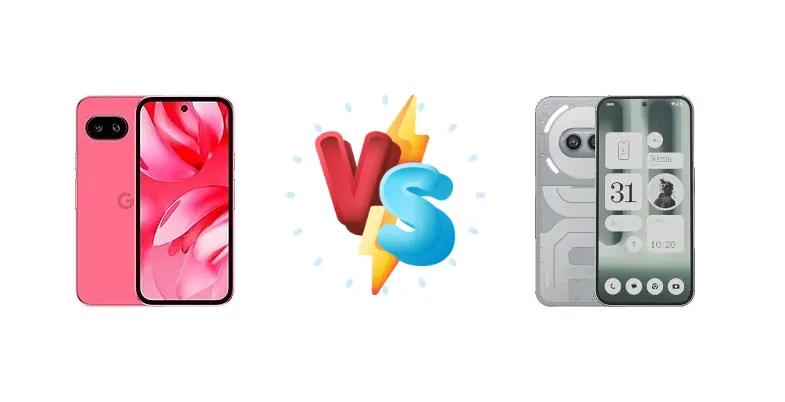
|
🏆 Quick Verdict
For the average user prioritizing software experience and long-term support, the Google Pixel 9a is the better choice. Its Tensor G4 chip and guaranteed updates outweigh the Nothing Phone (2a) Plus’s faster charging and brighter screen. However, users who value rapid replenishment and a visually striking display will find the Nothing Phone (2a) Plus more appealing.
| PHONES | ||
|---|---|---|
| Phone Names | Google Pixel 9a | Nothing Phone (2a) Plus |
| Network | ||
|---|---|---|
| 2G bands | GSM 850 / 900 / 1800 / 1900 | GSM 850 / 900 / 1800 / 1900 |
| 3G bands | HSDPA 800 / 850 / 900 / 1700(AWS) / 1900 / 2100 | HSDPA 800 / 850 / 900 / 1700(AWS) / 1900 / 2100 |
| 4G bands | 1, 2, 3, 4, 5, 7, 8, 12, 14, 17, 18, 19, 20, 21, 26, 28, 32, 38, 39, 40, 41, 42, 66, 75 - International | 1, 3, 4, 5, 7, 8, 18, 19, 20, 26, 28, 38, 39, 40, 41, 42, 66 |
| 5G bands | 1, 2, 3, 5, 7, 8, 12, 20, 26, 28, 38, 40, 41, 66, 75, 77, 78, 79 SA/NSA/Sub6 - International | 1, 3, 5, 7, 8, 20, 28, 38, 40, 41, 66, 77, 78 SA/NSA |
| Speed | HSPA, LTE, 5G | HSPA, LTE, 5G |
| Technology | GSM / HSPA / LTE / 5G | GSM / HSPA / LTE / 5G |
| Launch | ||
|---|---|---|
| Announced | 2025, March 19 | 2024, July 31 |
| Status | Available. Released 2025, April 10 | Available. Released 2024, August 03 |
| Body | ||
|---|---|---|
| Build | Glass front (Gorilla Glass 3), aluminum frame, plastic back | Glass front (Gorilla Glass 5), plastic frame, plastic back |
| Dimensions | 154.7 x 73.3 x 8.9 mm (6.09 x 2.89 x 0.35 in) | 161.7 x 76.3 x 8.5 mm (6.37 x 3.00 x 0.33 in) |
| SIM | Nano-SIM + eSIM | Nano-SIM + Nano-SIM |
| Weight | 186 g (6.56 oz) | 190 g (6.70 oz) |
| Display | ||
|---|---|---|
| Protection | Corning Gorilla Glass 3, Mohs level 4 | Corning Gorilla Glass 5 |
| Resolution | 1080 x 2424 pixels, 20:9 ratio (~422 ppi density) | 1080 x 2412 pixels, 20:9 ratio (~395 ppi density) |
| Size | 6.3 inches, 94.7 cm2 (~83.5% screen-to-body ratio) | 6.7 inches, 107.5 cm2 (~87.1% screen-to-body ratio) |
| Type | P-OLED, HDR, 120Hz, 1800 nits (HBM), 2700 nits (peak) | AMOLED, 1B colors, 120Hz, 2160Hz PWM, HDR10+, 700 nits (typ), 1100 nits (HBM), 1300 nits (peak) |
| Platform | ||
|---|---|---|
| CPU | Octa-core (1x3.1 GHz Cortex-X4 & 3x2.6 GHz Cortex-A720 & 4x1.9 GHz Cortex-A520) | Octa-core (2x3.0 GHz Cortex-A715 & 6x 2.0 GHz Cortex-A510) |
| Chipset | Google Tensor G4 (4 nm) | Mediatek Dimensity 7350 Pro (4 nm) |
| GPU | Mali-G715 MP7 | Mali-G610 MC4 |
| OS | Android 15, upgradable to Android 16, up to 7 major Android upgrades | Android 14, up to 3 major Android upgrades, Nothing OS 3.0 |
| Memory | ||
|---|---|---|
| Card slot | No | No |
| Internal | 128GB 8GB RAM, 256GB 8GB RAM | 256GB 8GB RAM, 256GB 12GB RAM |
| Main Camera | ||
|---|---|---|
| Dual | 48 MP, f/1.7, 25mm (wide), 1/2.0", 0.8µm, dual pixel PDAF, OIS 13 MP, f/2.2, 120˚ (ultrawide), 1/3.1", 1.12µm | 50 MP, f/1.9, 24mm (wide), 1/1.57", 1.0µm, PDAF, OIS 50 MP, f/2.2, 114˚ (ultrawide), 1/2.76", 0.64µm |
| Features | Dual-LED flash, Pixel Shift, Ultra HDR, panorama, Best Take | LED flash, panorama, HDR |
| Video | 4K@30/60fps, 1080p@30/60/120/240fps, gyro-EIS, OIS | 4K@30fps, 1080p@60/120fps, gyro-EIS |
| Selfie camera | ||
|---|---|---|
| Features | HDR, panorama | HDR |
| Single | 13 MP, f/2.2, 20mm (ultrawide), 1/3.1", 1.12µm | 50 MP, f/2.2, (wide), 1/2.76" |
| Video | 4K@30fps, 1080p@30fps | 4K@30fps |
| Sound | ||
|---|---|---|
| 35mm jack | No | No |
| Loudspeaker | Yes, with stereo speakers | Yes, with stereo speakers |
| Comms | ||
|---|---|---|
| Bluetooth | 5.3, A2DP, LE | 5.3, A2DP, LE |
| NFC | Yes | Yes, 360˚ |
| Positioning | GPS (L1+L5), GLONASS, GALILEO, BDS, QZSS, NavIC | GPS, GALILEO, GLONASS, BDS, QZSS |
| Radio | No | No |
| USB | USB Type-C 3.2 | USB Type-C 2.0, OTG |
| WLAN | Wi-Fi 802.11 a/b/g/n/ac/6e, dual/tri-band (market/region dependent) | Wi-Fi 802.11 a/b/g/n/ac/6, dual-band, Wi-Fi Direct |
| Features | ||
|---|---|---|
| Sensors | Fingerprint (under display, optical), accelerometer, gyro, proximity, compass, barometer | Fingerprint (under display, optical), accelerometer, gyro, proximity, compass |
| Battery | ||
|---|---|---|
| Charging | 23W wired, PD3.0 7.5W wireless Bypass charging | 50W wired, 50% in 21 min, 100% in 56 min |
| Type | Li-Po 5100 mAh | 5000 mAh |
| Misc | ||
|---|---|---|
| Colors | Obsidian, Porcelain, Iris, Peony | Black, Grey |
| Models | GXQ96, GTF7P, G3Y12 | A142P |
| Price | $ 348.12 / C$ 479.99 / £ 345.00 / € 381.99 / ₹ 41,990 | € 269.90 / ₹ 22,599 |
| SAR EU | 0.99 W/kg (head) 1.39 W/kg (body) | - |
| EU LABEL | ||
|---|---|---|
| Battery | 52:19h endurance, 1000 cycles | - |
| Energy | Class B | - |
| Free fall | Class A (270 falls) | - |
| Repairability | Class B | - |
Google Pixel 9a
- Exceptional camera processing and image quality
- Guaranteed software updates and long-term support
- Strong AI and machine learning capabilities
- Slower charging speed (23W)
- Lower peak display brightness (estimated)
Nothing Phone (2a) Plus
- Ultra-fast 50W wired charging
- Bright and vibrant display (1097 nits)
- Sleek and minimalist design
- Less refined software experience compared to Pixel
- Potentially shorter software support lifespan
Display Comparison
The Nothing Phone (2a) Plus boasts a significantly brighter display, reaching a measured peak of 1097 nits, making it more usable in direct sunlight compared to the Pixel 9a (brightness data unavailable, but typically lower for Pixel 'a' series). While the Pixel 9a’s panel quality is likely excellent, Nothing’s higher peak brightness provides a tangible advantage for outdoor visibility. Both phones likely utilize OLED panels, but the Nothing Phone (2a) Plus’s brightness is a clear differentiator. The absence of LTPO on either device suggests standard refresh rate management, impacting battery consumption during dynamic content.
Camera Comparison
Without detailed camera specs, analysis focuses on processing. The Pixel 9a leverages Google’s computational photography prowess, renowned for its dynamic range and accurate color reproduction. The Tensor G4’s image signal processor (ISP) is optimized for Google’s algorithms. The Nothing Phone (2a) Plus relies on MediaTek’s ISP and Nothing’s image processing. While the Nothing Phone (2a) Plus may offer a more vibrant, stylized look, the Pixel 9a is expected to deliver more natural and consistently excellent results, particularly in challenging lighting conditions. The absence of telephoto lenses on either device limits optical zoom capabilities.
Performance
The chipset battle pits Google’s Tensor G4 (4nm) against MediaTek’s Dimensity 7350 Pro (4nm). While both are built on a 4nm process for efficiency, their architectures differ. The Tensor G4 features a Cortex-X4 prime core clocked at 3.1 GHz, promising strong single-core performance, alongside A720 and A520 cores. The Dimensity 7350 Pro utilizes Cortex-A715 and A510 cores, prioritizing sustained multi-core performance. The Pixel’s Tensor G4 excels in AI and machine learning tasks, enhancing camera features and voice recognition. The Nothing Phone (2a) Plus’s Dimensity 7350 Pro is likely to offer more consistent gaming performance due to its core configuration, though the Pixel’s Tensor G4 benefits from Google’s software optimizations.
Battery Life
The Nothing Phone (2a) Plus shines in charging speed, achieving 50% charge in 21 minutes and 100% in 56 minutes with its 50W wired charging. The Pixel 9a’s 23W wired charging is considerably slower. However, the Pixel 9a boasts impressive endurance with a 52:19h rating, suggesting efficient power management. The Nothing Phone (2a) Plus has an active use score of 16:34h, while the Pixel 9a achieves 12:42h. The Pixel 9a’s 1000 cycle battery longevity also indicates a longer lifespan. The Nothing Phone (2a) Plus’s faster charging is ideal for users who need quick top-ups, while the Pixel 9a prioritizes overall endurance and long-term battery health.
Buying Guide
Buy the Google Pixel 9a if you need a consistently smooth software experience, exceptional camera processing, and guaranteed long-term software updates. It’s ideal for users deeply embedded in the Google ecosystem. Buy the Nothing Phone (2a) Plus if you prioritize fast charging, a vibrant display for media consumption, and a unique, minimalist aesthetic. It’s a strong contender for users who frequently find themselves needing to quickly top up their battery.