
Google Pixel 9a vs Motorola Edge (2024): A Deep Dive into Performance and Power
| Phones Images | |||||
|---|---|---|---|---|---|
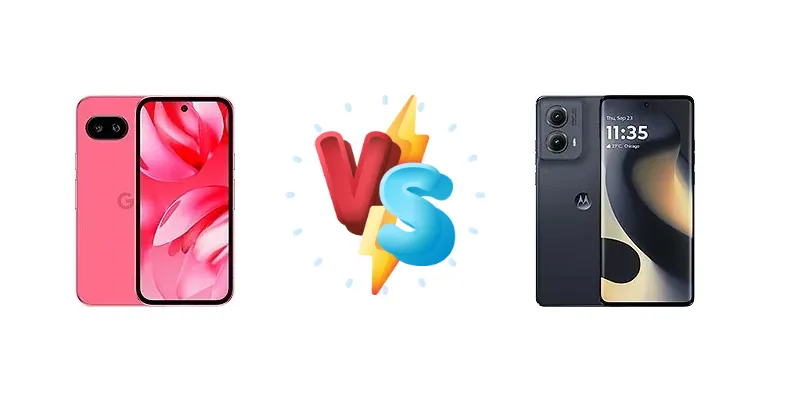
|
🏆 Quick Verdict
For the average user prioritizing long-term software support and consistent performance, the Google Pixel 9a emerges as the stronger choice. Its Tensor G4 chip, coupled with a remarkable 52:19h battery endurance, offers a smoother, more reliable experience. However, users who value blazing-fast charging will find the Motorola Edge (2024)'s 68W capability more appealing.
| PHONES | ||
|---|---|---|
| Phone Names | Google Pixel 9a | Motorola Edge (2024) |
| Network | ||
|---|---|---|
| 2G bands | GSM 850 / 900 / 1800 / 1900 | GSM 850 / 900 / 1800 / 1900 |
| 3G bands | HSDPA 800 / 850 / 900 / 1700(AWS) / 1900 / 2100 | HSDPA 850 / 900 / 1700(AWS) / 1900 / 2100 |
| 4G bands | 1, 2, 3, 4, 5, 7, 8, 12, 14, 17, 18, 19, 20, 21, 26, 28, 32, 38, 39, 40, 41, 42, 66, 75 - International | 1, 2, 3, 4, 5, 7, 8, 12, 13, 14, 17, 18, 19, 20, 25, 26, 29, 30, 38, 39, 40, 41, 48, 66, 71 |
| 5G bands | 1, 2, 3, 5, 7, 8, 12, 20, 26, 28, 38, 40, 41, 66, 75, 77, 78, 79 SA/NSA/Sub6 - International | 1, 2, 3, 5, 7, 12, 14, 20, 25, 26, 29, 30, 38, 40, 41, 48, 66, 70, 71, 77, 78 SA/NSA/Sub6 |
| Speed | HSPA, LTE, 5G | HSPA, LTE, 5G |
| Technology | GSM / HSPA / LTE / 5G | GSM / HSPA / LTE / 5G |
| Launch | ||
|---|---|---|
| Announced | 2025, March 19 | 2024, June 04 |
| Status | Available. Released 2025, April 10 | Available. Released 2024, June 20 |
| Body | ||
|---|---|---|
| Build | Glass front (Gorilla Glass 3), aluminum frame, plastic back | Glass front, aluminum frame, silicone polymer back (eco leather) |
| Dimensions | 154.7 x 73.3 x 8.9 mm (6.09 x 2.89 x 0.35 in) | 159.6 x 72 x 8.1 mm (6.28 x 2.83 x 0.32 in) |
| SIM | Nano-SIM + eSIM | Nano-SIM + eSIM |
| Weight | 186 g (6.56 oz) | 174 g (6.14 oz) |
| Display | ||
|---|---|---|
| Protection | Corning Gorilla Glass 3, Mohs level 4 | Corning Gorilla Glass 3 |
| Resolution | 1080 x 2424 pixels, 20:9 ratio (~422 ppi density) | 1080 x 2400 pixels, 20:9 ratio (~402 ppi density) |
| Size | 6.3 inches, 94.7 cm2 (~83.5% screen-to-body ratio) | 6.6 inches, 103.6 cm2 (~90.2% screen-to-body ratio) |
| Type | P-OLED, HDR, 120Hz, 1800 nits (HBM), 2700 nits (peak) | P-OLED, 1B colors, 144Hz, 1300 nits (peak) |
| Platform | ||
|---|---|---|
| CPU | Octa-core (1x3.1 GHz Cortex-X4 & 3x2.6 GHz Cortex-A720 & 4x1.9 GHz Cortex-A520) | Octa-core (4x2.40 GHz Cortex-A78 & 4x1.95 GHz Cortex-A55) |
| Chipset | Google Tensor G4 (4 nm) | Qualcomm SM7435-AB Snapdragon 7s Gen 2 (4 nm) |
| GPU | Mali-G715 MP7 | Adreno 710 |
| OS | Android 15, upgradable to Android 16, up to 7 major Android upgrades | Android 14 |
| Memory | ||
|---|---|---|
| Card slot | No | No |
| Internal | 128GB 8GB RAM, 256GB 8GB RAM | 256GB 8GB RAM |
| Main Camera | ||
|---|---|---|
| Dual | 48 MP, f/1.7, 25mm (wide), 1/2.0", 0.8µm, dual pixel PDAF, OIS 13 MP, f/2.2, 120˚ (ultrawide), 1/3.1", 1.12µm | 50 MP, f/1.8, (wide), 1/1.5", 1.0µm, multi-directional PDAF, OIS 13 MP, f/2.2, 120˚ (ultrawide), 1.12µm, AF |
| Features | Dual-LED flash, Pixel Shift, Ultra HDR, panorama, Best Take | Dual-LED flash, HDR, panorama |
| Video | 4K@30/60fps, 1080p@30/60/120/240fps, gyro-EIS, OIS | 4K@30fps, 1080p@30/60fps, HDR, gyro-EIS |
| Selfie camera | ||
|---|---|---|
| Features | HDR, panorama | HDR |
| Single | 13 MP, f/2.2, 20mm (ultrawide), 1/3.1", 1.12µm | 32 MP, f/2.4, (wide), 0.7µm, AF |
| Video | 4K@30fps, 1080p@30fps | 1080p@30fps |
| Sound | ||
|---|---|---|
| 35mm jack | No | No |
| Loudspeaker | Yes, with stereo speakers | Yes, with stereo speakers |
| Comms | ||
|---|---|---|
| Bluetooth | 5.3, A2DP, LE | 5.2, A2DP, LE |
| NFC | Yes | Yes |
| Positioning | GPS (L1+L5), GLONASS, GALILEO, BDS, QZSS, NavIC | GPS, GLONASS, GALILEO |
| Radio | No | No |
| USB | USB Type-C 3.2 | USB Type-C 3.1, DisplayPort 1.4 |
| WLAN | Wi-Fi 802.11 a/b/g/n/ac/6e, dual/tri-band (market/region dependent) | Wi-Fi 802.11 a/b/g/n/ac/6e, tri-band, Wi-Fi Direct |
| Features | ||
|---|---|---|
| Sensors | Fingerprint (under display, optical), accelerometer, gyro, proximity, compass, barometer | Fingerprint (under display, optical), accelerometer, gyro, proximity, compass |
| Battery | ||
|---|---|---|
| Charging | 23W wired, PD3.0 7.5W wireless Bypass charging | 68W wired 15W wireless |
| Type | Li-Po 5100 mAh | 5000 mAh |
| Misc | ||
|---|---|---|
| Colors | Obsidian, Porcelain, Iris, Peony | Black |
| Models | GXQ96, GTF7P, G3Y12 | XT2405V, XT-2405V |
| Price | $ 348.12 / C$ 479.99 / £ 345.00 / € 381.99 / ₹ 41,990 | $ 186.72 / C$ 254.99 |
| SAR EU | 0.99 W/kg (head) 1.39 W/kg (body) | - |
| EU LABEL | ||
|---|---|---|
| Battery | 52:19h endurance, 1000 cycles | - |
| Energy | Class B | - |
| Free fall | Class A (270 falls) | - |
| Repairability | Class B | - |
Google Pixel 9a
- Exceptional battery life (52:19h endurance)
- Powerful Tensor G4 processor with AI capabilities
- Guaranteed software updates and long-term support
- Slower charging speed (23W wired)
- Potentially less vibrant display compared to the Edge
Motorola Edge (2024)
- Ultra-fast 68W wired charging
- Clean Android experience with minimal bloatware
- Potentially higher refresh rate display
- Less powerful processor compared to the Tensor G4
- Shorter software support commitment
Display Comparison
While display specifications are missing for both devices, the Motorola Edge historically focuses on high refresh rate panels. The Pixel 'a' series typically prioritizes color accuracy. Without specific data, it's reasonable to assume the Edge may offer a smoother visual experience for scrolling and gaming, while the Pixel 9a will likely excel in accurate color reproduction. The absence of LTPO technology in either device suggests both will rely on adaptive refresh rates to conserve battery, but may not achieve the same level of efficiency as flagship panels.
Camera Comparison
Without detailed camera specs, it's difficult to make a definitive judgment. However, Google’s Pixel phones are renowned for their computational photography prowess, leveraging software algorithms to produce exceptional image quality, even with modest hardware. The Tensor G4’s dedicated image signal processor (ISP) will likely give the Pixel 9a an edge in dynamic range and low-light performance. Motorola typically focuses on delivering a versatile camera system, but often relies less on software enhancements. The absence of information regarding sensor sizes and optical image stabilization (OIS) makes a precise comparison impossible, but the Pixel’s software advantage is a significant factor.
Performance
The core difference lies in the chipsets. The Google Pixel 9a utilizes the Google Tensor G4 (4nm), featuring a Cortex-X4 prime core clocked at 3.1 GHz. This architecture is designed for advanced AI and machine learning tasks, enhancing features like voice recognition and image processing. Conversely, the Motorola Edge (2024) employs the Qualcomm Snapdragon 7s Gen 2 (4nm) with a Cortex-A78 based CPU. While the Snapdragon 7s Gen 2 is a capable performer, the Tensor G4’s Cortex-X4 core provides a performance advantage in demanding applications. The Pixel 9a’s CPU configuration (1x3.1GHz, 3x2.6GHz, 4x1.9GHz) suggests a more balanced approach to sustained performance compared to the Edge’s (4x2.40GHz, 4x1.95GHz).
Battery Life
The Pixel 9a boasts an impressive 52:19h endurance score, indicating exceptional battery life. Its 12:42h active use score further reinforces this claim. The Motorola Edge (2024) doesn’t have comparable endurance data, but its 68W wired charging significantly surpasses the Pixel 9a’s 23W. This translates to a much faster 0-100% charge time for the Motorola Edge. While the Pixel 9a prioritizes longevity, the Edge offers the convenience of quickly replenishing its battery. The Pixel 9a also supports 7.5W wireless charging and bypass charging, features absent in the Motorola Edge (2024).
Buying Guide
Buy the Google Pixel 9a if you need a phone with guaranteed software updates, a strong focus on computational photography, and exceptional battery life for all-day use. Buy the Motorola Edge (2024) if you prefer a cleaner Android experience, prioritize the fastest possible charging speeds, and frequently find yourself needing to top up your battery throughout the day.