
Pixel 9a vs Pixel 8a: Which Google Mid-Ranger Reigns Supreme?
| Phones Images | |||||
|---|---|---|---|---|---|
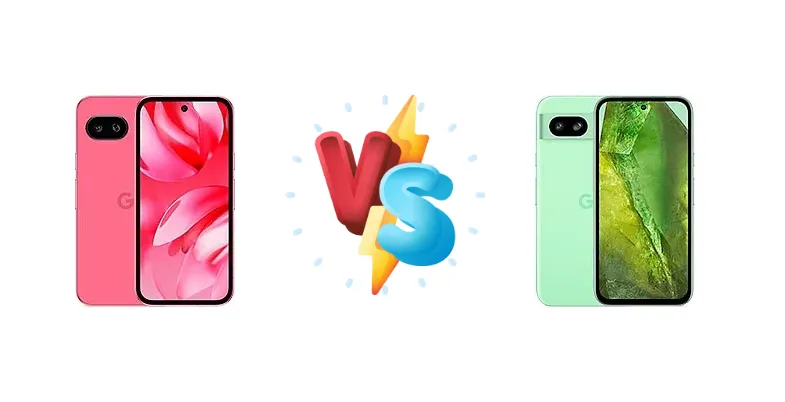
|
🏆 Quick Verdict
For most users, the Pixel 9a emerges as the superior choice. Its significantly improved 52:19h battery endurance and the newer Tensor G4 chipset offer a tangible upgrade in longevity and performance, justifying the likely price premium. However, the Pixel 8a remains a compelling option for those prioritizing a brighter display.
| PHONES | ||
|---|---|---|
| Phone Names | Google Pixel 9a | Google Pixel 8a |
| Network | ||
|---|---|---|
| 2G bands | GSM 850 / 900 / 1800 / 1900 | GSM 850 / 900 / 1800 / 1900 |
| 3G bands | HSDPA 800 / 850 / 900 / 1700(AWS) / 1900 / 2100 | HSDPA 800 / 850 / 900 / 1700(AWS) / 1900 / 2100 |
| 4G bands | 1, 2, 3, 4, 5, 7, 8, 12, 14, 17, 18, 19, 20, 21, 26, 28, 32, 38, 39, 40, 41, 42, 66, 75 - International | 1, 2, 3, 4, 5, 7, 8, 12, 17, 18, 19, 20, 26, 28, 32, 38, 40, 41, 42, 66 - G6GPR (International) |
| 5G bands | 1, 2, 3, 5, 7, 8, 12, 20, 26, 28, 38, 40, 41, 66, 75, 77, 78, 79 SA/NSA/Sub6 - International | 1, 2, 3, 5, 7, 8, 12, 20, 26, 28, 38, 40, 41, 66, 75, 76, 77, 78 SA/NSA/Sub6 - G6GPR (International) |
| Speed | HSPA, LTE, 5G | HSPA, LTE, 5G |
| Technology | GSM / HSPA / LTE / 5G | GSM / HSPA / LTE / 5G |
| Launch | ||
|---|---|---|
| Announced | 2025, March 19 | 2024, May 07 |
| Status | Available. Released 2025, April 10 | Available. Released 2024, May 14 |
| Body | ||
|---|---|---|
| Build | Glass front (Gorilla Glass 3), aluminum frame, plastic back | Glass front (Gorilla Glass 3), aluminum frame, plastic back |
| Dimensions | 154.7 x 73.3 x 8.9 mm (6.09 x 2.89 x 0.35 in) | 152.1 x 72.7 x 8.9 mm (5.99 x 2.86 x 0.35 in) |
| SIM | Nano-SIM + eSIM | Nano-SIM + eSIM |
| Weight | 186 g (6.56 oz) | 188 g (6.63 oz) |
| Display | ||
|---|---|---|
| Protection | Corning Gorilla Glass 3, Mohs level 4 | Corning Gorilla Glass 3, Mohs level 5 |
| Resolution | 1080 x 2424 pixels, 20:9 ratio (~422 ppi density) | 1080 x 2400 pixels, 20:9 ratio (~430 ppi density) |
| Size | 6.3 inches, 94.7 cm2 (~83.5% screen-to-body ratio) | 6.1 inches, 90.3 cm2 (~81.6% screen-to-body ratio) |
| Type | P-OLED, HDR, 120Hz, 1800 nits (HBM), 2700 nits (peak) | OLED, HDR, 120Hz, 2000 nits (peak) |
| Platform | ||
|---|---|---|
| CPU | Octa-core (1x3.1 GHz Cortex-X4 & 3x2.6 GHz Cortex-A720 & 4x1.9 GHz Cortex-A520) | Nona-core (1x3.0 GHz Cortex-X3 & 4x2.45 GHz Cortex-A715 & 4x2.15 GHz Cortex-A510) |
| Chipset | Google Tensor G4 (4 nm) | Google Tensor G3 (4 nm) |
| GPU | Mali-G715 MP7 | Immortalis-G715s MC10 |
| OS | Android 15, upgradable to Android 16, up to 7 major Android upgrades | Android 14, upgradable to Android 16, up to 7 major Android upgrades |
| Memory | ||
|---|---|---|
| Card slot | No | No |
| Internal | 128GB 8GB RAM, 256GB 8GB RAM | 128GB 8GB RAM, 256GB 8GB RAM |
| Main Camera | ||
|---|---|---|
| Dual | 48 MP, f/1.7, 25mm (wide), 1/2.0", 0.8µm, dual pixel PDAF, OIS 13 MP, f/2.2, 120˚ (ultrawide), 1/3.1", 1.12µm | 64 MP (16 MP eff.), f/1.9, 26mm (wide), 1/1.73", 0.8µm, dual pixel PDAF, OIS 13 MP, f/2.2, 120˚ (ultrawide), 1.12µm |
| Features | Dual-LED flash, Pixel Shift, Ultra HDR, panorama, Best Take | Dual-LED flash, Pixel Shift, Ultra HDR, panorama, Best Take |
| Video | 4K@30/60fps, 1080p@30/60/120/240fps, gyro-EIS, OIS | 4K@30/60fps, 1080p@30/60/120/240fps, OIS |
| Selfie camera | ||
|---|---|---|
| Features | HDR, panorama | HDR, panorama |
| Single | 13 MP, f/2.2, 20mm (ultrawide), 1/3.1", 1.12µm | 13 MP, f/2.2, 20mm (ultrawide), 1.12µm |
| Video | 4K@30fps, 1080p@30fps | 4K@30fps, 1080p@30/60fps |
| Sound | ||
|---|---|---|
| 35mm jack | No | No |
| Loudspeaker | Yes, with stereo speakers | Yes, with stereo speakers |
| Comms | ||
|---|---|---|
| Bluetooth | 5.3, A2DP, LE | 5.3, A2DP, LE |
| NFC | Yes | Yes |
| Positioning | GPS (L1+L5), GLONASS, GALILEO, BDS, QZSS, NavIC | GPS, GLONASS, GALILEO, BDS, QZSS, NavIC |
| Radio | No | No |
| USB | USB Type-C 3.2 | USB Type-C 3.2 |
| WLAN | Wi-Fi 802.11 a/b/g/n/ac/6e, dual/tri-band (market/region dependent) | Wi-Fi 802.11 a/b/g/n/ac/6e, dual/tri-band (market/region dependent) |
| Features | ||
|---|---|---|
| Sensors | Fingerprint (under display, optical), accelerometer, gyro, proximity, compass, barometer | Fingerprint (under display, optical), accelerometer, gyro, proximity, compass, barometer |
| Battery | ||
|---|---|---|
| Charging | 23W wired, PD3.0 7.5W wireless Bypass charging | 18W wired, PD3.0 7.5W wireless Bypass charging |
| Type | Li-Po 5100 mAh | Li-Po 4492 mAh |
| Misc | ||
|---|---|---|
| Colors | Obsidian, Porcelain, Iris, Peony | Obsidian, Porcelain, Bay, Aloe |
| Models | GXQ96, GTF7P, G3Y12 | GKV4X, G6GPR, G8HHN, G576D |
| Price | $ 348.12 / C$ 479.99 / £ 345.00 / € 381.99 / ₹ 41,990 | $ 229.98 / C$ 417.99 / £ 279.00 / € 299.99 / ₹ 33,300 |
| SAR EU | 0.99 W/kg (head) 1.39 W/kg (body) | - |
| EU LABEL | ||
|---|---|---|
| Battery | 52:19h endurance, 1000 cycles | 40:06h endurance, 1000 cycles |
| Energy | Class B | Class B |
| Free fall | Class A (270 falls) | Class A (270 falls) |
| Repairability | Class B | Class B |
Google Pixel 9a
- Significantly longer battery life (52:19h endurance)
- More powerful Tensor G4 processor
- Faster 23W wired charging
- Potential for improved camera processing
- Display brightness may be lower than Pixel 8a
- Likely higher price point
Google Pixel 8a
- Brighter display (1508 nits)
- More affordable price
- Excellent camera performance
- Compact and comfortable design
- Shorter battery life (40:06h endurance)
- Less powerful Tensor G3 processor
- Slower 18W wired charging
Display Comparison
The Pixel 8a boasts a measured peak brightness of 1508 nits, a significant advantage for outdoor use in direct sunlight. While the Pixel 9a’s display specifications are currently unavailable, the 8a’s brightness sets a high benchmark. Both phones support PD3.0 charging, but the 8a’s higher peak brightness may come at the cost of slightly reduced power efficiency. The absence of LTPO technology on either device suggests a standard 60Hz or 90Hz refresh rate, focusing on power conservation rather than fluid animations.
Camera Comparison
Without detailed camera specifications for the Pixel 9a, it’s difficult to make definitive claims. However, Google’s computational photography prowess is a consistent strength. The Pixel 8a’s image processing is already excellent, and the Tensor G4 in the 9a should further enhance these capabilities. The focus should be on improvements to low-light performance and video stabilization. Ignoring the typical 2MP macro lens found on both devices, the quality of the main sensor and its accompanying OIS will be the determining factors. Any increase in sensor size or aperture on the 9a would be a significant advantage.
Performance
The Pixel 9a’s Google Tensor G4 (4nm) represents a generational leap over the Pixel 8a’s Tensor G3 (4nm). The G4’s CPU configuration – a 1x3.1 GHz Cortex-X4, 3x2.6 GHz Cortex-A720, and 4x1.9 GHz Cortex-A520 – promises improved performance compared to the 8a’s 1x3.0 GHz Cortex-X3, 4x2.45 GHz Cortex-A715, and 4x2.15 GHz Cortex-A510. The Cortex-X4 core in the 9a is a key upgrade, offering substantial gains in single-core performance, crucial for responsive app launches and smoother multitasking. While both chips are fabricated on a 4nm process, the architectural improvements in the G4 should translate to better efficiency and sustained performance under load.
Battery Life
The Pixel 9a’s battery endurance of 52:19h, based on 1000 charge cycles, is a substantial improvement over the Pixel 8a’s 40:06h. This translates to a real-world active use score of 12:42h for the 9a versus 11:25h for the 8a. While both support 7.5W wireless charging and bypass charging, the 9a’s 23W wired charging is a step up from the 8a’s 18W, allowing for faster top-ups. The increased endurance of the 9a is particularly beneficial for users who heavily utilize their phones throughout the day, reducing range anxiety.
Buying Guide
Buy the Google Pixel 9a if you prioritize all-day battery life and future-proofed performance with the Tensor G4. It’s ideal for power users, mobile gamers, and anyone who frequently relies on their phone throughout the day. Buy the Google Pixel 8a if you value a brighter display for outdoor visibility and are looking for a more budget-friendly option, accepting a trade-off in battery endurance and processing power.