
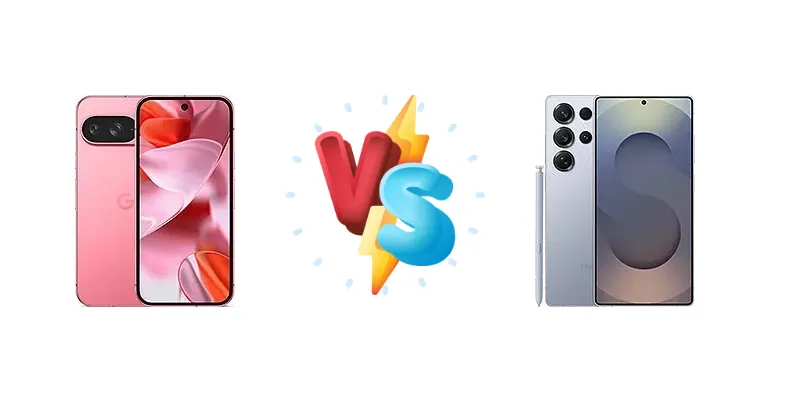
Google Pixel 9 vs Samsung Galaxy S25 Ultra: A Deep Dive Comparison
| Phones Images | |||||
|---|---|---|---|---|---|
|
🏆 Quick Verdict
For the average user prioritizing sustained performance and battery longevity, the Samsung Galaxy S25 Ultra emerges as the winner. Its Snapdragon 8 Elite chipset and larger battery capacity provide a noticeable advantage in demanding tasks and all-day use, despite the Pixel 9’s strong software integration.
| PHONES | ||
|---|---|---|
| Phone Names | Google Pixel 9 | Samsung Galaxy S25 Ultra |
| Network | ||
|---|---|---|
| 2G bands | GSM 850 / 900 / 1800 / 1900 | GSM 850 / 900 / 1800 / 1900 |
| 3G bands | HSDPA 800 / 850 / 900 / 1700(AWS) / 1900 / 2100 | HSDPA 850 / 900 / 1700(AWS) / 1900 / 2100 |
| 4G bands | 1, 2, 3, 4, 5, 7, 8, 12, 13, 14, 17, 18, 19, 20, 25, 26, 28, 29, 30, 38, 40, 41, 48, 66, 71 - G2YBB | 1, 2, 3, 4, 5, 7, 8, 12, 13, 17, 18, 19, 20, 25, 26, 28, 32, 38, 39, 40, 41, 66 - International |
| 5G bands | 1, 2, 3, 5, 7, 8, 12, 14, 20, 25, 26, 28, 29, 30, 38, 40, 41, 48, 66, 70, 71, 77, 78, 258, 260, 261 SA/NSA/Sub6/mmWave - G2YBB | 1, 2, 3, 5, 7, 8, 12, 20, 25, 26, 28, 38, 40, 41, 66, 75, 77, 78 SA/NSA/Sub6 - International |
| Speed | HSPA, LTE, 5G | HSPA, LTE (up to 7CA), 5G |
| Technology | GSM / HSPA / LTE / 5G | GSM / CDMA / HSPA / EVDO / LTE / 5G |
| Launch | ||
|---|---|---|
| Announced | 2024, August 13 | 2025, January 22 |
| Status | Available. Released 2024, August 22 | Available. Released 2025, February 03 |
| Body | ||
|---|---|---|
| Build | Glass front (Gorilla Glass Victus 2), glass back (Gorilla Glass Victus 2), aluminum frame | Glass front (Corning Gorilla Armor 2), glass back (Gorilla Glass Victus 2), titanium frame (grade 5) |
| Dimensions | 152.8 x 72 x 8.5 mm (6.02 x 2.83 x 0.33 in) | 162.8 x 77.6 x 8.2 mm (6.41 x 3.06 x 0.32 in) |
| SIM | Nano-SIM + eSIM | · Nano-SIM + Nano-SIM + eSIM + eSIM (max 2 at a time) - INT· Nano-SIM + eSIM + eSIM (max 2 at a time) - USA· Nano-SIM + Nano-SIM - CN |
| Weight | 198 g (6.98 oz) | 218 g (7.69 oz) |
| Display | ||
|---|---|---|
| Protection | Corning Gorilla Glass Victus 2, Mohs level 4 | Corning Gorilla Armor 2, Mohs level 6 |
| Resolution | 1080 x 2424 pixels, 20:9 ratio (~422 ppi density) | 1440 x 3120 pixels, 19.5:9 ratio (~498 ppi density) |
| Size | 6.3 inches, 94.7 cm2 (~86.1% screen-to-body ratio) | 6.9 inches, 116.9 cm2 (~92.5% screen-to-body ratio) |
| Type | OLED, 120Hz, HDR10+, 1800 nits (HBM), 2700 nits (peak) | Dynamic LTPO AMOLED 2X, 120Hz, HDR10+, 2600 nits (peak) |
| Platform | ||
|---|---|---|
| CPU | Octa-core (1x3.1 GHz Cortex-X4 & 3x2.6 GHz Cortex-A720 & 4x1.92 GHz Cortex-A520) | Octa-core (2x4.47 GHz Oryon V2 Phoenix L + 6x3.53 GHz Oryon V2 Phoenix M) |
| Chipset | Google Tensor G4 (4 nm) | Qualcomm SM8750-AC Snapdragon 8 Elite (3 nm) |
| GPU | Mali-G715 MC7 | Adreno 830 (1200 MHz) |
| OS | Android 14, upgradable to Android 16, up to 7 major Android upgrades | Android 15, up to 7 major Android upgrades, One UI 7 |
| Memory | ||
|---|---|---|
| Card slot | No | No |
| Internal | 128GB 12GB RAM, 256GB 12GB RAM | 256GB 12GB RAM, 512GB 12GB RAM, 1TB 12GB RAM, 1TB 16GB RAM |
| Main Camera | ||
|---|---|---|
| Dual | 50 MP, f/1.7, 25mm (wide), 1/1.31", 1.2µm, dual pixel PDAF, OIS 48 MP, f/1.7, 123˚ (ultrawide), 1/2.55", dual pixel PDAF | - |
| Features | Single-zone Laser AF, LED flash, Pixel Shift, Ultra-HDR, panorama, Best Take | Laser AF, Best Face, LED flash, auto-HDR, panorama |
| Quad | - | 200 MP, f/1.7, 24mm (wide), 1/1.3", 0.6µm, multi-directional PDAF, OIS 10 MP, f/2.4, 67mm (telephoto), 1/3.52", 1.12µm, PDAF, OIS, 3x optical zoom 50 MP, f/3.4, 111mm (periscope telephoto), 1/2.52", 0.7µm, PDAF, OIS, 5x optical zoom 50 MP, f/1.9, 120˚ (ultrawide), 1/2.5", 0.7µm, dual pixel PDAF, Super Steady video |
| Video | 4K@24/30/60fps, 1080p@24/30/60/120/240fps; gyro-EIS, OIS, 10-bit HDR | 8K@24/30fps, 4K@30/60/120fps, 1080p@30/60/120/240fps, 10-bit HDR, HDR10+, stereo sound rec., gyro-EIS |
| Selfie camera | ||
|---|---|---|
| Features | HDR, panorama | HDR, HDR10+ |
| Single | 10.5 MP, f/2.2, 20mm (ultrawide), 1/3.1", 1.22µm, PDAF | 12 MP, f/2.2, 26mm (wide), 1/3.2", 1.12µm, dual pixel PDAF |
| Video | 4K@30/60fps, 1080p@30/60fps | 4K@30/60fps, 1080p@30fps |
| Sound | ||
|---|---|---|
| 35mm jack | No | No |
| Loudspeaker | Yes, with stereo speakers | Yes, with stereo speakers |
| Comms | ||
|---|---|---|
| Bluetooth | 5.3, A2DP, LE, aptX HD | 5.4, A2DP, LE |
| NFC | Yes | Yes |
| Positioning | GPS (L1+L5), GLONASS, GALILEO, BDS, QZSS, NavIC | GPS, GLONASS, BDS, GALILEO, QZSS |
| Radio | No | No |
| USB | USB Type-C 3.2 | USB Type-C 3.2, DisplayPort 1.2, OTG |
| WLAN | Wi-Fi 802.11 a/b/g/n/ac/6e/7, tri-band | Wi-Fi 802.11 a/b/g/n/ac/6e/7, tri-band, Wi-Fi Direct |
| Features | ||
|---|---|---|
| Sensors | Fingerprint (under display, ultrasonic), accelerometer, gyro, proximity, compass, barometer | Fingerprint (under display, ultrasonic), accelerometer, gyro, proximity, compass, barometer |
| Battery | ||
|---|---|---|
| Charging | 27W wired, PD3.0, PPS, 55% in 30 min 15W wireless (w/ Pixel Stand) 12W wireless (w/ Qi compatible charger) Reverse wireless Bypass charging | 45W wired, PD3.0, 65% in 30 min 15W wireless (Qi2 Ready) 4.5W reverse wireless |
| Type | Li-Ion 4700 mAh | Li-Ion 5000 mAh |
| Misc | ||
|---|---|---|
| Colors | Obsidian, Porcelain, Wintergreen, Peony | Titanium Silver Blue, Titanium Black, Titanium White Silver, Titanium Gray, Titanium Jade Green, Titanium Jet Black, Titanium Pink Gold |
| Models | G2YBB, GUR25, G1B60 | SM-S938B, SM-S938B/DS, SM-S938U, SM-S938U1, SM-S938W, SM-S938N, SM-S9380, SM-S938E, SM-S938E/DS |
| Price | € 478.99 / $ 379.84 / £ 499.00 | € 895.00 / $ 859.98 / £ 799.99 / ₹ 110,498 |
| SAR | - | 1.26 W/kg (head) 0.64 W/kg (body) |
| SAR EU | 0.99 W/kg (head) 1.40 W/kg (body) | 1.25 W/kg (head) 1.42 W/kg (body) |
| EU LABEL | ||
|---|---|---|
| Battery | 49:12h endurance, 1000 cycles | 44:54h endurance, 2000 cycles |
| Energy | Class A | Class B |
| Free fall | Class A (270 falls) | Class A (270 falls) |
| Repairability | Class B | Class C |
Google Pixel 9
- Exceptional computational photography
- Seamless Google software experience
- Higher peak display brightness
- Less powerful chipset than Snapdragon 8 Elite
- Lower battery cycle count
Samsung Galaxy S25 Ultra
- Superior performance with Snapdragon 8 Elite
- Longer battery life and cycle count
- Faster wired charging
- Lower peak display brightness
- Samsung’s One UI may not appeal to all users
Display Comparison
The Samsung Galaxy S25 Ultra’s 1417 nits max brightness, while lower than the Pixel 9’s 2232 nits, is still excellent for outdoor visibility. However, the Pixel 9’s significantly higher peak brightness suggests superior HDR performance and a more vibrant image in challenging lighting conditions. Both displays likely utilize LTPO technology for adaptive refresh rates, but Samsung’s history suggests a more aggressive implementation for power savings. The difference in brightness may be more noticeable in direct sunlight, favoring the Pixel 9, but the S25 Ultra’s color accuracy is likely to be more refined, aligning with Samsung’s display expertise.
Camera Comparison
Without detailed camera specs, analysis relies on brand tendencies. Samsung typically prioritizes high-resolution sensors and versatile zoom capabilities, while Google focuses on computational photography. The S25 Ultra will likely feature a larger main sensor and more advanced optical image stabilization (OIS) than the Pixel 9, resulting in better low-light performance and sharper images. However, the Pixel 9’s image processing algorithms are renowned for their dynamic range and realistic color reproduction. The Tensor G4’s dedicated image processing unit will likely provide faster processing times for features like Night Sight and Super Res Zoom. The absence of a dedicated telephoto lens spec on the Pixel 9 could be a disadvantage against Samsung’s typically robust zoom system.
Performance
The Qualcomm Snapdragon 8 Elite in the S25 Ultra, built on a 3nm process, is expected to deliver a substantial performance advantage over the Google Tensor G4 (4nm). The Snapdragon’s Oryon V2 Phoenix cores (2x4.47 GHz + 6x3.53 GHz) boast higher clock speeds and a more efficient architecture than the Tensor G4’s Cortex-X4 (3.1 GHz) and A720/A520 configuration. This translates to faster app loading, smoother multitasking, and superior gaming performance. While the Tensor G4 excels in AI tasks, the Snapdragon 8 Elite’s raw processing power will be more noticeable in everyday use and graphically intensive applications. The S25 Ultra’s LPDDR5x RAM will further enhance performance.
Battery Life
The Samsung Galaxy S25 Ultra’s 44:54h endurance and 2000 charge cycles significantly outperform the Pixel 9’s 49:12h endurance and 1000 cycles. While the Pixel 9 boasts a slightly better active use score (13:05h vs 14:49h), the S25 Ultra’s larger battery capacity and more efficient chipset provide a clear advantage in longevity. The S25 Ultra’s 45W wired charging (65% in 30 min) is also faster than the Pixel 9’s 27W charging (55% in 30 min). Both support wireless charging, but the S25 Ultra’s reverse wireless charging at 4.5W is slower than the Pixel 9’s options.
Buying Guide
Buy the Google Pixel 9 if you prioritize a seamless software experience, exceptional computational photography, and a more manageable size. It’s ideal for users deeply invested in the Google ecosystem and those who value AI-powered features. Buy the Samsung Galaxy S25 Ultra if you demand the absolute best performance, longest battery life, and a comprehensive feature set, including faster charging and a more robust display. It’s the choice for power users, gamers, and those who want a device that can handle anything.