
Pixel 9 vs iPhone 17 Pro Max: A Deep Dive into Flagship Performance and Battery Life
| Phones Images | |||||
|---|---|---|---|---|---|
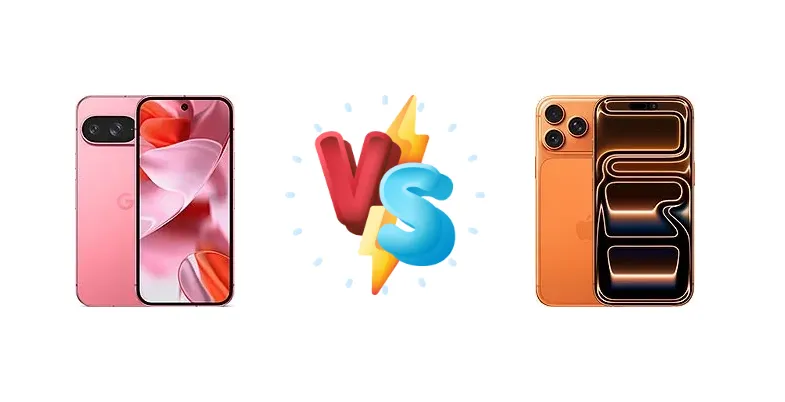
|
🏆 Quick Verdict
For the average user prioritizing all-day battery life and a more open ecosystem, the iPhone 17 Pro Max emerges as the winner. Its significantly longer active use score (17:58h vs 13:05h) and faster charging, despite a lower peak brightness, provide a more seamless experience. However, the Pixel 9’s reverse wireless charging and Google’s software innovations offer compelling alternatives.
| PHONES | ||
|---|---|---|
| Phone Names | Google Pixel 9 | Apple iPhone 17 Pro Max |
| Network | ||
|---|---|---|
| 2G bands | GSM 850 / 900 / 1800 / 1900 | GSM 850 / 900 / 1800 / 1900 |
| 3G bands | HSDPA 800 / 850 / 900 / 1700(AWS) / 1900 / 2100 | HSDPA 850 / 900 / 1700(AWS) / 1900 / 2100 |
| 4G bands | 1, 2, 3, 4, 5, 7, 8, 12, 13, 14, 17, 18, 19, 20, 25, 26, 28, 29, 30, 38, 40, 41, 48, 66, 71 - G2YBB | 1, 2, 3, 4, 5, 7, 8, 12, 13, 17, 18, 19, 20, 25, 26, 28, 30, 32, 34, 38, 39, 40, 41, 42, 48, 53, 66 - A3526 |
| 5G bands | 1, 2, 3, 5, 7, 8, 12, 14, 20, 25, 26, 28, 29, 30, 38, 40, 41, 48, 66, 70, 71, 77, 78, 258, 260, 261 SA/NSA/Sub6/mmWave - G2YBB | 1, 2, 3, 5, 7, 8, 12, 20, 25, 26, 28, 30, 38, 40, 41, 48, 53, 66, 70, 75, 77, 78, 79 SA/NSA/Sub6 - A3526 |
| Speed | HSPA, LTE, 5G | HSPA, LTE, 5G, EV-DO Rev.A 3.1 Mbps |
| Technology | GSM / HSPA / LTE / 5G | GSM / CDMA / HSPA / EVDO / LTE / 5G |
| Launch | ||
|---|---|---|
| Announced | 2024, August 13 | 2025, September 09 |
| Status | Available. Released 2024, August 22 | Available. Released 2025, September 19 |
| Body | ||
|---|---|---|
| Build | Glass front (Gorilla Glass Victus 2), glass back (Gorilla Glass Victus 2), aluminum frame | Glass front (Ceramic Shield 2), aluminum alloy frame, aluminum alloy back/ glass back (Ceramic Shield) |
| Dimensions | 152.8 x 72 x 8.5 mm (6.02 x 2.83 x 0.33 in) | 163.4 x 78 x 8.8 mm (6.43 x 3.07 x 0.35 in) |
| SIM | Nano-SIM + eSIM | · Nano-SIM + eSIM + eSIM (max 2 at a time; International)· eSIM + eSIM (8 or more, max 2 at a time; USA)· Nano-SIM + Nano-SIM (China) |
| Weight | 198 g (6.98 oz) | 233 g (8.22 oz) |
| Display | ||
|---|---|---|
| Protection | Corning Gorilla Glass Victus 2, Mohs level 4 | Ceramic Shield 2, Mohs level 5 |
| Resolution | 1080 x 2424 pixels, 20:9 ratio (~422 ppi density) | 1320 x 2868 pixels, 19.5:9 ratio (~460 ppi density) |
| Size | 6.3 inches, 94.7 cm2 (~86.1% screen-to-body ratio) | 6.9 inches, 115.6 cm2 (~90.7% screen-to-body ratio) |
| Type | OLED, 120Hz, HDR10+, 1800 nits (HBM), 2700 nits (peak) | LTPO Super Retina XDR OLED, 120Hz, HDR10, Dolby Vision, 1000 nits (typ), 1600 nits (HBM), 3000 nits (peak) |
| Platform | ||
|---|---|---|
| CPU | Octa-core (1x3.1 GHz Cortex-X4 & 3x2.6 GHz Cortex-A720 & 4x1.92 GHz Cortex-A520) | Hexa-core (2x4.26 GHz + 4xX.X GHz) |
| Chipset | Google Tensor G4 (4 nm) | Apple A19 Pro (3 nm) |
| GPU | Mali-G715 MC7 | Apple GPU (6-core graphics) |
| OS | Android 14, upgradable to Android 16, up to 7 major Android upgrades | iOS 26, upgradable to iOS 26.1 |
| Memory | ||
|---|---|---|
| Card slot | No | No |
| Internal | 128GB 12GB RAM, 256GB 12GB RAM | 256GB 12GB RAM, 512GB 12GB RAM, 1TB 12GB RAM, 2TB 12GB RAM |
| Main Camera | ||
|---|---|---|
| Dual | 50 MP, f/1.7, 25mm (wide), 1/1.31", 1.2µm, dual pixel PDAF, OIS 48 MP, f/1.7, 123˚ (ultrawide), 1/2.55", dual pixel PDAF | - |
| Features | Single-zone Laser AF, LED flash, Pixel Shift, Ultra-HDR, panorama, Best Take | Dual-LED dual-tone flash, HDR (photo/panorama) |
| Triple | - | 48 MP, f/1.8, 24mm (wide), 1/1.28", 1.22µm, dual pixel PDAF, sensor-shift OIS 48 MP, f/2.8, 100mm (periscope telephoto), 1/2.55", 0.7µm, PDAF, 3D sensor‑shift OIS, 4x optical zoom 48 MP, f/2.2, 13mm, 120˚ (ultrawide), 1/2.55", 0.7µm, PDAF TOF 3D LiDAR scanner (depth) |
| Video | 4K@24/30/60fps, 1080p@24/30/60/120/240fps; gyro-EIS, OIS, 10-bit HDR | 4K@24/25/30/60/100/120fps, 1080p@25/30/60/120/240fps, 10-bit HDR, Dolby Vision HDR (up to 120fps), ProRes, ProRes RAW (up to 120fps), Apple Log 2, 3D (spatial) video/audio, stereo sound rec. |
| Selfie camera | ||
|---|---|---|
| Features | HDR, panorama | HDR, Dolby Vision HDR, 3D (spatial) audio, stereo sound rec., ProRes RAW, Apple Log 2 |
| Single | 10.5 MP, f/2.2, 20mm (ultrawide), 1/3.1", 1.22µm, PDAF | 18 MP multi-aspect, f/1.9, 20mm (ultrawide), PDAF SL 3D, (depth/biometrics sensor) |
| Video | 4K@30/60fps, 1080p@30/60fps | 4K@24/25/30/60fps, 1080p@25/30/60/120fps, gyro-EIS |
| Sound | ||
|---|---|---|
| 35mm jack | No | No |
| Loudspeaker | Yes, with stereo speakers | Yes, with stereo speakers |
| Comms | ||
|---|---|---|
| Bluetooth | 5.3, A2DP, LE, aptX HD | 6.0, A2DP, LE |
| NFC | Yes | Yes |
| Positioning | GPS (L1+L5), GLONASS, GALILEO, BDS, QZSS, NavIC | GPS (L1+L5), GLONASS, GALILEO, BDS, QZSS, NavIC |
| Radio | No | No |
| USB | USB Type-C 3.2 | USB Type-C 3.2 Gen 2, DisplayPort |
| WLAN | Wi-Fi 802.11 a/b/g/n/ac/6e/7, tri-band | Wi-Fi 802.11 a/b/g/n/ac/6e/7, tri-band, hotspot |
| Features | ||
|---|---|---|
| Sensors | Fingerprint (under display, ultrasonic), accelerometer, gyro, proximity, compass, barometer | Face ID, accelerometer, gyro, proximity, compass, barometer |
| Battery | ||
|---|---|---|
| Charging | 27W wired, PD3.0, PPS, 55% in 30 min 15W wireless (w/ Pixel Stand) 12W wireless (w/ Qi compatible charger) Reverse wireless Bypass charging | Wired, PD3.2, AVS, 50% in 20 min 25W wireless MagSafe/Qi2, 50% in 30 min (15W - China) 4.5W reverse wired |
| Type | Li-Ion 4700 mAh | Market-dependent versions:· Li-Ion 4823 mAh - Nano SIM model· Li-Ion 5088 mAh - eSIM only model |
| Misc | ||
|---|---|---|
| Colors | Obsidian, Porcelain, Wintergreen, Peony | Silver, Cosmic Orange, Deep Blue |
| Models | G2YBB, GUR25, G1B60 | iPhone18,2, A3526, A3257, A3527, A3525 |
| Price | € 478.99 / $ 379.84 / £ 499.00 | € 1,344.19 / $ 1,419.00 / £ 1,199.00 / ₹ 149,900 |
| SAR | - | 1.19 W/kg (head) 1.19 W/kg (body) |
| SAR EU | 0.99 W/kg (head) 1.40 W/kg (body) | 1.49 W/kg (head) 1.49 W/kg (body) |
| EU LABEL | ||
|---|---|---|
| Battery | 49:12h endurance, 1000 cycles | 53:00h endurance, 1000 cycles |
| Energy | Class A | Class A |
| Free fall | Class A (270 falls) | Class B (180 falls) |
| Repairability | Class B | Class C |
Google Pixel 9
- Brighter display for outdoor visibility
- Reverse wireless charging for accessories
- Google’s AI-powered software features
- Shorter battery life compared to iPhone
- Potentially slower processor performance
- Less optimized ecosystem compared to Apple
Apple iPhone 17 Pro Max
- Superior battery endurance and active use time
- Faster charging speeds with PD3.2 and MagSafe
- Industry-leading processor performance with A19 Pro
- Lower peak display brightness
- Less flexible operating system (iOS)
- Ecosystem lock-in
Display Comparison
The Pixel 9 boasts a significantly brighter display, reaching a measured 2232 nits, compared to the iPhone 17 Pro Max’s 1000 nits. This makes the Pixel 9 more legible in direct sunlight. However, Apple’s display technology is likely to feature advancements in color accuracy and LTPO for variable refresh rates, potentially offering a smoother viewing experience despite the lower peak brightness. The lack of specific refresh rate data for the Pixel 9 means Apple likely has an advantage in power efficiency related to the display.
Camera Comparison
Without specific camera specs, we can infer that both devices will feature advanced camera systems. However, Apple historically prioritizes computational photography and video recording quality, while Google focuses on innovative software features like Magic Eraser and Photo Unblur. The iPhone 17 Pro Max will likely benefit from Apple’s continued refinement of sensor-shift stabilization and advanced image processing algorithms. The Pixel 9’s strength lies in its AI-powered image processing, potentially offering superior low-light performance and dynamic range. The absence of detailed camera information necessitates a cautious approach to direct comparisons.
Performance
The iPhone 17 Pro Max’s Apple A19 Pro, fabricated on a 3nm process, is expected to deliver superior performance and efficiency compared to the Pixel 9’s 4nm Google Tensor G4. While the Tensor G4 utilizes an octa-core configuration with a high-clocked Cortex-X4, Apple’s custom silicon typically excels in both single-core and multi-core tasks. The A19 Pro’s hexa-core design, with two high-performance cores clocked at 4.26 GHz, suggests a focus on sustained performance. The Pixel 9’s CPU architecture, while modern, is likely to be outpaced by Apple’s advancements in neural engine capabilities, impacting AI-driven tasks.
Battery Life
The iPhone 17 Pro Max demonstrates a clear advantage in battery endurance, offering 53:00h compared to the Pixel 9’s 49:12h. This translates to a significantly longer active use score of 17:58h for the iPhone versus 13:05h for the Pixel. While the Pixel 9 supports 27W wired charging and offers reverse wireless charging, the iPhone 17 Pro Max’s PD3.2 and AVS charging capabilities, achieving 50% charge in 20 minutes, are faster. The iPhone also offers 25W wireless charging via MagSafe/Qi2, exceeding the Pixel 9’s 15W and 12W wireless options.
Buying Guide
Buy the Google Pixel 9 if you need exceptional software features powered by Google AI, prioritize reverse wireless charging for accessories, and prefer the flexibility of the Android ecosystem. Buy the Apple iPhone 17 Pro Max if you value industry-leading battery endurance, seamless integration with other Apple devices, and a consistently high-performing, optimized experience, even if it comes at a premium.