
Pixel 9 Pro XL vs. vivo X200 Pro mini: A Deep Dive into Performance and Endurance
| Phones Images | |||||
|---|---|---|---|---|---|
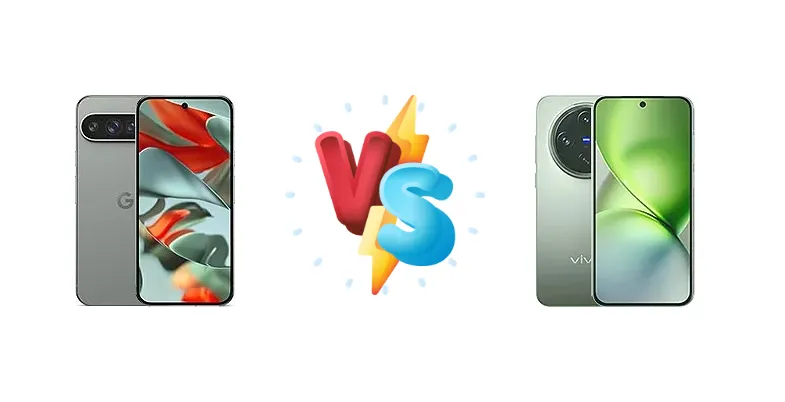
|
🏆 Quick Verdict
For users prioritizing exceptional battery life and Google's software ecosystem, the Pixel 9 Pro XL is the clear winner. However, the vivo X200 Pro mini delivers a compelling package for those who value raw processing power and blazing-fast 90W charging in a more pocketable design.
| PHONES | ||
|---|---|---|
| Phone Names | Google Pixel 9 Pro XL | vivo X200 Pro mini |
| Network | ||
|---|---|---|
| 2G bands | GSM 850 / 900 / 1800 / 1900 | GSM 850 / 900 / 1800 / 1900 |
| 3G bands | HSDPA 800 / 850 / 900 / 1700(AWS) / 1900 / 2100 | HSDPA 800 / 850 / 900 / 1700(AWS) / 1900 / 2100 |
| 4G bands | 1, 2, 3, 4, 5, 7, 8, 12, 13, 14, 17, 18, 19, 20, 25, 26, 28, 29, 30, 38, 40, 41, 48, 66, 71 - GGX8B | 1, 2, 3, 4, 5, 7, 8, 18, 19, 26, 28, 34, 38, 39, 40, 41, 66 |
| 5G bands | 1, 2, 3, 5, 7, 8, 12, 14, 20, 25, 26, 28, 29, 30, 38, 40, 41, 48, 66, 70, 71, 77, 78, 258, 260, 261 SA/NSA/Sub6/mmWave - GGX8B | 1, 3, 5, 8, 28, 38, 40, 41, 77, 78 SA/NSA |
| Speed | HSPA, LTE, 5G | HSPA, LTE, 5G |
| Technology | GSM / HSPA / LTE / 5G | GSM / HSPA / LTE / 5G |
| Launch | ||
|---|---|---|
| Announced | 2024, August 13 | 2024, October 14 |
| Status | Available. Released 2024, August 22 | Available. Released 2024, October 25 |
| Body | ||
|---|---|---|
| Build | Glass front (Gorilla Glass Victus 2), glass back (Gorilla Glass Victus 2), aluminum frame | Glass front, aluminum alloy frame |
| Dimensions | 162.8 x 76.6 x 8.5 mm (6.41 x 3.02 x 0.33 in) | 150.8 x 71.8 x 8.2 mm (5.94 x 2.83 x 0.32 in) |
| SIM | Nano-SIM + eSIM | Nano-SIM + Nano-SIM |
| Weight | 221 g (7.80 oz) | 187 g (6.60 oz) |
| Display | ||
|---|---|---|
| Protection | Corning Gorilla Glass Victus 2, Mohs level 4 | - |
| Resolution | 1344 x 2992 pixels, 20:9 ratio (~486 ppi density) | 1216 x 2640 pixels, 19.5:9 ratio (~460 ppi density) |
| Size | 6.8 inches, 109.7 cm2 (~88.0% screen-to-body ratio) | 6.31 inches, 98.0 cm2 (~90.5% screen-to-body ratio) |
| Type | LTPO OLED, 120Hz, HDR10+, 2000 nits (HBM), 3000 nits (peak) | LTPO AMOLED, 1B colors, 120Hz, 2160Hz PWM, HDR10+, 4500 nits (peak) |
| Platform | ||
|---|---|---|
| CPU | Octa-core (1x3.1 GHz Cortex-X4 & 3x2.6 GHz Cortex-A720 & 4x1.92 GHz Cortex-A520) | Octa-core (1x3.63 GHz Cortex-X925 & 3x3.3 GHz Cortex-X4 & 4x2.4 GHz Cortex-A720) |
| Chipset | Google Tensor G4 (4 nm) | Mediatek Dimensity 9400 (3 nm) |
| GPU | Mali-G715 MC7 | Immortalis-G925 |
| OS | Android 14, upgradable to Android 16, up to 7 major Android upgrades | Android 15, OriginOS 5 (China) |
| Memory | ||
|---|---|---|
| Card slot | No | No |
| Internal | 128GB 16GB RAM, 256GB 16GB RAM, 512GB 16GB RAM, 1TB 16GB RAM | 256GB 12GB RAM, 512GB 12GB RAM, 512GB 16GB RAM, 1TB 16GB RAM |
| Main Camera | ||
|---|---|---|
| Features | Multi-zone Laser AF, LED flash, Pixel Shift, Ultra-HDR, panorama, Best Take, Zoom Enhance | Laser AF, Zeiss optics, Zeiss T* lens coating, LED flash, panorama, HDR |
| Triple | 50 MP, f/1.7, 25mm (wide), 1/1.31", 1.2µm, dual pixel PDAF, OIS 48 MP, f/2.8, 113mm (periscope telephoto), 1/2.55", dual pixel PDAF, OIS, 5x optical zoom 48 MP, f/1.7, 123˚ (ultrawide), 1/2.55", dual pixel PDAF, | 50 MP, f/1.6, 23mm (wide), 1/1.28", 1.22µm, PDAF, OIS 50 MP, f/2.6, 70mm (periscope telephoto), 1/1.95", PDAF, OIS, 3x optical zoom 50 MP, f/2.0, 15mm, 119˚ (ultrawide), 1/2.76", 0.64µm, AF |
| Video | 8K@30fps (via cloud-based upscaling), 4K@24/30/60fps, 1080p@24/30/60/120/240fps; gyro-EIS, OIS, 10-bit HDR | 4K@30/60fps, 1080p@30/60/120fps, gyro-EIS, HDR |
| Selfie camera | ||
|---|---|---|
| Features | HDR, panorama | HDR |
| Single | 42 MP, f/2.2, 17mm (ultrawide), PDAF | 32 MP, f/2.0, 20mm (ultrawide) |
| Video | 4K@30/60fps, 1080p@30/60fps | 4K, 1080p |
| Sound | ||
|---|---|---|
| 35mm jack | No | No |
| Loudspeaker | Yes, with stereo speakers | Yes, with stereo speakers |
| Comms | ||
|---|---|---|
| Bluetooth | 5.3, A2DP, LE, aptX HD | 5.4, A2DP, LE, aptX HD, LHDC 5 |
| Infrared port | - | Yes |
| NFC | Yes | Yes |
| Positioning | GPS (L1+L5), GLONASS, GALILEO, BDS, QZSS, NavIC | GPS (L1+L5), GLONASS (L1), BDS (B1I+B1c+B2a+B2b), GALILEO (E1+E5a+E5b), QZSS (L1+L5), NavIC (L5) |
| Radio | No | No |
| USB | USB Type-C 3.2 | USB Type-C 2.0, OTG |
| WLAN | Wi-Fi 802.11 a/b/g/n/ac/6e/7, tri-band | Wi-Fi 802.11 a/b/g/n/ac/6/7, dual-band |
| Features | ||
|---|---|---|
| Sensors | Fingerprint (under display, ultrasonic), accelerometer, gyro, proximity, compass, barometer, thermometer (skin temperature) | Fingerprint (under display, optical), accelerometer, gyro, proximity, compass |
| Battery | ||
|---|---|---|
| Charging | 37W wired, PD3.0, PPS, 70% in 30 min 23W wireless (w/ Pixel Stand) 12W wireless (w/ Qi compatible charger) Reverse wireless Bypass charging | 90W wired 30W wireless Reverse wired |
| Type | Li-Ion 5060 mAh | Si/C Li-Ion 5700 mAh |
| Misc | ||
|---|---|---|
| Colors | Porcelain, Rose Quartz, Hazel, Obsidian | Black, White, Green, Pink |
| Models | GGX8B, GZC4K, GQ57S | V2419A |
| Price | $ 474.43 / C$ 909.98 / £ 599.95 / € 495.04 / ₹ 99,990 | About 610 EUR |
| SAR EU | 0.99 W/kg (head) 1.40 W/kg (body) | - |
| EU LABEL | ||
|---|---|---|
| Battery | 49:30h endurance, 1000 cycles | - |
| Energy | Class B | - |
| Free fall | Class A (270 falls) | - |
| Repairability | Class C | - |
Google Pixel 9 Pro XL
- Exceptional battery life (49:30h endurance)
- Google’s AI-powered features and software support
- High peak display brightness (2365 nits)
- Slower wired charging (37W)
- Potentially lower peak CPU performance compared to Dimensity 9400
vivo X200 Pro mini
- Blazing-fast 90W wired charging
- Powerful MediaTek Dimensity 9400 (3nm)
- Compact and pocketable design
- Likely shorter battery life compared to Pixel 9 Pro XL
- Software experience may not be as refined as Pixel
Display Comparison
The Pixel 9 Pro XL boasts a peak brightness of 2365 nits, ensuring excellent visibility even in direct sunlight. While the X200 Pro mini’s display specs are currently unknown, vivo typically employs high-quality AMOLED panels. The Pixel’s larger size likely offers a more immersive viewing experience, but the X200 Pro mini’s smaller footprint will appeal to those who prefer one-handed use. The Pixel’s display tech is likely LTPO, offering variable refresh rates for power efficiency, a feature we expect to see on the vivo as well given its flagship status.
Camera Comparison
Without detailed camera specs for either device, analysis is limited. However, Google’s Pixel line is renowned for its computational photography prowess, leveraging the Tensor G4’s AI capabilities for exceptional image processing. The X200 Pro mini, benefiting from the Dimensity 9400’s ISP, will likely deliver strong image quality as well. The absence of information on sensor sizes and lens apertures makes a direct comparison impossible, but we anticipate both phones will feature multi-camera systems with OIS for stable video recording. The Pixel’s strength will be in software-driven enhancements, while the vivo may focus on hardware capabilities.
Performance
The core battle lies between the Google Tensor G4 (4nm) and the MediaTek Dimensity 9400 (3nm). The Dimensity 9400, built on a more advanced 3nm process, theoretically offers superior power efficiency and transistor density compared to the Tensor G4’s 4nm node. The Dimensity 9400’s CPU configuration – a Cortex-X925 prime core alongside three Cortex-X4 cores – suggests a focus on peak performance, potentially outperforming the Tensor G4’s Cortex-X4 setup in CPU-intensive tasks. However, Google’s Tensor chips excel in AI and machine learning tasks, potentially giving the Pixel an edge in areas like image processing and voice recognition. The X200 Pro mini’s CPU has a higher clock speed on its prime core (3.63 GHz vs 3.1 GHz), indicating a potential advantage in single-core performance.
Battery Life
The Pixel 9 Pro XL’s 49:30h endurance rating is a significant advantage, suggesting it can comfortably last through a full day and beyond for most users. The X200 Pro mini’s battery capacity is unknown, but its smaller size likely means a smaller battery. However, the X200 Pro mini compensates with incredibly fast 90W wired charging, capable of significantly reducing downtime. The Pixel 9 Pro XL offers 37W wired charging, which is respectable but slower. The X200 Pro mini also supports 30W wireless charging, while the Pixel offers 23W with its proprietary stand and 12W with standard Qi chargers. The Pixel’s inclusion of reverse wireless charging adds versatility.
Buying Guide
Buy the Google Pixel 9 Pro XL if you need a phone that reliably lasts through a full day of heavy use, benefits from Google’s AI-powered features, and values a mature software experience. Buy the vivo X200 Pro mini if you prefer a more compact device, demand the latest chipset performance for demanding tasks like gaming, and prioritize the fastest possible wired charging speeds.