
Google Pixel 9 Pro Fold vs. Honor Magic V2 RSR Porsche Design: A Deep Dive
| Phones Images | |||||
|---|---|---|---|---|---|
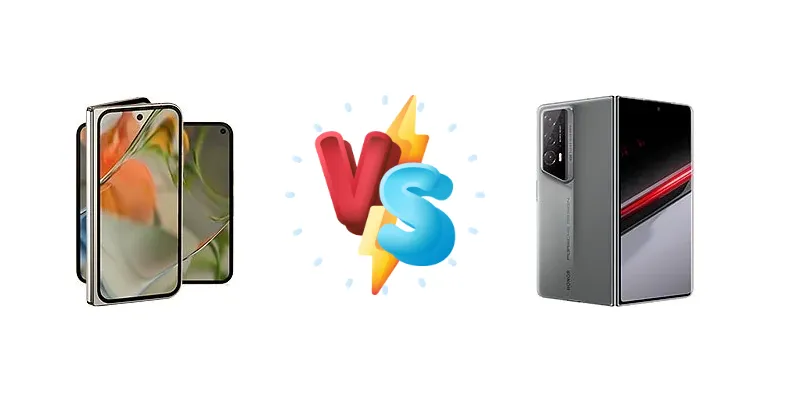
|
🏆 Quick Verdict
For the average user prioritizing seamless software integration and a refined user experience, the Google Pixel 9 Pro Fold is the better choice. However, power users and those demanding the fastest possible charging and raw performance will find the Honor Magic V2 RSR Porsche Design more appealing.
| PHONES | ||
|---|---|---|
| Phone Names | Google Pixel 9 Pro Fold | Honor Magic V2 RSR Porsche Design |
| Network | ||
|---|---|---|
| 2G bands | GSM 850 / 900 / 1800 / 1900 | GSM 850 / 900 / 1800 / 1900 |
| 3G bands | HSDPA 800 / 850 / 900 / 1700(AWS) / 1900 / 2100 | HSDPA 800 / 850 / 900 / 1700(AWS) / 1900 / 2100 |
| 4G bands | 1, 2, 3, 4, 5, 7, 8, 12, 13, 14, 17, 18, 19, 20, 21, 25, 26, 28, 29, 30, 32, 38, 39, 40, 41, 42, 46, 48, 66, 71 | 1, 2, 3, 4, 5, 7, 8, 12, 17, 18, 19, 20, 26, 28, 34, 38, 39, 40, 41, 66 |
| 5G bands | 1, 2, 3, 5, 7, 8, 12, 14, 20, 25, 26, 28, 29, 30, 38, 40, 41, 48, 66, 70, 71, 75, 76, 77, 78, 79, 257, 258, 260, 261 SA/NSA/Sub6/mmWave | 1, 3, 5, 8, 28, 38, 41, 77, 78 SA/NSA |
| Speed | HSPA, LTE, 5G | HSPA, LTE, 5G |
| Technology | GSM / HSPA / LTE / 5G | GSM / CDMA / HSPA / CDMA2000 / LTE / 5G |
| Launch | ||
|---|---|---|
| Announced | 2024, August 13 | 2024, January 11 |
| Status | Available. Released 2024, September 04 | Available. Released 2024, January 12 |
| Body | ||
|---|---|---|
| Build | Glass front (Gorilla Glass Victus 2) (folded), plastic front (unfolded), glass back (Gorilla Glass Victus 2), aluminum frame | Glass front, glass back, magnesium alloy frame, titanium alloy folding mechanism |
| Dimensions | Unfolded: 155.2 x 150.2 x 5.1 mmFolded: 155.2 x 77.1 x 10.5 mm | Unfolded: 156.7 x 145.4 x 4.7 mm or 4.8 mmFolded: 156.7 x 74 x 9.9 mm or 10.1 mm |
| SIM | Nano-SIM + eSIM | · Nano-SIM + eSIM· Nano-SIM + Nano-SIM |
| Weight | 257 g (9.07 oz) | 234 g (8.25 oz) |
| Display | ||
|---|---|---|
| Resolution | 2076 x 2152 pixels, 1:1 ratio (~373 ppi density) | 2156 x 2344 pixels (~402 ppi density) |
| Size | 8.0 inches, 207.4 cm2 (~89.0% screen-to-body ratio) | 7.92 inches, 201.6 cm2 (~88.5% screen-to-body ratio) |
| Type | Foldable LTPO OLED, 120Hz, HDR10+, 1600 nits (HBM), 2700 nits (peak) | Foldable LTPO OLED, 1B colors, 120Hz, HDR10+, 1600 nits (peak) |
| Platform | ||
|---|---|---|
| CPU | Octa-core (1x3.1 GHz Cortex-X4 & 3x2.6 GHz Cortex-A720 & 4x1.92 GHz Cortex-A520) | Octa-core (1x3.36 GHz Cortex-X3 & 2x2.8 GHz Cortex-A715 & 2x2.8 GHz Cortex-A710 & 3x2.0 GHz Cortex-A510) |
| Chipset | Google Tensor G4 (4 nm) | Qualcomm SM8550-AC Snapdragon 8 Gen 2 (4 nm) |
| GPU | Mali-G715 MC7 | Adreno 740 |
| OS | Android 14, upgradable to Android 16, up to 7 major Android upgrades | Android 13, upgradable to Android 14, MagicOS 8 |
| Memory | ||
|---|---|---|
| Card slot | No | No |
| Internal | 256GB 16GB RAM, 512GB 16GB RAM | 1TB 16GB RAM |
| Main Camera | ||
|---|---|---|
| Features | Multi-zone Laser AF, LED flash, Pixel Shift, Ultra-HDR, panorama, Best Take, Zoom Enhance | Multi-zone Laser AF (8x8 dToF), color spectrum sensor, LED flash, HDR, panorama |
| Triple | 48 MP, f/1.7, 25mm (wide), 1/2.0", 0.8µm, dual pixel PDAF, OIS 10.8 MP, f/3.1, 112mm (telephoto), 1/3.2", dual pixel PDAF, OIS, 5x optical zoom 10.5 MP, f/2.2, 127˚ (ultrawide), 1/3.4", PDAF | 50 MP, f/1.9, (wide), PDAF, OIS 20 MP, f/2.4, 62mm (telephoto), PDAF, 2.5x optical zoom, OIS 50 MP, f/2.0, 13mm (ultrawide), AF |
| Video | 4K@24/30/60fps, 1080p@24/30/60/120/240fps, 10-bit HDR, gyro-EIS, OIS | 4K@30/60fps (10-bit), 1080p@30/60fps, gyro-EIS, HDR10+, OIS |
| Selfie camera | ||
|---|---|---|
| Features | HDR, panorama | HDR |
| Single | 10 MP, f/2.2, 23mm (wide), 1/3.94", PDAF Cover camera: 10 MP, f/2.2, 23mm (wide), 1/3.94", PDAF | 16 MP, f/2.2, (wide) |
| Video | 4K@30/60fps, 1080p@30/60fps | 4K@30fps, 1080p@30fps, gyro-EIS |
| Sound | ||
|---|---|---|
| 35mm jack | No | No |
| Loudspeaker | Yes, with stereo speakers | Yes, with stereo speakers |
| Comms | ||
|---|---|---|
| Bluetooth | 5.3, A2DP, LE, aptX HD | 5.3, A2DP, LE, aptX HD |
| Infrared port | - | Yes |
| NFC | Yes | Yes |
| Positioning | GPS (L1+L5), GLONASS, GALILEO, BDS, QZSS, NavIC | GPS (L1+L5), GLONASS (L1), BDS (B1I+B1c+B2a), GALILEO (E1+E5a), QZSS (L1+L5) |
| Radio | No | No |
| USB | USB Type-C 3.2 | USB Type-C 3.1, OTG, Display Port 1.2 |
| WLAN | Wi-Fi 802.11 a/b/g/n/ac/6e/7, tri-band | Wi-Fi 802.11 a/b/g/n/ac/6e/7, dual-band, Wi-Fi Direct |
| Features | ||
|---|---|---|
| Sensors | Fingerprint (side-mounted), accelerometer, gyro, proximity, compass, barometer | Fingerprint (side-mounted), accelerometer, gyro, proximity, compass |
| Battery | ||
|---|---|---|
| Charging | 21W wired 7.5W wireless Bypass charging | 66W wired 5W reverse wired |
| Type | 4650 mAh | Si/C Li-Ion 5000 mAh |
| Misc | ||
|---|---|---|
| Colors | Obsidian, Porcelain | Agate Gray |
| Models | GGH2X, GC15S | VER-AN10 |
| Price | € 1,020.97 / $ 649.95 / £ 784.99 | About 2700 EUR |
| SAR EU | 0.98 W/kg (head) 1.39 W/kg (body) | - |
Google Pixel 9 Pro Fold
- Exceptional software experience and updates
- Excellent camera processing and AI features
- Long battery life with optimized usage
- Slower charging speeds compared to the competition
- Less raw processing power than Snapdragon 8 Gen 2
Honor Magic V2 RSR Porsche Design
- Blazing-fast 66W wired charging
- Superior CPU and GPU performance with Snapdragon 8 Gen 2
- Potentially more efficient thermal management
- Software experience may not be as refined as Pixel
- Battery life dependent on capacity (unknown)
Display Comparison
The Pixel 9 Pro Fold boasts a measured peak brightness of 2199 nits, ensuring excellent visibility even in direct sunlight. While the Honor Magic V2 RSR’s display specs aren’t provided, Honor typically employs LTPO panels for adaptive refresh rates, potentially offering power savings. The key difference will likely be color calibration; Google is known for its accurate displays, while Honor often leans towards more vibrant, saturated colors. The foldable form factor inherently introduces a crease, and the quality of hinge design will be crucial for minimizing its visibility and durability – a factor not specified in the provided data.
Camera Comparison
Without detailed camera specifications, a direct comparison is limited. However, Google’s Pixel line is renowned for its computational photography prowess, leveraging AI to produce exceptional images, particularly in challenging lighting conditions. The Tensor G4 chip plays a vital role in this processing. The Honor Magic V2 RSR, while likely equipped with high-resolution sensors, will rely more on hardware capabilities. The absence of sensor size or aperture information makes it difficult to assess low-light performance. The Pixel’s image processing style tends towards realism, while Honor often favors more vibrant, contrast-rich images.
Performance
The Honor Magic V2 RSR leverages the Qualcomm Snapdragon 8 Gen 2 (4nm), a proven performer with a Cortex-X3 prime core clocked at 3.36 GHz. This architecture demonstrably outperforms the Google Tensor G4’s Cortex-X4 (3.1 GHz) in raw CPU power and GPU capabilities. The Tensor G4, while optimized for Google’s AI and machine learning tasks, will likely exhibit lower sustained performance under heavy load due to thermal constraints. The Snapdragon 8 Gen 2’s 4nm process offers superior thermal efficiency, translating to less throttling during extended gaming sessions. The Pixel’s strength lies in its software optimization, potentially mitigating some performance gaps.
Battery Life
The Pixel 9 Pro Fold achieves an impressive 11:54h of active use, indicating strong battery optimization despite the power demands of a foldable display. The Honor Magic V2 RSR’s battery capacity is unknown, but its 66W wired charging significantly surpasses the Pixel’s 21W charging. This means the Honor can replenish its battery much faster, a crucial advantage for power users. The Pixel offers 7.5W wireless charging and bypass charging, allowing for charging without heat buildup, while the Honor provides 5W reverse wired charging, useful for topping up accessories.
Buying Guide
Buy the Google Pixel 9 Pro Fold if you need a foldable with exceptional software support, a consistently smooth experience, and prioritize camera processing over sheer speed. Buy the Honor Magic V2 RSR Porsche Design if you prefer a device optimized for gaming, content creation, and rapid charging, and are comfortable with a less Google-centric software experience.