
Pixel 8 vs Xiaomi 14T Pro: A Deep Dive into Two Android Flagships
| Phones Images | |||||
|---|---|---|---|---|---|
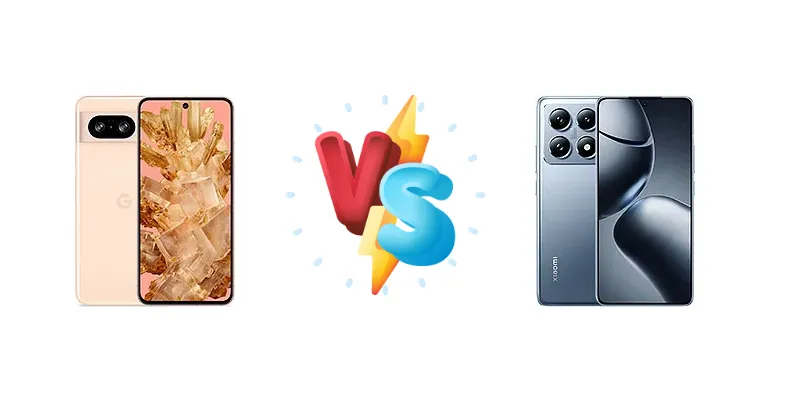
|
🏆 Quick Verdict
For the average user prioritizing a seamless software experience and exceptional camera capabilities, the Google Pixel 8 is the better choice. However, the Xiaomi 14T Pro delivers significantly faster charging and a performance edge, making it ideal for power users and gamers.
| PHONES | ||
|---|---|---|
| Phone Names | Google Pixel 8 | Xiaomi 14T Pro |
| Network | ||
|---|---|---|
| 2G bands | GSM 850 / 900 / 1800 / 1900 | GSM 850 / 900 / 1800 / 1900 |
| 3G bands | HSDPA 800 / 850 / 900 / 1700(AWS) / 1900 / 2100 | HSDPA 800 / 850 / 900 / 1700(AWS) / 1900 / 2100 |
| 4G bands | 1, 2, 3, 4, 5, 7, 8, 12, 13, 14, 17, 18, 19, 20, 25, 26, 28, 29, 30, 38, 40, 41, 46, 48, 66, 71 - GKWS6, G9BQD | 1, 2, 3, 4, 5, 7, 8, 12, 13, 17, 18, 19, 20, 25, 26, 28, 32, 38, 39, 40, 41, 42, 48, 66 |
| 5G bands | 1, 2, 3, 5, 7, 8, 12, 20, 25, 26, 28, 29, 30, 38, 40, 41, 48, 66, 70, 71, 77, 78, 258, 260, 261 SA/NSA/Sub6/mmWave - GKWS6 | 1, 2, 3, 5, 7, 8, 12, 20, 25, 26, 28, 38, 40, 41, 48, 66, 75, 77, 78 SA/NSA |
| Speed | HSPA, LTE, 5G | HSPA, LTE, 5G |
| Technology | GSM / HSPA / LTE / 5G | GSM / HSPA / LTE / 5G |
| Launch | ||
|---|---|---|
| Announced | 2023, October 04 | 2024, September 26 |
| Status | Available. Released 2023, October 12 | Available. Released 2024, September 26 |
| Body | ||
|---|---|---|
| Build | Glass front (Gorilla Glass Victus), glass back (Gorilla Glass Victus), aluminum frame | Glass front (Gorilla Glass 5), aluminum frame, glass back (Panda X) |
| Dimensions | 150.5 x 70.8 x 8.9 mm (5.93 x 2.79 x 0.35 in) | 160.4 x 75.1 x 8.4 mm (6.31 x 2.96 x 0.33 in) |
| SIM | Nano-SIM + eSIM | · Nano-SIM + eSIM· eSIM + eSIM· Nano-SIM + Nano-SIM |
| Weight | 187 g (6.60 oz) | 209 g (7.37 oz) |
| Display | ||
|---|---|---|
| Protection | Corning Gorilla Glass Victus | Corning Gorilla Glass 5 |
| Resolution | 1080 x 2400 pixels, 20:9 ratio (~428 ppi density) | 1220 x 2712 pixels, 20:9 ratio (~446 ppi density) |
| Size | 6.2 inches, 91.1 cm2 (~85.5% screen-to-body ratio) | 6.67 inches, 107.4 cm2 (~89.1% screen-to-body ratio) |
| Type | OLED, 120Hz, HDR10+, 1400 nits (HBM), 2000 nits (peak) | AMOLED, 68B colors, 144Hz, 3840Hz PWM, Dolby Vision, HDR10+, 1600 nits (HBM), 4000 nits (peak) |
| Platform | ||
|---|---|---|
| CPU | Nona-core (1x3.0 GHz Cortex-X3 & 4x2.45 GHz Cortex-A715 & 4x2.15 GHz Cortex-A510) | Octa-core (1x3.4 GHz Cortex-X4 & 3x2.85 GHz Cortex-X4 & 4x2.0 GHz Cortex-A720) |
| Chipset | Google Tensor G3 (4 nm) | Mediatek Dimensity 9300+ (4 nm) |
| GPU | Immortalis-G715s MC10 | Immortalis-G720 MC12 |
| OS | Android 14, upgradable to Android 16, up to 7 major Android upgrades | Android 14, HyperOS |
| Memory | ||
|---|---|---|
| Card slot | No | No |
| Internal | 128GB 8GB RAM, 256GB 8GB RAM | 256GB 12GB RAM, 512GB 12GB RAM, 512GB 16GB RAM, 1TB 12GB RAM |
| Main Camera | ||
|---|---|---|
| Dual | 50 MP (12 MP eff.), f/1.7, 25mm (wide), 1/1.31", 1.2µm, dual pixel PDAF, OIS 12 MP, f/2.2, 126˚ (ultrawide), 1/2.9", 1.25µm, AF | - |
| Features | Laser AF, Dual-LED flash, Pixel Shift, Ultra HDR, panorama, Best Take | Leica lens, Ultra HDR, LED flash, HDR, panorama |
| Triple | - | 50 MP, f/1.6, 23mm (wide), 1/1.31", 1.2µm, PDAF, OIS 50 MP, f/2.0, 60mm (telephoto), 1/2.88", 0.61µm, PDAF, 2.6x optical zoom 12 MP, f/2.2, 15mm (ultrawide), 1/3.06", 1.12µm |
| Video | 4K@24/30/60fps, 1080p@30/60/120/240fps; gyro-EIS, OIS, 10-bit HDR | 8K@24/30fps, 4K@24/30/60fps, 1080p@30/60/120/240/960fps, gyro-EIS, 10-bit Rec. 2020, HDR10+ |
| Selfie camera | ||
|---|---|---|
| Features | HDR, panorama | HDR |
| Single | 10.5 MP, f/2.2, 20mm (ultrawide), 1/3.1", 1.22µm | 32 MP, f/2.0, 25mm (wide), 1/3.44", 0.64µm |
| Video | 4K@24/30/60fps, 1080p@30/60fps | 4K@30fps, 1080p@30/60fps, HDR10+ |
| Sound | ||
|---|---|---|
| 35mm jack | No | No |
| Loudspeaker | Yes, with stereo speakers | Yes, with stereo speakers |
| Comms | ||
|---|---|---|
| Bluetooth | 5.3, A2DP, LE, aptX HD | 5.4, A2DP, LE, LHDC |
| Infrared port | - | Yes |
| NFC | Yes | Yes (market/region dependent) |
| Positioning | GPS (L1+L5), GLONASS (G1), GALILEO (E1+E5a), QZSS (L1+L5) | GPS (L1+L5), BDS (B1I+B1C+B2a+B2b), GALILEO (E1+E5a+E5b), QZSS (L1+L5), NavIC (L5), GLONASS |
| Radio | No | No |
| USB | USB Type-C 3.2 | USB Type-C 2.0, OTG |
| WLAN | Wi-Fi 802.11 a/b/g/n/ac/6e/7, tri-band, Wi-Fi Direct | Wi-Fi 802.11 a/b/g/n/ac/6e/7, dual-band, Wi-Fi Direct |
| Features | ||
|---|---|---|
| Sensors | Fingerprint (under display, optical), accelerometer, gyro, proximity, compass, barometer | Fingerprint (under display, optical), accelerometer, gyro, proximity, compass |
| Battery | ||
|---|---|---|
| Charging | 27W wired, PD3.0, PPS, 50% in 30 min 18W wireless Reverse wireless Bypass charging | 120W wired, PD3.0, QC4, 100% in 19 min 50W wireless, 100% in 45 min |
| Type | Li-Ion 4575 mAh | Li-Po 5000 mAh |
| Misc | ||
|---|---|---|
| Colors | Obsidian, Hazel, Rose, Mint | Titan Gray, Titan Blue, Titan Black |
| Models | GKWS6, G9BQD, GA04851-US, GZPFO, GPJ41 | 2407FPN8EG |
| Price | € 296.00 / $ 268.93 / £ 260.00 / ₹ 38,999 | $ 550.00 / £ 498.00 / € 539.99 |
| SAR EU | - | 0.99 W/kg (head) 1.00 W/kg (body) |
Google Pixel 8
- Exceptional camera and image processing
- Clean and intuitive software experience
- Guaranteed software updates and AI features
- Slower charging speeds
- Less raw processing power compared to the 14T Pro
Xiaomi 14T Pro
- Blazing-fast 120W wired charging
- Powerful Mediatek Dimensity 9300+ processor
- Competitive battery life
- Xiaomi's MIUI software can be cluttered
- Camera performance may not match the Pixel 8's consistency
Display Comparison
Both the Pixel 8 and Xiaomi 14T Pro feature vibrant displays, but with key differences. The Pixel 8 reaches a measured peak brightness of 1446 nits, while the 14T Pro achieves 1228 nits. While the Pixel 8 is brighter, the difference isn't massive. Neither specification details refresh rate or panel technology (LTPO), but both are expected to offer smooth scrolling. The Pixel 8's color accuracy is likely to be more refined, aligning with Google's display calibration standards, while the 14T Pro may lean towards more saturated colors, typical of Xiaomi's displays.
Camera Comparison
The Pixel 8's camera prowess is rooted in Google's computational photography. While specific sensor details are missing, the Pixel line is renowned for its image processing. The Xiaomi 14T Pro's camera system is less defined in the provided data, but Xiaomi typically focuses on high-resolution sensors. The Pixel 8's strength lies in its ability to produce consistently excellent photos and videos in various conditions, leveraging AI to enhance detail and dynamic range. The 14T Pro may offer more flexibility with manual controls and potentially better zoom capabilities, but the Pixel 8's software advantage is a significant differentiator. We can assume both phones will offer capable video recording, but the Pixel 8's video stabilization and processing are likely to be superior.
Performance
The chipset battle is significant. The Xiaomi 14T Pro boasts the Mediatek Dimensity 9300+, an octa-core processor with a high-clocked 3.4 GHz Cortex-X4 prime core and three additional X4 cores, paired with Cortex-A720 efficiency cores. This configuration promises superior multi-core performance compared to the Pixel 8’s Google Tensor G3. The Tensor G3, a 4nm chip with a 3.0 GHz Cortex-X3 core, focuses on AI and machine learning tasks. While the Tensor G3 excels in on-device AI processing, the Dimensity 9300+ will likely outperform it in CPU-intensive tasks like video editing and gaming. Both utilize a 4nm process, but the Dimensity 9300+'s core configuration suggests a more aggressive performance profile.
Battery Life
Battery life is a nuanced comparison. The Xiaomi 14T Pro edges out the Pixel 8 in active use, achieving 12:32h versus 11:17h. However, the charging speeds are dramatically different. The 14T Pro's 120W wired charging can fully charge the battery in just 19 minutes, a massive advantage over the Pixel 8's 27W charging (50% in 30 minutes). The 14T Pro also supports 50W wireless charging (100% in 45 minutes), while the Pixel 8 offers 18W wireless and reverse wireless charging. The Pixel 8's older 'Endurance rating' of 83h is less relevant than the active use score, but suggests reasonable standby time. The 14T Pro's faster charging effectively mitigates any slight disadvantage in battery capacity.
Buying Guide
Buy the Google Pixel 8 if you need a consistently excellent camera, a clean and intuitive software experience with guaranteed updates, and value AI-powered features like Magic Eraser. Buy the Xiaomi 14T Pro if you prioritize blazing-fast charging, raw processing power for demanding tasks, and don't mind a more customized Android skin.