
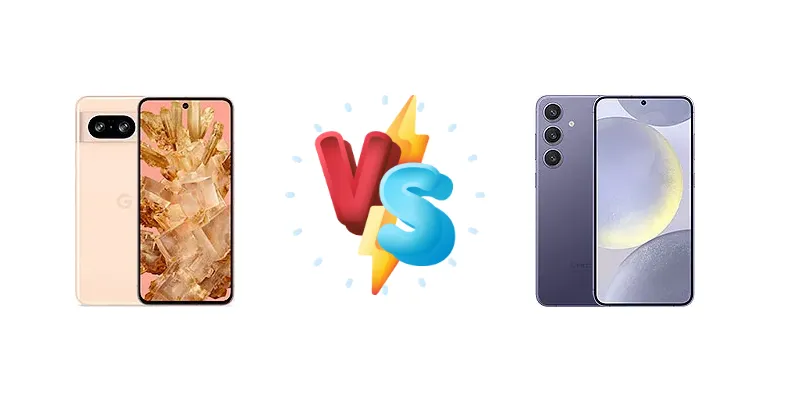
Google Pixel 8 vs Samsung Galaxy S24+: Which Flagship Reigns Supreme?
| Phones Images | |||||
|---|---|---|---|---|---|
|
🏆 Quick Verdict
For the average user prioritizing all-day battery life and consistently fast performance, the Samsung Galaxy S24+ emerges as the winner. Its 12:30h active use score and Snapdragon 8 Gen 3 (or Exynos 2400) chipset provide a noticeable edge, though the Pixel 8’s camera and AI features remain compelling.
| PHONES | ||
|---|---|---|
| Phone Names | Google Pixel 8 | Samsung Galaxy S24+ |
| Network | ||
|---|---|---|
| 2G bands | GSM 850 / 900 / 1800 / 1900 | GSM 850 / 900 / 1800 / 1900 |
| 3G bands | HSDPA 800 / 850 / 900 / 1700(AWS) / 1900 / 2100 | HSDPA 850 / 900 / 1700(AWS) / 1900 / 2100 |
| 4G bands | 1, 2, 3, 4, 5, 7, 8, 12, 13, 14, 17, 18, 19, 20, 25, 26, 28, 29, 30, 38, 40, 41, 46, 48, 66, 71 - GKWS6, G9BQD | 1, 2, 3, 4, 5, 7, 8, 12, 13, 17, 18, 19, 20, 25, 26, 28, 32, 38, 39, 40, 41, 66 - International |
| 5G bands | 1, 2, 3, 5, 7, 8, 12, 20, 25, 26, 28, 29, 30, 38, 40, 41, 48, 66, 70, 71, 77, 78, 258, 260, 261 SA/NSA/Sub6/mmWave - GKWS6 | 1, 2, 3, 5, 7, 8, 12, 20, 25, 26, 28, 38, 40, 41, 66, 75, 77, 78 SA/NSA/Sub6 - International |
| Speed | HSPA, LTE, 5G | HSPA, LTE (up to 7CA), 5G |
| Technology | GSM / HSPA / LTE / 5G | GSM / CDMA / HSPA / EVDO / LTE / 5G |
| Launch | ||
|---|---|---|
| Announced | 2023, October 04 | 2024, January 17 |
| Status | Available. Released 2023, October 12 | Available. Released 2024, January 24 |
| Body | ||
|---|---|---|
| Build | Glass front (Gorilla Glass Victus), glass back (Gorilla Glass Victus), aluminum frame | Glass front (Gorilla Glass Victus 2), glass back (Gorilla Glass Victus 2), aluminum frame |
| Dimensions | 150.5 x 70.8 x 8.9 mm (5.93 x 2.79 x 0.35 in) | 158.5 x 75.9 x 7.7 mm (6.24 x 2.99 x 0.30 in) |
| SIM | Nano-SIM + eSIM | · Nano-SIM + Nano-SIM + eSIM + eSIM (max 2 at a time) - INT· Nano-SIM + eSIM + eSIM (max 2 at a time) - USA· Nano-SIM + Nano-SIM - CN |
| Weight | 187 g (6.60 oz) | 196 g or 197 g (6.91 oz) |
| Display | ||
|---|---|---|
| Protection | Corning Gorilla Glass Victus | Corning Gorilla Glass Victus 2 |
| Resolution | 1080 x 2400 pixels, 20:9 ratio (~428 ppi density) | 1440 x 3120 pixels, 19.5:9 ratio (~513 ppi density) |
| Size | 6.2 inches, 91.1 cm2 (~85.5% screen-to-body ratio) | 6.7 inches, 110.2 cm2 (~91.6% screen-to-body ratio) |
| Type | OLED, 120Hz, HDR10+, 1400 nits (HBM), 2000 nits (peak) | Dynamic LTPO AMOLED 2X, 120Hz, HDR10+, 2600 nits (peak) |
| Platform | ||
|---|---|---|
| CPU | Nona-core (1x3.0 GHz Cortex-X3 & 4x2.45 GHz Cortex-A715 & 4x2.15 GHz Cortex-A510) | 8-core (1x3.39GHz Cortex-X4 & 3x3.1GHz Cortex-A720 & 2x2.9GHz Cortex-A720 & 2x2.2GHz Cortex-A520)10-core (1x3.2GHz Cortex-X4 & 2x2.9GHz Cortex-A720 & 3x2.6GHz Cortex-A720 & 4x1.95GHz Cortex-A520) |
| Chipset | Google Tensor G3 (4 nm) | Qualcomm SM8650-AC Snapdragon 8 Gen 3 (4 nm) - USA/Canada/ChinaExynos 2400 (4 nm) - International |
| GPU | Immortalis-G715s MC10 | Adreno 750 (1 GHz) - USA/Canada/ChinaXclipse 940 - International |
| OS | Android 14, upgradable to Android 16, up to 7 major Android upgrades | Android 14, up to 7 major Android upgrades, One UI 8.0 |
| Memory | ||
|---|---|---|
| Card slot | No | No |
| Internal | 128GB 8GB RAM, 256GB 8GB RAM | 256GB 12GB RAM, 512GB 12GB RAM |
| Main Camera | ||
|---|---|---|
| Dual | 50 MP (12 MP eff.), f/1.7, 25mm (wide), 1/1.31", 1.2µm, dual pixel PDAF, OIS 12 MP, f/2.2, 126˚ (ultrawide), 1/2.9", 1.25µm, AF | - |
| Features | Laser AF, Dual-LED flash, Pixel Shift, Ultra HDR, panorama, Best Take | LED flash, auto-HDR, panorama |
| Triple | - | 50 MP, f/1.8, 24mm (wide), 1/1.56", 1.0µm, dual pixel PDAF, OIS 10 MP, f/2.4, 67mm (telephoto), 1/3.94", 1.0µm, PDAF, OIS, 3x optical zoom 12 MP, f/2.2, 13mm, 120˚ (ultrawide), 1/2.55" 1.4µm, Super Steady video |
| Video | 4K@24/30/60fps, 1080p@30/60/120/240fps; gyro-EIS, OIS, 10-bit HDR | 8K@24/30fps, 4K@30/60fps, 1080p@30/60/120/240fps, HDR10+, stereo sound rec., gyro-EIS |
| Selfie camera | ||
|---|---|---|
| Features | HDR, panorama | HDR, HDR10+ |
| Single | 10.5 MP, f/2.2, 20mm (ultrawide), 1/3.1", 1.22µm | 12 MP, f/2.2, 26mm (wide), 1/3.2", 1.12µm, dual pixel PDAF |
| Video | 4K@24/30/60fps, 1080p@30/60fps | 4K@30/60fps, 1080p@30fps |
| Sound | ||
|---|---|---|
| 35mm jack | No | No |
| Loudspeaker | Yes, with stereo speakers | Yes, with stereo speakers |
| Comms | ||
|---|---|---|
| Bluetooth | 5.3, A2DP, LE, aptX HD | 5.3, A2DP, LE |
| NFC | Yes | Yes |
| Positioning | GPS (L1+L5), GLONASS (G1), GALILEO (E1+E5a), QZSS (L1+L5) | GPS, GLONASS, BDS, GALILEO, QZSS |
| Radio | No | No |
| USB | USB Type-C 3.2 | USB Type-C 3.2, DisplayPort 1.2, OTG |
| WLAN | Wi-Fi 802.11 a/b/g/n/ac/6e/7, tri-band, Wi-Fi Direct | Wi-Fi 802.11 a/b/g/n/ac/6e, tri-band, Wi-Fi Direct |
| Features | ||
|---|---|---|
| Sensors | Fingerprint (under display, optical), accelerometer, gyro, proximity, compass, barometer | Fingerprint (under display, ultrasonic), accelerometer, gyro, proximity, compass, barometer |
| Battery | ||
|---|---|---|
| Charging | 27W wired, PD3.0, PPS, 50% in 30 min 18W wireless Reverse wireless Bypass charging | 45W wired, PD3.0, 65% in 30 min 15W wireless (Qi) 4.5W reverse wireless |
| Type | Li-Ion 4575 mAh | Li-Ion 4900 mAh |
| Misc | ||
|---|---|---|
| Colors | Obsidian, Hazel, Rose, Mint | Onyx Black, Marble Grey, Cobalt Violet, Amber Yellow, Jade Green, Sandstone Orange, Sapphire Blue |
| Models | GKWS6, G9BQD, GA04851-US, GZPFO, GPJ41 | SM-S926B, SM-S926B/DS, SM-S926U, SM-S926U1, SM-S926W, SM-S926N, SM-S9260, SM-S926E, SM-S926E/DS |
| Price | € 296.00 / $ 268.93 / £ 260.00 / ₹ 38,999 | $ 429.50 / € 549.00 / £ 445.98 |
| SAR | - | 1.16 W/kg (head) 0.84 W/kg (body) |
| SAR EU | - | 0.74 W/kg (head) 1.25 W/kg (body) |
Google Pixel 8
- Exceptional computational photography and AI features
- Seamless Google ecosystem integration
- Compact and comfortable design
- Shorter battery life compared to S24+
- Less powerful chipset than Snapdragon 8 Gen 3
Samsung Galaxy S24+
- Longer battery life and faster charging
- Powerful Snapdragon 8 Gen 3 (or competitive Exynos 2400)
- Brighter display with potential LTPO technology
- Samsung’s One UI can be overwhelming for some users
- Image processing can be overly saturated
Display Comparison
Both the Pixel 8 and Galaxy S24+ boast excellent displays, achieving nearly identical peak brightness levels at 1446 and 1452 nits respectively. This ensures excellent visibility even in direct sunlight. However, Samsung’s display technology is likely to be LTPO, enabling adaptive refresh rates for improved power efficiency, a feature not explicitly stated for the Pixel 8. While both offer vibrant colors, Samsung’s historically accurate color calibration may appeal to professionals, while the Pixel 8’s display is tuned for a more consumer-friendly look.
Camera Comparison
Both phones excel in photography and videography, but approach it differently. The Pixel 8 leverages Google’s renowned computational photography algorithms to produce stunning images, particularly in challenging lighting conditions. While sensor sizes aren’t specified, the Pixel 8’s strength lies in its software processing. The S24+ likely features a larger main sensor, enabling better light capture and detail. Samsung’s image processing tends to be more saturated and vibrant, appealing to a broader audience. Both phones offer robust video capabilities, but the Pixel 8’s video features are heavily integrated with its AI capabilities, such as Audio Magic Eraser. The usefulness of the 2MP macro cameras on both devices is questionable, offering limited benefit over the main sensor’s close-up capabilities.
Performance
The core performance difference lies in the chipset. The Galaxy S24+ utilizes the Qualcomm Snapdragon 8 Gen 3 (in USA/Canada/China) or the Exynos 2400 (International). The Snapdragon 8 Gen 3, with its Cortex-X4 prime core clocked at 3.39GHz, offers a significant performance uplift over the Pixel 8’s Google Tensor G3. The Tensor G3’s nona-core configuration, while optimized for AI tasks, doesn’t match the raw processing power of the Snapdragon. The S24+’s CPU architecture (8-core vs 9-core) and higher clock speeds translate to faster app loading, smoother multitasking, and better sustained performance in demanding games. The Exynos 2400 variant, while competitive, may exhibit slightly lower thermal efficiency than the Snapdragon, potentially leading to more throttling under prolonged load.
Battery Life
The Galaxy S24+ demonstrates a clear advantage in battery endurance, achieving an active use score of 12:30h compared to the Pixel 8’s 11:17h. While the Pixel 8’s older endurance rating of 83 hours suggests respectable standby time, the S24+’s larger battery capacity and more efficient chipset contribute to longer real-world usage. Charging speeds also favor the S24+, with 45W wired charging reaching 65% in 30 minutes, versus the Pixel 8’s 27W charging reaching 50% in the same timeframe. The S24+ also supports PD3.0 and PPS for faster charging, while the Pixel 8 offers convenient bypass charging.
Buying Guide
Buy the Google Pixel 8 if you need a smartphone with exceptional computational photography, seamless Google ecosystem integration, and a focus on AI-powered features like Magic Eraser and Best Take. Buy the Samsung Galaxy S24+ if you prefer a device with longer battery life, faster charging, and a more versatile feature set, including DeX and a brighter display, even if it means sacrificing some of Google’s unique software experiences.