
Google Pixel 8 vs Samsung Galaxy S24 FE: Which Flagship Killer Reigns Supreme?
| Phones Images | |||||
|---|---|---|---|---|---|
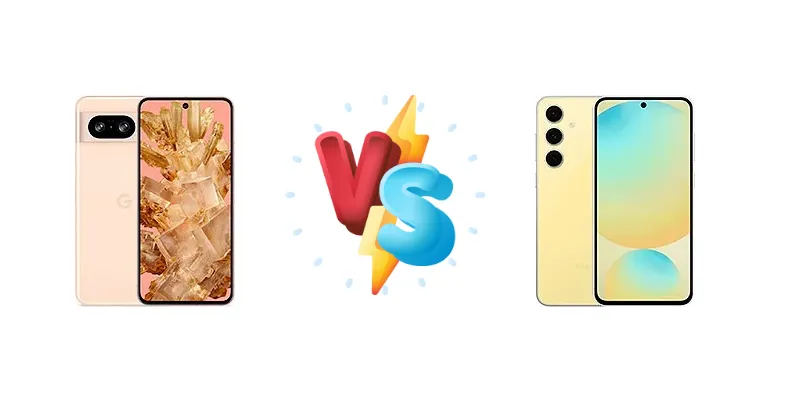
|
🏆 Quick Verdict
For the average user prioritizing computational photography and a streamlined software experience, the Google Pixel 8 emerges as the winner. While the S24 FE boasts a slightly longer active use battery life and a more powerful core CPU clock speed, the Pixel 8’s Tensor G3 excels in AI-driven tasks and offers a more cohesive user experience.
| PHONES | ||
|---|---|---|
| Phone Names | Google Pixel 8 | Samsung Galaxy S24 FE |
| Network | ||
|---|---|---|
| 2G bands | GSM 850 / 900 / 1800 / 1900 | GSM 850 / 900 / 1800 / 1900 |
| 3G bands | HSDPA 800 / 850 / 900 / 1700(AWS) / 1900 / 2100 | HSDPA 850 / 900 / 1700(AWS) / 1900 / 2100 |
| 4G bands | 1, 2, 3, 4, 5, 7, 8, 12, 13, 14, 17, 18, 19, 20, 25, 26, 28, 29, 30, 38, 40, 41, 46, 48, 66, 71 - GKWS6, G9BQD | 1, 2, 3, 4, 5, 7, 8, 12, 17, 18, 19, 20, 25, 26, 28, 32, 38, 40, 41, 66 - International |
| 5G bands | 1, 2, 3, 5, 7, 8, 12, 20, 25, 26, 28, 29, 30, 38, 40, 41, 48, 66, 70, 71, 77, 78, 258, 260, 261 SA/NSA/Sub6/mmWave - GKWS6 | 1, 2, 3, 5, 7, 8, 12, 20, 25, 26, 28, 38, 40, 41, 66, 75, 77, 78 SA/NSA/Sub6 - International |
| Speed | HSPA, LTE, 5G | HSPA, LTE, 5G |
| Technology | GSM / HSPA / LTE / 5G | GSM / HSPA / LTE / 5G |
| Launch | ||
|---|---|---|
| Announced | 2023, October 04 | 2024, September 26 |
| Status | Available. Released 2023, October 12 | Available. Released 2024, October 03 |
| Body | ||
|---|---|---|
| Build | Glass front (Gorilla Glass Victus), glass back (Gorilla Glass Victus), aluminum frame | Glass front (Gorilla Glass Victus+), glass back (Gorilla Glass Victus+), aluminum frame |
| Dimensions | 150.5 x 70.8 x 8.9 mm (5.93 x 2.79 x 0.35 in) | 162 x 77.3 x 8 mm (6.38 x 3.04 x 0.31 in) |
| SIM | Nano-SIM + eSIM | · Nano-SIM· Nano-SIM + Nano-SIM· Nano-SIM + eSIM· eSIM + eSIM |
| Weight | 187 g (6.60 oz) | 213 g (7.51 oz) |
| Display | ||
|---|---|---|
| Protection | Corning Gorilla Glass Victus | Corning Gorilla Glass Victus+, Mohs level 5 |
| Resolution | 1080 x 2400 pixels, 20:9 ratio (~428 ppi density) | 1080 x 2340 pixels, 19.5:9 ratio (~385 ppi density) |
| Size | 6.2 inches, 91.1 cm2 (~85.5% screen-to-body ratio) | 6.7 inches, 110.2 cm2 (~88.0% screen-to-body ratio) |
| Type | OLED, 120Hz, HDR10+, 1400 nits (HBM), 2000 nits (peak) | Dynamic AMOLED 2X, 120Hz, HDR10+, 1900 nits (peak) |
| Platform | ||
|---|---|---|
| CPU | Nona-core (1x3.0 GHz Cortex-X3 & 4x2.45 GHz Cortex-A715 & 4x2.15 GHz Cortex-A510) | 10-core (1x3.1 GHz + 2x2.9 GHz + 3x2.6 GHz + 4x1.95 GHz) |
| Chipset | Google Tensor G3 (4 nm) | Exynos 2400e (4 nm) |
| GPU | Immortalis-G715s MC10 | Xclipse 940 |
| OS | Android 14, upgradable to Android 16, up to 7 major Android upgrades | Android 14, up to 7 major Android upgrades, One UI 8.0 |
| Memory | ||
|---|---|---|
| Card slot | No | No |
| Internal | 128GB 8GB RAM, 256GB 8GB RAM | 128GB 8GB RAM, 256GB 8GB RAM, 512GB 8GB RAM |
| Main Camera | ||
|---|---|---|
| Dual | 50 MP (12 MP eff.), f/1.7, 25mm (wide), 1/1.31", 1.2µm, dual pixel PDAF, OIS 12 MP, f/2.2, 126˚ (ultrawide), 1/2.9", 1.25µm, AF | - |
| Features | Laser AF, Dual-LED flash, Pixel Shift, Ultra HDR, panorama, Best Take | LED flash, HDR, panorama |
| Triple | - | 50 MP, f/1.8, 24mm (wide), 1/1.57", 1.0µm, dual pixel PDAF, OIS 8 MP, f/2.4, 75mm (telephoto), 1/4.4", 1.0µm, PDAF, OIS, 3x optical zoom 12 MP, f/2.2, 13mm, 123˚ (ultrawide), 1/3.0", 1.12µm |
| Video | 4K@24/30/60fps, 1080p@30/60/120/240fps; gyro-EIS, OIS, 10-bit HDR | 8K@30fps, 4K@30/60/120fps, 1080p@30/60/120/240fps |
| Selfie camera | ||
|---|---|---|
| Features | HDR, panorama | - |
| Single | 10.5 MP, f/2.2, 20mm (ultrawide), 1/3.1", 1.22µm | 10 MP, f/2.4, 26mm (wide), 1/3.0", 1.22µm |
| Video | 4K@24/30/60fps, 1080p@30/60fps | 4K@30/60fps, 1080p@30/60fps; gyro-EIS |
| Sound | ||
|---|---|---|
| 35mm jack | No | No |
| Loudspeaker | Yes, with stereo speakers | Yes, with stereo speakers |
| Comms | ||
|---|---|---|
| Bluetooth | 5.3, A2DP, LE, aptX HD | 5.3, A2DP, LE |
| NFC | Yes | Yes |
| Positioning | GPS (L1+L5), GLONASS (G1), GALILEO (E1+E5a), QZSS (L1+L5) | GPS, GLONASS, GALILEO, BDS |
| Radio | No | Unspecified |
| USB | USB Type-C 3.2 | USB Type-C 3.2, OTG |
| WLAN | Wi-Fi 802.11 a/b/g/n/ac/6e/7, tri-band, Wi-Fi Direct | Wi-Fi 802.11 a/b/g/n/ac/6e, dual-band or tri-band (market/region dependent), Wi-Fi Direct |
| Features | ||
|---|---|---|
| Sensors | Fingerprint (under display, optical), accelerometer, gyro, proximity, compass, barometer | Fingerprint (under display, optical), accelerometer, gyro, compass |
| Battery | ||
|---|---|---|
| Charging | 27W wired, PD3.0, PPS, 50% in 30 min 18W wireless Reverse wireless Bypass charging | 25W wired, PD, QC2, 50% in 30 min 15W wireless Reverse wireless |
| Type | Li-Ion 4575 mAh | 4700 mAh |
| Misc | ||
|---|---|---|
| Colors | Obsidian, Hazel, Rose, Mint | Blue, Graphite, Gray, Mint, Yellow |
| Models | GKWS6, G9BQD, GA04851-US, GZPFO, GPJ41 | SM-S721B, SM-S721B/DS, SM-S721U1, SM-S721U, SM-S721W, SM-S7210, SM-S721N |
| Price | € 296.00 / $ 268.93 / £ 260.00 / ₹ 38,999 | $ 249.74 / C$ 498.99 / £ 335.00 / € 387.00 / ₹ 34,180 |
| SAR | - | 0.94 W/kg (head) 0.71 W/kg (body) |
| SAR EU | - | 0.86 W/kg (head) 1.29 W/kg (body) |
| EU LABEL | ||
|---|---|---|
| Battery | - | 42:00h endurance, 2000 cycles |
| Energy | - | Class B |
| Free fall | - | Class A (270 falls) |
| Repairability | - | Class C |
Google Pixel 8
- Exceptional camera with AI-powered features
- Clean and intuitive software experience
- Faster wireless charging (18W vs 15W)
- Slightly lower peak CPU clock speed
- No LTPO display for variable refresh rate
Samsung Galaxy S24 FE
- Longer battery endurance and 2000 charge cycles
- More powerful CPU core clock speed
- Customizable One UI software
- Lower peak display brightness
- Less refined camera image processing
Display Comparison
Both the Pixel 8 and S24 FE feature vibrant displays, but the Pixel 8 edges out the competition with a measured peak brightness of 1446 nits compared to the S24 FE’s 1372 nits. This translates to better visibility in direct sunlight. While both lack LTPO technology for variable refresh rates, the Pixel 8’s color accuracy is generally considered superior, offering more natural-looking images. The S24 FE’s display, while still excellent, leans towards Samsung’s signature saturated color profile.
Camera Comparison
The Pixel 8’s camera system is renowned for its computational photography prowess, leveraging Google’s AI algorithms to produce stunning images, even in challenging lighting conditions. While specific sensor details are not provided, the Pixel 8’s image processing excels in dynamic range and detail preservation. The S24 FE’s camera, while capable, relies more on hardware specifications. The absence of detailed sensor information makes a direct comparison difficult, but Samsung’s history suggests a focus on vibrant colors and sharp details. The Pixel 8’s video capabilities are also highly regarded, offering excellent stabilization and dynamic range.
Performance
The chipset battle pits Google’s Tensor G3 (4nm) against Samsung’s Exynos 2400e (4nm). The S24 FE’s 10-core CPU, with a peak clock speed of 3.1 GHz, appears more potent on paper than the Pixel 8’s 9-core Tensor G3 at 3.0 GHz. However, the Tensor G3’s strength lies in its dedicated AI processing unit, enabling features like Magic Eraser and real-time translation. The Exynos 2400e focuses on raw CPU and GPU power, potentially benefiting users engaged in intensive gaming or video editing. Both utilize a 4nm process, suggesting comparable thermal efficiency, though real-world testing would be needed to confirm sustained performance under load.
Battery Life
The Samsung Galaxy S24 FE boasts an impressive endurance rating of 42:00h and a claimed 2000 charge cycles, suggesting long-term battery health. However, the Pixel 8 holds its own with an active use score of 11:17h, only slightly behind the S24 FE’s 11:48h. Both phones support 50% charging in 30 minutes, with the S24 FE offering 25W wired charging and the Pixel 8 at 27W. The S24 FE’s 15W wireless charging is slower than the Pixel 8’s 18W, but both offer reverse wireless charging for topping up accessories.
Buying Guide
Buy the Google Pixel 8 if you need a smartphone with exceptional camera capabilities, particularly in computational photography and video processing, and value a clean, AI-powered software experience with guaranteed updates. Buy the Samsung Galaxy S24 FE if you prefer a more customizable Android experience, prioritize raw processing power for demanding tasks, and appreciate the longevity offered by Samsung’s 2000-cycle battery promise.