
Google Pixel 8 vs OnePlus 12R: A Deep Dive into Performance, Camera, and Battery Life
| Phones Images | |||||
|---|---|---|---|---|---|
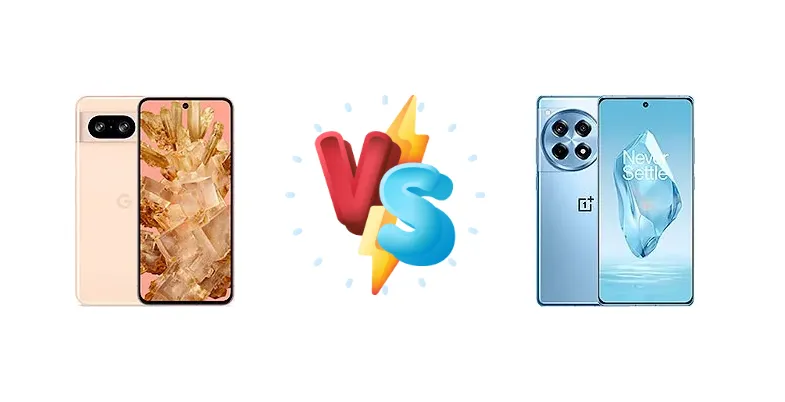
|
🏆 Quick Verdict
For the average user prioritizing camera quality and software experience, the Google Pixel 8 is the better choice. However, the OnePlus 12R delivers superior battery life and significantly faster charging, making it ideal for power users and gamers who demand all-day endurance and quick top-ups.
| PHONES | ||
|---|---|---|
| Phone Names | Google Pixel 8 | OnePlus 12R |
| Network | ||
|---|---|---|
| 2G bands | GSM 850 / 900 / 1800 / 1900 | GSM 850 / 900 / 1800 / 1900 |
| 3G bands | HSDPA 800 / 850 / 900 / 1700(AWS) / 1900 / 2100 | HSDPA 850 / 900 / 1700(AWS) / 1900 / 2100 |
| 4G bands | 1, 2, 3, 4, 5, 7, 8, 12, 13, 14, 17, 18, 19, 20, 25, 26, 28, 29, 30, 38, 40, 41, 46, 48, 66, 71 - GKWS6, G9BQD | 1, 2, 3, 4, 5, 7, 8, 12, 17, 18, 19, 20, 26, 28, 32, 38, 39, 40, 41, 66 |
| 5G bands | 1, 2, 3, 5, 7, 8, 12, 20, 25, 26, 28, 29, 30, 38, 40, 41, 48, 66, 70, 71, 77, 78, 258, 260, 261 SA/NSA/Sub6/mmWave - GKWS6 | 1, 2, 3, 5, 7, 8, 12, 20, 28, 38, 40, 41, 66, 77, 78 SA/NSA |
| Speed | HSPA, LTE, 5G | HSPA, LTE, 5G |
| Technology | GSM / HSPA / LTE / 5G | GSM / CDMA / HSPA / LTE / 5G |
| Launch | ||
|---|---|---|
| Announced | 2023, October 04 | 2024, January 23 |
| Status | Available. Released 2023, October 12 | Available. Released 2024, February 06 |
| Body | ||
|---|---|---|
| Build | Glass front (Gorilla Glass Victus), glass back (Gorilla Glass Victus), aluminum frame | Glass front (Gorilla Glass Victus 2), aluminum frame, glass back |
| Dimensions | 150.5 x 70.8 x 8.9 mm (5.93 x 2.79 x 0.35 in) | 163.3 x 75.3 x 8.8 mm (6.43 x 2.96 x 0.35 in) |
| SIM | Nano-SIM + eSIM | · Nano-SIM + Nano-SIM + eSIM (max 2 at a time)· Nano-SIM + Nano-SIM |
| Weight | 187 g (6.60 oz) | 207 g (7.30 oz) |
| Display | ||
|---|---|---|
| Protection | Corning Gorilla Glass Victus | Corning Gorilla Glass Victus 2 |
| Resolution | 1080 x 2400 pixels, 20:9 ratio (~428 ppi density) | 1264 x 2780 pixels (~450 ppi density) |
| Size | 6.2 inches, 91.1 cm2 (~85.5% screen-to-body ratio) | 6.78 inches, 111.7 cm2 (~90.9% screen-to-body ratio) |
| Type | OLED, 120Hz, HDR10+, 1400 nits (HBM), 2000 nits (peak) | LTPO4 AMOLED, 1B colors, 120Hz, HDR10+, Dolby Vision, 1600 nits (HBM), 4500 nits (peak) |
| Platform | ||
|---|---|---|
| CPU | Nona-core (1x3.0 GHz Cortex-X3 & 4x2.45 GHz Cortex-A715 & 4x2.15 GHz Cortex-A510) | Octa-core (1x3.2 GHz Cortex-X3 & 2x2.8 GHz Cortex-A715 & 2x2.8 GHz Cortex-A710 & 3x2.0 GHz Cortex-A510) |
| Chipset | Google Tensor G3 (4 nm) | Qualcomm SM8550-AB Snapdragon 8 Gen 2 (4 nm) |
| GPU | Immortalis-G715s MC10 | Adreno 740 |
| OS | Android 14, upgradable to Android 16, up to 7 major Android upgrades | Android 14, up to 3 major Android upgrades, OxygenOS 15 |
| Memory | ||
|---|---|---|
| Card slot | No | No |
| Internal | 128GB 8GB RAM, 256GB 8GB RAM | 128GB 8GB RAM, 256GB 8GB RAM, 256GB 12GB RAM, 256GB 16GB RAM |
| Main Camera | ||
|---|---|---|
| Dual | 50 MP (12 MP eff.), f/1.7, 25mm (wide), 1/1.31", 1.2µm, dual pixel PDAF, OIS 12 MP, f/2.2, 126˚ (ultrawide), 1/2.9", 1.25µm, AF | - |
| Features | Laser AF, Dual-LED flash, Pixel Shift, Ultra HDR, panorama, Best Take | Laser AF, color spectrum sensor, LED flash, HDR, panorama |
| Triple | - | 50 MP, f/1.8, 24mm (wide), 1/1.56", 1.0µm, multi-directional PDAF, OIS 8 MP, f/2.2, 16mm, 112˚ (ultrawide), 1/4.0", 1.12µm 2 MP (macro) |
| Video | 4K@24/30/60fps, 1080p@30/60/120/240fps; gyro-EIS, OIS, 10-bit HDR | 4K@30/60fps, 1080p@30/60/120/240fps, gyro-EIS, OIS |
| Selfie camera | ||
|---|---|---|
| Features | HDR, panorama | HDR, panorama |
| Single | 10.5 MP, f/2.2, 20mm (ultrawide), 1/3.1", 1.22µm | 16 MP, f/2.4, 26mm (wide), 1/3", 1.0µm |
| Video | 4K@24/30/60fps, 1080p@30/60fps | 1080p@30fps, gyro-EIS |
| Sound | ||
|---|---|---|
| 35mm jack | No | No |
| Loudspeaker | Yes, with stereo speakers | Yes, with stereo speakers |
| Comms | ||
|---|---|---|
| Bluetooth | 5.3, A2DP, LE, aptX HD | 5.3, A2DP, LE, aptX HD |
| Infrared port | - | Yes |
| NFC | Yes | Yes |
| Positioning | GPS (L1+L5), GLONASS (G1), GALILEO (E1+E5a), QZSS (L1+L5) | GPS, GALILEO, GLONASS, BDS, QZSS |
| Radio | No | No |
| USB | USB Type-C 3.2 | USB Type-C 2.0 |
| WLAN | Wi-Fi 802.11 a/b/g/n/ac/6e/7, tri-band, Wi-Fi Direct | Wi-Fi 802.11 a/b/g/n/ac/6/7, dual-band |
| Features | ||
|---|---|---|
| Sensors | Fingerprint (under display, optical), accelerometer, gyro, proximity, compass, barometer | Fingerprint (under display, optical), accelerometer, gyro, proximity, compass |
| Battery | ||
|---|---|---|
| Charging | 27W wired, PD3.0, PPS, 50% in 30 min 18W wireless Reverse wireless Bypass charging | 100W wired, 100% in 26 min |
| Type | Li-Ion 4575 mAh | Li-Ion 5500 mAh |
| Misc | ||
|---|---|---|
| Colors | Obsidian, Hazel, Rose, Mint | Iron Gray, Cool Blue, Electric Violet, Sunset Dune |
| Models | GKWS6, G9BQD, GA04851-US, GZPFO, GPJ41 | CPH2609, CPH2585, CPH2611 |
| Price | € 296.00 / $ 268.93 / £ 260.00 / ₹ 38,999 | € 410.84 / $ 399.95 / £ 649.00 |
| SAR | - | 1.19 W/kg (head) 0.82 W/kg (body) |
Google Pixel 8
- Superior camera and image processing
- AI-powered features and software experience
- Brighter display for outdoor visibility
- Shorter battery life compared to the 12R
- Slower charging speed
OnePlus 12R
- Exceptional battery life and endurance
- Blazing-fast 100W charging
- Powerful Snapdragon 8 Gen 2 processor
- Less refined camera experience
- Software updates may be less frequent
Display Comparison
The Pixel 8 boasts a measured peak brightness of 1446 nits, exceeding the OnePlus 12R’s 1181 nits. While both displays are excellent, the Pixel 8’s higher brightness translates to better visibility in direct sunlight. Both likely utilize OLED panels, but the Pixel 8’s panel is expected to have a variable refresh rate (LTPO) for improved efficiency, a feature not explicitly stated for the 12R. The difference in peak brightness is noticeable, making the Pixel 8 the better choice for outdoor use.
Camera Comparison
The context data doesn't provide detailed camera specs, but the Pixel 8 is renowned for its computational photography prowess, leveraging Google’s image processing algorithms. While the 12R likely features a capable camera system, the Pixel 8’s strength lies in its ability to extract detail and dynamic range in challenging lighting conditions. The Pixel 8’s video capabilities are also expected to be superior, benefiting from the Tensor G3’s dedicated image signal processor (ISP). Without specific sensor details for the 12R, it’s safe to assume the Pixel 8 holds an advantage in overall image quality and versatility.
Performance
The OnePlus 12R leverages the Qualcomm Snapdragon 8 Gen 2 (SM8550-AB), an octa-core chipset with a peak clock speed of 3.2 GHz on its Cortex-X3 prime core. This contrasts with the Pixel 8’s Google Tensor G3, a nona-core chip clocked at 3.0 GHz. While core count differs, the Snapdragon 8 Gen 2 is widely recognized for its superior GPU performance and thermal efficiency. The 12R’s CPU configuration (1x3.2GHz + 2x2.8GHz + 2x2.8GHz + 3x2.0GHz) provides a balanced approach, while the Tensor G3 prioritizes AI and machine learning tasks. The Snapdragon 8 Gen 2’s 4nm process node contributes to better sustained performance under heavy load, minimizing throttling during extended gaming sessions.
Battery Life
The OnePlus 12R shines in battery endurance, achieving an active use score of 14:32h, significantly outperforming the Pixel 8’s 11:17h. This difference is further amplified by the 12R’s 100W wired charging, capable of a full charge in just 26 minutes, compared to the Pixel 8’s 27W charging which takes 30 minutes for 50%. The Pixel 8 offers 18W wireless and reverse wireless charging, features absent in the 12R. However, the 12R’s faster charging and longer battery life make it the clear winner for users who prioritize minimizing downtime.
Buying Guide
Buy the Google Pixel 8 if you need a consistently excellent camera experience, seamless software updates, and benefit from Google's AI-powered features. Buy the OnePlus 12R if you prioritize long battery life, blazing-fast 100W charging, and raw processing power for demanding tasks like gaming, all without breaking the bank.