
Pixel 8 vs. Motorola Edge+ (2023): A Deep Dive into Android Flagships
| Phones Images | |||||
|---|---|---|---|---|---|
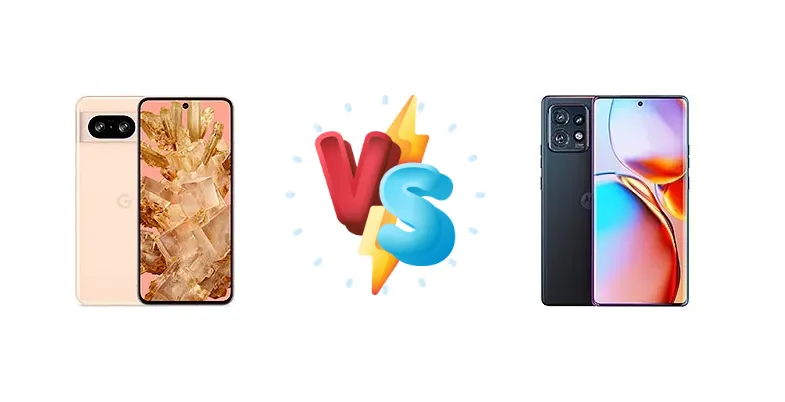
|
🏆 Quick Verdict
For the average user prioritizing camera quality, software experience, and long-term support, the Google Pixel 8 is the better choice. However, power users and gamers will find the Motorola Edge+ (2023)'s Snapdragon 8 Gen 2 and faster charging more appealing.
| PHONES | ||
|---|---|---|
| Phone Names | Google Pixel 8 | Motorola Edge+ (2023) |
| Network | ||
|---|---|---|
| 2G bands | GSM 850 / 900 / 1800 / 1900 | GSM 850 / 900 / 1800 / 1900 |
| 3G bands | HSDPA 800 / 850 / 900 / 1700(AWS) / 1900 / 2100 | HSDPA 850 / 900 / 1700(AWS) / 1900 / 2100 |
| 4G bands | 1, 2, 3, 4, 5, 7, 8, 12, 13, 14, 17, 18, 19, 20, 25, 26, 28, 29, 30, 38, 40, 41, 46, 48, 66, 71 - GKWS6, G9BQD | 1, 2, 3, 4, 5, 7, 8, 12, 13, 14, 17, 18, 20, 25, 26, 28, 29, 30, 38, 39, 40, 41, 41, 46, 48, 66, 71 |
| 5G bands | 1, 2, 3, 5, 7, 8, 12, 20, 25, 26, 28, 29, 30, 38, 40, 41, 48, 66, 70, 71, 77, 78, 258, 260, 261 SA/NSA/Sub6/mmWave - GKWS6 | 1, 2, 3, 5, 7, 12, 14, 20, 25, 26, 28, 29, 30, 38, 41, 41, 48, 66, 70, 71, 77, 78 SA/NSA/Sub6/mmWave |
| Speed | HSPA, LTE, 5G | HSPA, LTE, 5G |
| Technology | GSM / HSPA / LTE / 5G | GSM / HSPA / LTE / 5G |
| Launch | ||
|---|---|---|
| Announced | 2023, October 04 | 2023, May 02 |
| Status | Available. Released 2023, October 12 | Available. Released 2023, May 19 |
| Body | ||
|---|---|---|
| Build | Glass front (Gorilla Glass Victus), glass back (Gorilla Glass Victus), aluminum frame | Glass front (Gorilla Glass Victus), glass back (Gorilla Glass Victus), aluminum frame |
| Dimensions | 150.5 x 70.8 x 8.9 mm (5.93 x 2.79 x 0.35 in) | 161.2 x 74 x 8.6 mm (6.35 x 2.91 x 0.34 in) |
| SIM | Nano-SIM + eSIM | Nano-SIM + eSIM |
| Weight | 187 g (6.60 oz) | 203 g (7.16 oz) |
| - | IP68 dust/water resistant (up to 1.5m for 30 min) | |
| Display | ||
|---|---|---|
| Protection | Corning Gorilla Glass Victus | Corning Gorilla Glass Victus |
| Resolution | 1080 x 2400 pixels, 20:9 ratio (~428 ppi density) | 1080 x 2400 pixels, 20:9 ratio (~395 ppi density) |
| Size | 6.2 inches, 91.1 cm2 (~85.5% screen-to-body ratio) | 6.67 inches, 107.4 cm2 (~90.0% screen-to-body ratio) |
| Type | OLED, 120Hz, HDR10+, 1400 nits (HBM), 2000 nits (peak) | OLED, 1B colors, 165Hz, HDR10+, Dolby Vision, 1300 nits (peak) |
| Platform | ||
|---|---|---|
| CPU | Nona-core (1x3.0 GHz Cortex-X3 & 4x2.45 GHz Cortex-A715 & 4x2.15 GHz Cortex-A510) | Octa-core (1x3.2 GHz Cortex-X3 & 2x2.8 GHz Cortex-A715 & 2x2.8 GHz Cortex-A710 & 3x2.0 GHz Cortex-A510) |
| Chipset | Google Tensor G3 (4 nm) | Qualcomm SM8550-AB Snapdragon 8 Gen 2 (4 nm) |
| GPU | Immortalis-G715s MC10 | Adreno 740 |
| OS | Android 14, upgradable to Android 16, up to 7 major Android upgrades | Android 13, upgradable to Android 14 |
| Memory | ||
|---|---|---|
| Card slot | No | No |
| Internal | 128GB 8GB RAM, 256GB 8GB RAM | 512GB 8GB RAM |
| - | UFS 4.0 | |
| Main Camera | ||
|---|---|---|
| Dual | 50 MP (12 MP eff.), f/1.7, 25mm (wide), 1/1.31", 1.2µm, dual pixel PDAF, OIS 12 MP, f/2.2, 126˚ (ultrawide), 1/2.9", 1.25µm, AF | - |
| Features | Laser AF, Dual-LED flash, Pixel Shift, Ultra HDR, panorama, Best Take | Dual-LED flash, panorama, HDR |
| Triple | - | 50 MP, f/1.8, (wide), 1/1.55", 1.0µm, multi-directional PDAF, OIS 12 MP, f/1.6, (telephoto), 1/2.93", 1.22µm, PDAF, 2x optical zoom 50 MP, f/2.2, 114˚ (ultrawide), 1/2.76", 0.64µm, AF |
| Video | 4K@24/30/60fps, 1080p@30/60/120/240fps; gyro-EIS, OIS, 10-bit HDR | 8K@30fps, 4K@30/60fps, 1080p@30/60/120/240/960fps, 10-bit HDR10+, gyro-EIS |
| Selfie camera | ||
|---|---|---|
| Features | HDR, panorama | HDR |
| Single | 10.5 MP, f/2.2, 20mm (ultrawide), 1/3.1", 1.22µm | 60 MP, f/2.2, (wide), 1/2.8", 0.61µm |
| Video | 4K@24/30/60fps, 1080p@30/60fps | 4K@30/60fps, 1080p@30/60/120/240fps |
| Sound | ||
|---|---|---|
| 3.5mm jack | - | No |
| 35mm jack | No | No |
| Loudspeaker | Yes, with stereo speakers | Yes, with stereo speakers |
| Comms | ||
|---|---|---|
| Bluetooth | 5.3, A2DP, LE, aptX HD | 5.3, A2DP, LE, aptX HD, aptX Adaptive |
| NFC | Yes | Yes |
| Positioning | GPS (L1+L5), GLONASS (G1), GALILEO (E1+E5a), QZSS (L1+L5) | GPS, GLONASS, GALILEO, BDS |
| Radio | No | No |
| USB | USB Type-C 3.2 | USB Type-C 3.2, OTG, DisplayPort 1.4 |
| WLAN | Wi-Fi 802.11 a/b/g/n/ac/6e/7, tri-band, Wi-Fi Direct | Wi-Fi 802.11 a/b/g/n/ac/6e/7, tri-band, Wi-Fi Direct |
| Features | ||
|---|---|---|
| Sensors | Fingerprint (under display, optical), accelerometer, gyro, proximity, compass, barometer | Fingerprint (under display, optical), accelerometer, gyro, proximity, compass, barometer |
| - | Ready For 3.5 support | |
| Battery | ||
|---|---|---|
| Charging | 27W wired, PD3.0, PPS, 50% in 30 min 18W wireless Reverse wireless Bypass charging | 68W wired 15W wireless 5W reverse wired 5W reverse wireless |
| Type | Li-Ion 4575 mAh | Li-Po 5100 mAh |
| Misc | ||
|---|---|---|
| Colors | Obsidian, Hazel, Rose, Mint | Interstellar Black |
| Models | GKWS6, G9BQD, GA04851-US, GZPFO, GPJ41 | - |
| Price | € 296.00 / $ 268.93 / £ 260.00 / ₹ 38,999 | $ 298.99 |
Google Pixel 8
- Exceptional camera and image processing
- Clean and intuitive software experience
- Guaranteed software updates and long-term support
- Slower charging speeds compared to the Edge+
- Tensor G3 chip may not match Snapdragon 8 Gen 2 in raw performance
Motorola Edge+ (2023)
- Powerful Snapdragon 8 Gen 2 processor
- Ultra-fast 68W wired charging
- Potentially larger display for immersive viewing
- Software updates may be less frequent than Pixel
- Camera performance may rely more on hardware than software
Display Comparison
The Pixel 8 boasts a measured peak brightness of 1446 nits, ensuring excellent visibility even in direct sunlight. While the Edge+ (2023) display specs aren't provided, Motorola typically utilizes high-quality OLED panels. The Pixel 8’s smaller size (6.2 inches vs. the Edge+'s likely larger panel) contributes to a higher pixel density, potentially resulting in a sharper image. The Pixel 8’s display technology is likely to include LTPO for variable refresh rates, improving battery efficiency, a feature not confirmed for the Edge+.
Camera Comparison
Both devices are expected to deliver strong camera performance, but approach it differently. The Pixel 8’s strength lies in Google’s computational photography prowess, leveraging its Tensor G3 chip for advanced image processing. While specific sensor details are missing, Pixel phones consistently excel in dynamic range and low-light performance. The Edge+ (2023) likely relies on a high-resolution sensor and Qualcomm’s image signal processor. The Pixel 8’s focus is on software-driven enhancements, while the Edge+ may prioritize capturing more raw data. Without detailed sensor specs for the Edge+, it’s difficult to definitively declare a winner, but the Pixel 8’s established track record in computational photography gives it an edge.
Performance
The Motorola Edge+ (2023) leverages the Qualcomm Snapdragon 8 Gen 2 (4nm), an octa-core processor with a peak clock speed of 3.2 GHz on its Cortex-X3 prime core. This configuration, built on a 4nm process, offers a clear advantage in sustained performance and thermal efficiency compared to the Google Tensor G3. The Tensor G3, while also 4nm, utilizes a nona-core arrangement with a slightly lower peak clock speed of 3.0 GHz. This translates to the Edge+ being better suited for graphically intensive tasks and prolonged gaming sessions, minimizing potential throttling. The Edge+’s CPU configuration (1x3.2GHz Cortex-X3, 2x2.8GHz Cortex-A715, 2x2.8GHz Cortex-A710, 3x2.0GHz Cortex-A510) provides a balanced approach to performance and efficiency.
Battery Life
The Pixel 8 achieves an active use battery score of 11:17 hours, and an endurance rating of 83 hours. The Motorola Edge+ (2023) offers significantly faster charging at 68W wired, capable of reaching a 50% charge in under 30 minutes, compared to the Pixel 8’s 27W charging. While the Pixel 8 supports 18W wireless and reverse wireless charging, the Edge+ offers 15W wireless and 5W reverse wired/wireless. The faster charging of the Edge+ is a significant advantage for users who frequently need to top up their battery quickly. The Pixel 8’s endurance rating suggests efficient power management, but the Edge+’s charging speed could offset a potentially smaller battery capacity.
Buying Guide
Buy the Google Pixel 8 if you need a consistently excellent camera, seamless software updates, and innovative AI features like Magic Eraser. It’s ideal for users deeply integrated into the Google ecosystem. Buy the Motorola Edge+ (2023) if you prioritize maximum performance for demanding tasks like gaming, require significantly faster charging speeds, and prefer a more straightforward Android experience without heavy customization.