
Asus ROG Phone 8 Pro vs. Google Pixel 8: A Deep Dive into Gaming, AI, and Flagship Features
| Phones Images | |||||
|---|---|---|---|---|---|
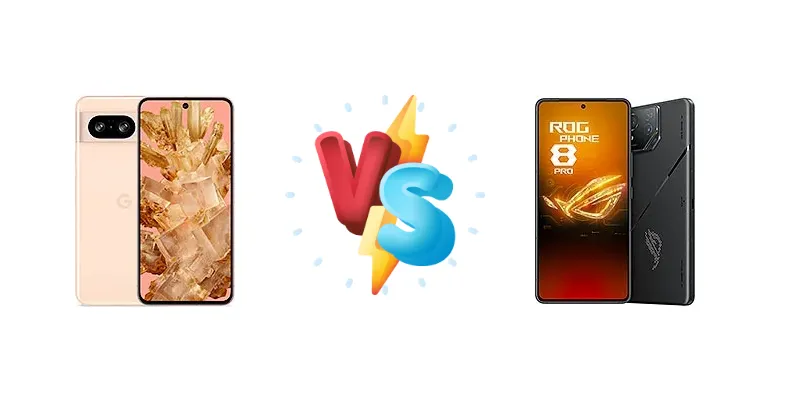
|
🏆 Quick Verdict
For the average user prioritizing everyday tasks and computational photography, the Google Pixel 8 is the better choice. However, the Asus ROG Phone 8 Pro unequivocally wins for gamers and power users demanding maximum performance, extended battery life, and rapid charging capabilities.
| PHONES | ||
|---|---|---|
| Phone Names | Google Pixel 8 | Asus ROG Phone 8 Pro |
| Network | ||
|---|---|---|
| 2G bands | GSM 850 / 900 / 1800 / 1900 | GSM 850 / 900 / 1800 / 1900 |
| 3G bands | HSDPA 800 / 850 / 900 / 1700(AWS) / 1900 / 2100 | HSDPA 850 / 900 / 1700(AWS) / 1800 / 1900 / 2100 - International |
| 4G bands | 1, 2, 3, 4, 5, 7, 8, 12, 13, 14, 17, 18, 19, 20, 25, 26, 28, 29, 30, 38, 40, 41, 46, 48, 66, 71 - GKWS6, G9BQD | 1, 2, 3, 4, 5, 7, 8, 12, 17, 18, 19, 20, 25, 26, 28, 32, 34, 38, 39, 40, 41, 42, 43, 48, 66 - International |
| 5G bands | 1, 2, 3, 5, 7, 8, 12, 20, 25, 26, 28, 29, 30, 38, 40, 41, 48, 66, 70, 71, 77, 78, 258, 260, 261 SA/NSA/Sub6/mmWave - GKWS6 | 1, 2, 3, 5, 7, 8, 12, 18, 20, 25, 26, 28, 38, 40, 41, 48, 66, 77, 78, 79 SA/NSA/Sub6 - International |
| Speed | HSPA, LTE, 5G | HSPA, LTE (Up to 7CA), 5G |
| Technology | GSM / HSPA / LTE / 5G | GSM / CDMA / HSPA / LTE / 5G |
| Launch | ||
|---|---|---|
| Announced | 2023, October 04 | 2024, January 08 |
| Status | Available. Released 2023, October 12 | Available. Released 2024, January 18 |
| Body | ||
|---|---|---|
| Build | Glass front (Gorilla Glass Victus), glass back (Gorilla Glass Victus), aluminum frame | Glass front (Gorilla Glass Victus 2), glass back (Gorilla Glass), aluminum frame |
| Dimensions | 150.5 x 70.8 x 8.9 mm (5.93 x 2.79 x 0.35 in) | 163.8 x 76.8 x 8.9 mm (6.45 x 3.02 x 0.35 in) |
| SIM | Nano-SIM + eSIM | Nano-SIM + Nano-SIM |
| Weight | 187 g (6.60 oz) | 225 g (7.94 oz) |
| Display | ||
|---|---|---|
| Protection | Corning Gorilla Glass Victus | Corning Gorilla Glass Victus 2 |
| Resolution | 1080 x 2400 pixels, 20:9 ratio (~428 ppi density) | 1080 x 2400 pixels, 20:9 ratio (~388 ppi density) |
| Size | 6.2 inches, 91.1 cm2 (~85.5% screen-to-body ratio) | 6.78 inches, 111.0 cm2 (~88.2% screen-to-body ratio) |
| Type | OLED, 120Hz, HDR10+, 1400 nits (HBM), 2000 nits (peak) | LTPO AMOLED, 1B colors, 165Hz, HDR10, 1600 nits (HBM), 2500 nits (peak) |
| Platform | ||
|---|---|---|
| CPU | Nona-core (1x3.0 GHz Cortex-X3 & 4x2.45 GHz Cortex-A715 & 4x2.15 GHz Cortex-A510) | Octa-core (1x3.3 GHz Cortex-X4 & 3x3.2 GHz Cortex-A720 & 2x3.0 GHz Cortex-A720 & 2x2.3 GHz Cortex-A520) |
| Chipset | Google Tensor G3 (4 nm) | Qualcomm SM8650-AB Snapdragon 8 Gen 3 (4 nm) |
| GPU | Immortalis-G715s MC10 | Adreno 750 |
| OS | Android 14, upgradable to Android 16, up to 7 major Android upgrades | Android 14, up to 2 major Android upgrades |
| Memory | ||
|---|---|---|
| Card slot | No | No |
| Internal | 128GB 8GB RAM, 256GB 8GB RAM | 512GB 16GB RAM, 1TB 24GB RAM |
| Main Camera | ||
|---|---|---|
| Dual | 50 MP (12 MP eff.), f/1.7, 25mm (wide), 1/1.31", 1.2µm, dual pixel PDAF, OIS 12 MP, f/2.2, 126˚ (ultrawide), 1/2.9", 1.25µm, AF | - |
| Features | Laser AF, Dual-LED flash, Pixel Shift, Ultra HDR, panorama, Best Take | LED flash, HDR, panorama |
| Triple | - | 50 MP, f/1.9, 24mm (wide), 1/1.56", 1.0µm, PDAF, gimbal OIS 32 MP, f/2.4, (telephoto), 1/3.2", 0.7µm, PDAF, OIS, 3x optical zoom 13 MP, f/2.2, 13mm, 120˚ (ultrawide) |
| Video | 4K@24/30/60fps, 1080p@30/60/120/240fps; gyro-EIS, OIS, 10-bit HDR | 8K@24fps, 4K@30/60fps, 1080p@30/60/120/240fps, 720p@480fps; gyro-EIS, HDR10+ |
| Selfie camera | ||
|---|---|---|
| Features | HDR, panorama | Panorama, HDR |
| Single | 10.5 MP, f/2.2, 20mm (ultrawide), 1/3.1", 1.22µm | 32 MP, f/2.5, 22mm (wide), 1/3.2", 0.7µm |
| Video | 4K@24/30/60fps, 1080p@30/60fps | 1080p@30fps |
| Sound | ||
|---|---|---|
| 35mm jack | No | Yes |
| Loudspeaker | Yes, with stereo speakers | Yes, with stereo speakers |
| Comms | ||
|---|---|---|
| Bluetooth | 5.3, A2DP, LE, aptX HD | 5.4, A2DP, LE, aptX HD, aptX Adaptive, aptX Lossless |
| NFC | Yes | Yes |
| Positioning | GPS (L1+L5), GLONASS (G1), GALILEO (E1+E5a), QZSS (L1+L5) | GPS (L1+L5), BDS (B1I+B1c+B2a), GALILEO (E1+E5a), QZSS (L1+L5), NavIC (L5), GLONASS |
| Radio | No | No |
| USB | USB Type-C 3.2 | USB Type-C (side), DisplayPort 1.4; USB Type-C (bottom), OTG |
| WLAN | Wi-Fi 802.11 a/b/g/n/ac/6e/7, tri-band, Wi-Fi Direct | Wi-Fi 802.11 a/b/g/n/ac/6e/7, tri-band, Wi-Fi Direct |
| Features | ||
|---|---|---|
| Sensors | Fingerprint (under display, optical), accelerometer, gyro, proximity, compass, barometer | Fingerprint (under display, optical), accelerometer, gyro, proximity, compass |
| Battery | ||
|---|---|---|
| Charging | 27W wired, PD3.0, PPS, 50% in 30 min 18W wireless Reverse wireless Bypass charging | 65W wired, PD3.0, PPS, QC5, 100% in 39 min - International 30W wired, PD3.0, PPS - India 15W wireless (Qi) 10W reverse wired |
| Type | Li-Ion 4575 mAh | 5500 mAh |
| Misc | ||
|---|---|---|
| Colors | Obsidian, Hazel, Rose, Mint | Phantom Black |
| Models | GKWS6, G9BQD, GA04851-US, GZPFO, GPJ41 | AI2401, AI2401_A, AI2401_D |
| Price | € 296.00 / $ 268.93 / £ 260.00 / ₹ 38,999 | $ 1,157.98 / £ 1,693.75 / € 632.66 |
Google Pixel 8
- Exceptional camera software and AI features
- Compact and pocketable design
- Seamless Google ecosystem integration
- Less powerful processor than the Snapdragon 8 Gen 3
- Shorter battery life compared to the ROG Phone 8 Pro
- Slower charging speeds
Asus ROG Phone 8 Pro
- Unmatched gaming performance with Snapdragon 8 Gen 3
- Superior battery life and faster charging
- Advanced cooling system for sustained performance
- Larger and heavier design
- Less refined camera software compared to Pixel 8
- Gaming-focused aesthetics may not appeal to everyone
Display Comparison
The Asus ROG Phone 8 Pro boasts a significantly brighter display, reaching 1765 nits measured, compared to the Pixel 8’s 1446 nits. This translates to superior visibility under direct sunlight. While both utilize AMOLED technology, the ROG Phone’s higher peak brightness and likely larger panel size (though not specified) contribute to a more immersive viewing experience. The Pixel 8’s display is still excellent, but the ROG Phone takes the lead in sheer visual impact. We expect the ROG Phone to have a higher refresh rate as well, though this wasn't specified in the data.
Camera Comparison
Both phones offer capable photo and video recording, but the specifics are limited in the provided data. We can infer that the Pixel 8 leverages Google’s renowned computational photography prowess, focusing on image processing algorithms to enhance detail and dynamic range. The ROG Phone 8 Pro, while likely equipped with high-resolution sensors, will likely prioritize speed and responsiveness for gaming-related photography and videography. Without sensor size or aperture information, it’s difficult to definitively declare a winner, but the Pixel 8’s software advantage is a significant factor for casual photographers.
Performance
The core difference lies in the chipsets: the Google Pixel 8 utilizes the Google Tensor G3 (4nm) with a nona-core CPU, while the Asus ROG Phone 8 Pro is powered by the Qualcomm Snapdragon 8 Gen 3 (4nm) with an octa-core configuration. The Snapdragon 8 Gen 3, featuring the latest Cortex-X4 prime core clocked at 3.3 GHz, demonstrably outperforms the Tensor G3 in raw processing power and GPU capabilities. The ROG Phone’s CPU architecture (3x Cortex-A720 and 2x Cortex-A720) is more focused on sustained performance than the Pixel 8’s mix of A715 and A510 cores. This difference is crucial for demanding games and multitasking. The ROG Phone’s superior thermal design, a hallmark of the ROG series, will further minimize throttling during extended gaming sessions.
Battery Life
The Asus ROG Phone 8 Pro delivers a substantial advantage in battery endurance, achieving an active use score of 14:43h versus the Pixel 8’s 11:17h. This, combined with the ROG Phone’s 65W wired charging (100% in 39 minutes internationally, slower in India at 30W) and 15W wireless charging, provides a significantly faster and more convenient charging experience. The Pixel 8’s 27W wired charging (50% in 30 minutes) and 18W wireless charging are adequate but pale in comparison. The ROG Phone’s larger battery capacity (not specified, but implied by the endurance rating) and faster charging capabilities cater directly to power users and gamers.
Buying Guide
Buy the Google Pixel 8 if you need a pocketable flagship with exceptional camera software, seamless Google integration, and cutting-edge AI features like Magic Eraser and Best Take. Buy the Asus ROG Phone 8 Pro if you prioritize uninterrupted gaming sessions, a massive battery, the fastest Android processor available, and a customizable gaming experience with accessories like AirTriggers.