
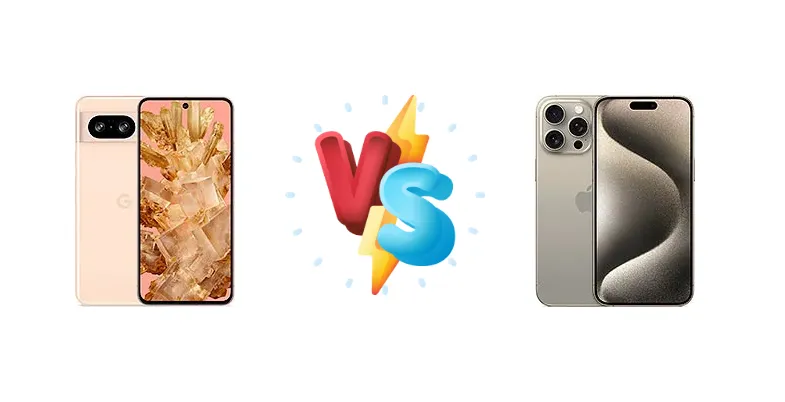
Google Pixel 8 vs. Apple iPhone 15 Pro Max: A Deep Dive Comparison
| Phones Images | |||||
|---|---|---|---|---|---|
|
🏆 Quick Verdict
For the average user prioritizing longevity and consistent performance, the iPhone 15 Pro Max is the superior choice. Its significantly longer battery life (16:01h active use) and more powerful A17 Pro chip outweigh the Pixel 8’s AI advantages. However, the Pixel 8 remains a compelling option for those deeply invested in the Google ecosystem and its unique software features.
| PHONES | ||
|---|---|---|
| Phone Names | Google Pixel 8 | Apple iPhone 15 Pro Max |
| Network | ||
|---|---|---|
| 2G bands | GSM 850 / 900 / 1800 / 1900 | GSM 850 / 900 / 1800 / 1900 |
| 3G bands | HSDPA 800 / 850 / 900 / 1700(AWS) / 1900 / 2100 | HSDPA 850 / 900 / 1700(AWS) / 1900 / 2100 |
| 4G bands | 1, 2, 3, 4, 5, 7, 8, 12, 13, 14, 17, 18, 19, 20, 25, 26, 28, 29, 30, 38, 40, 41, 46, 48, 66, 71 - GKWS6, G9BQD | 1, 2, 3, 4, 5, 7, 8, 12, 13, 17, 18, 19, 20, 25, 26, 28, 30, 32, 34, 38, 39, 40, 41, 42, 46, 48, 53, 66 - A3106 |
| 5G bands | 1, 2, 3, 5, 7, 8, 12, 20, 25, 26, 28, 29, 30, 38, 40, 41, 48, 66, 70, 71, 77, 78, 258, 260, 261 SA/NSA/Sub6/mmWave - GKWS6 | 1, 2, 3, 5, 7, 8, 12, 20, 25, 26, 28, 30, 38, 40, 41, 48, 53, 66, 70, 77, 78, 79 SA/NSA/Sub6 - A3106 |
| Speed | HSPA, LTE, 5G | HSPA, LTE, 5G, EV-DO Rev.A 3.1 Mbps |
| Technology | GSM / HSPA / LTE / 5G | GSM / CDMA / HSPA / EVDO / LTE / 5G |
| Launch | ||
|---|---|---|
| Announced | 2023, October 04 | 2023, September 12 |
| Status | Available. Released 2023, October 12 | Available. Released 2023, September 22 |
| Body | ||
|---|---|---|
| Build | Glass front (Gorilla Glass Victus), glass back (Gorilla Glass Victus), aluminum frame | Glass front, glass back, titanium frame (grade 5) |
| Dimensions | 150.5 x 70.8 x 8.9 mm (5.93 x 2.79 x 0.35 in) | 159.9 x 76.7 x 8.3 mm (6.30 x 3.02 x 0.33 in) |
| SIM | Nano-SIM + eSIM | · Nano-SIM + eSIM + eSIM (max 2 at a time; International)· eSIM + eSIM (8 or more, max 2 at a time; USA)· Nano-SIM + Nano-SIM (China) |
| Weight | 187 g (6.60 oz) | 221 g (7.80 oz) |
| Display | ||
|---|---|---|
| Protection | Corning Gorilla Glass Victus | Ceramic Shield glass |
| Resolution | 1080 x 2400 pixels, 20:9 ratio (~428 ppi density) | 1290 x 2796 pixels, 19.5:9 ratio (~460 ppi density) |
| Size | 6.2 inches, 91.1 cm2 (~85.5% screen-to-body ratio) | 6.7 inches, 110.2 cm2 (~89.8% screen-to-body ratio) |
| Type | OLED, 120Hz, HDR10+, 1400 nits (HBM), 2000 nits (peak) | LTPO Super Retina XDR OLED, 120Hz, HDR10, Dolby Vision, 1000 nits (typ), 2000 nits (HBM) |
| Platform | ||
|---|---|---|
| CPU | Nona-core (1x3.0 GHz Cortex-X3 & 4x2.45 GHz Cortex-A715 & 4x2.15 GHz Cortex-A510) | Hexa-core (2x3.78 GHz + 4x2.11 GHz) |
| Chipset | Google Tensor G3 (4 nm) | Apple A17 Pro (3 nm) |
| GPU | Immortalis-G715s MC10 | Apple GPU (6-core graphics) |
| OS | Android 14, upgradable to Android 16, up to 7 major Android upgrades | iOS 17, upgradable to iOS 26.1 |
| Memory | ||
|---|---|---|
| Card slot | No | No |
| Internal | 128GB 8GB RAM, 256GB 8GB RAM | 256GB 8GB RAM, 512GB 8GB RAM, 1TB 8GB RAM |
| Main Camera | ||
|---|---|---|
| Dual | 50 MP (12 MP eff.), f/1.7, 25mm (wide), 1/1.31", 1.2µm, dual pixel PDAF, OIS 12 MP, f/2.2, 126˚ (ultrawide), 1/2.9", 1.25µm, AF | - |
| Features | Laser AF, Dual-LED flash, Pixel Shift, Ultra HDR, panorama, Best Take | Dual-LED dual-tone flash, HDR (photo/panorama) |
| Triple | - | 48 MP, f/1.8, 24mm (wide), 1/1.28", 1.22µm, dual pixel PDAF, sensor-shift OIS 12 MP, f/2.8, 120mm (periscope telephoto), 1/3.06", 1.12µm, dual pixel PDAF, 3D sensor‑shift OIS, 5x optical zoom 12 MP, f/2.2, 13mm, 120˚ (ultrawide), 1/2.55", 1.4µm, dual pixel PDAF TOF 3D LiDAR scanner (depth) |
| Video | 4K@24/30/60fps, 1080p@30/60/120/240fps; gyro-EIS, OIS, 10-bit HDR | 4K@24/25/30/60fps, 1080p@25/30/60/120/240fps, 10-bit HDR, Dolby Vision HDR (up to 60fps), ProRes, 3D (spatial) video, stereo sound rec. |
| Selfie camera | ||
|---|---|---|
| Features | HDR, panorama | HDR, Dolby Vision HDR |
| Single | 10.5 MP, f/2.2, 20mm (ultrawide), 1/3.1", 1.22µm | 12 MP, f/1.9, 23mm (wide), 1/3.6", 1.0µm, PDAF, OIS SL 3D, (depth/biometrics sensor) |
| Video | 4K@24/30/60fps, 1080p@30/60fps | 4K@24/25/30/60fps, 1080p@25/30/60/120fps, gyro-EIS |
| Sound | ||
|---|---|---|
| 35mm jack | No | No |
| Loudspeaker | Yes, with stereo speakers | Yes, with stereo speakers |
| Comms | ||
|---|---|---|
| Bluetooth | 5.3, A2DP, LE, aptX HD | 5.3, A2DP, LE |
| NFC | Yes | Yes |
| Positioning | GPS (L1+L5), GLONASS (G1), GALILEO (E1+E5a), QZSS (L1+L5) | GPS (L1+L5), GLONASS, GALILEO, BDS, QZSS, NavIC |
| Radio | No | No |
| USB | USB Type-C 3.2 | USB Type-C 3.2 Gen 2, DisplayPort |
| WLAN | Wi-Fi 802.11 a/b/g/n/ac/6e/7, tri-band, Wi-Fi Direct | Wi-Fi 802.11 a/b/g/n/ac/6e, tri-band, hotspot |
| Features | ||
|---|---|---|
| Sensors | Fingerprint (under display, optical), accelerometer, gyro, proximity, compass, barometer | Face ID, accelerometer, gyro, proximity, compass, barometer |
| Battery | ||
|---|---|---|
| Charging | 27W wired, PD3.0, PPS, 50% in 30 min 18W wireless Reverse wireless Bypass charging | Wired, PD2.0, 50% in 30 min 15W wireless (MagSafe) 15W wireless (Qi2) - requires iOS 17.2 update 4.5W reverse wired |
| Type | Li-Ion 4575 mAh | Li-Ion 4441 mAh |
| Misc | ||
|---|---|---|
| Colors | Obsidian, Hazel, Rose, Mint | Black Titanium, White Titanium, Blue Titanium, Natural Titanium |
| Models | GKWS6, G9BQD, GA04851-US, GZPFO, GPJ41 | A2849, A3105, A3106, A3108, iPhone16,2 |
| Price | € 296.00 / $ 268.93 / £ 260.00 / ₹ 38,999 | € 758.79 / $ 579.87 / £ 628.29 |
| SAR | - | 1.07 W/kg (head) 1.11 W/kg (body) |
| SAR EU | - | 0.98 W/kg (head) 0.98 W/kg (body) |
Google Pixel 8
- Exceptional AI-powered features
- Competitive price point
- Clean Android experience
- Shorter battery life
- Less powerful chipset
- Charging speed is slower than iPhone
Apple iPhone 15 Pro Max
- Industry-leading performance
- Superior battery life
- Premium build quality
- Higher price
- Less customization options
- Ecosystem lock-in
Display Comparison
The iPhone 15 Pro Max boasts a brighter display, reaching a measured 1787 nits compared to the Pixel 8’s 1446 nits, making it more visible outdoors. While both offer excellent color accuracy, the iPhone’s higher peak brightness provides a noticeable advantage in HDR content. Neither specification details refresh rate, but both are expected to have adaptive refresh rate technology. The iPhone 15 Pro Max also supports Qi2 wireless charging, a newer standard, while the Pixel 8 supports both Qi and proprietary wireless charging.
Camera Comparison
Both devices are capable of capturing exceptional photos and videos, but approach image processing differently. The Pixel 8 leverages Google’s computational photography expertise, focusing on dynamic range and detail enhancement. The iPhone 15 Pro Max, while also employing computational photography, aims for a more natural look. Without specific sensor size data, it’s difficult to definitively declare a camera winner, but Apple’s history suggests a larger main sensor. Both phones offer excellent video recording capabilities, but the iPhone’s ProRes video format provides professional-grade options.
Performance
Apple’s A17 Pro (3nm) chipset significantly outperforms Google’s Tensor G3 (4nm) in raw processing power. The A17 Pro’s hexa-core configuration (2x3.78 GHz + 4x2.11 GHz) contrasts with the Tensor G3’s nona-core setup (1x3.0 GHz Cortex-X3 & 4x2.45 GHz Cortex-A715 & 4x2.15 GHz Cortex-A510). The 3nm fabrication process of the A17 Pro delivers superior power efficiency and thermal management, translating to sustained performance during demanding tasks. While the Tensor G3 excels in AI and machine learning tasks, the A17 Pro offers a broader performance advantage across the board.
Battery Life
The iPhone 15 Pro Max dominates in battery endurance, achieving an active use score of 16:01h and an endurance rating of 118h, compared to the Pixel 8’s 11:17h and 83h respectively. While both offer 50% charge in 30 minutes with wired charging, the iPhone’s larger battery capacity and more efficient chipset contribute to its significantly longer runtime. The Pixel 8 offers reverse wireless charging, a feature the iPhone 15 Pro Max only provides via a slower 4.5W wired connection.
Buying Guide
Buy the Google Pixel 8 if you need a smartphone deeply integrated with Google services, prioritize computational photography and AI-powered features like Magic Eraser, and value a more affordable price point. Buy the Apple iPhone 15 Pro Max if you prefer a seamless, high-performance experience, demand the longest possible battery life, and are committed to the iOS ecosystem and its app availability.