
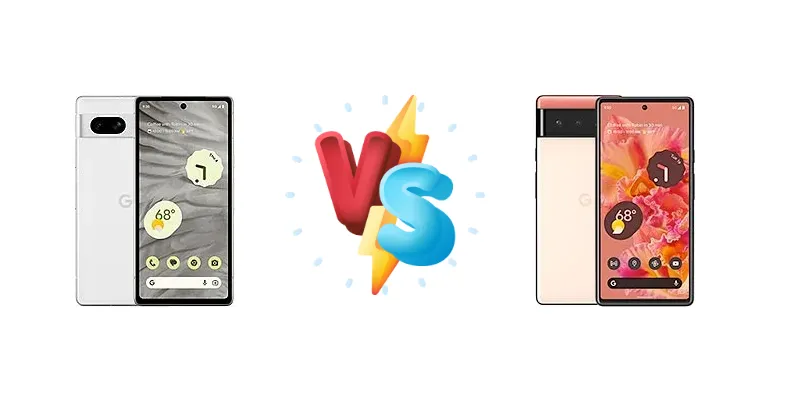
Google Pixel 7a vs Pixel 6: A Detailed Comparison
| Phones Images | |||||
|---|---|---|---|---|---|
|
🏆 Quick Verdict
The Pixel 7a offers a brighter display and a more modern chipset at a lower price. However, the Pixel 6 boasts faster wireless charging, reverse wireless charging, and slightly better battery endurance. For budget-conscious users prioritizing display and performance, the 7a wins; otherwise, the 6 remains a compelling option.
| PHONES | ||
|---|---|---|
| Phone Names | Google Pixel 7a | Google Pixel 6 |
| Network | ||
|---|---|---|
| 2G bands | GSM 850 / 900 / 1800 / 1900 | GSM 850 / 900 / 1800 / 1900 |
| 3G bands | HSDPA 800 / 850 / 900 / 1700(AWS) / 1900 / 2100 | HSDPA 800 / 850 / 900 / 1700(AWS) / 1900 / 2100 |
| 4G bands | 1, 2, 3, 4, 5, 7, 8, 12, 13, 14, 17, 20, 25, 26, 28, 29, 30, 38, 40, 41, 48, 66, 71 - GWKK3, G0DZQ | 1, 2, 3, 4, 5, 7, 8, 12, 13, 14, 17, 18, 19, 20, 25, 26, 28, 29, 30, 32, 38, 39, 40, 41, 42, 46, 48, 66, 71 - GB7N6, G9S9B16 |
| 5G bands | 1, 2, 3, 5, 7, 8, 12, 14, 20, 25, 28, 30, 38, 41, 48, 66, 71, 77, 78 SA/NSA/Sub6 - GWKK3 | 1, 2, 3, 5, 7, 8, 12, 14, 20, 25, 28, 30, 38, 40, 41, 48, 66, 71, 77, 78, 257, 258, 260, 261 SA/NSA/Sub6/mmWave - G9S9B |
| Speed | HSPA, LTE, 5G | HSPA, LTE, 5G |
| Technology | GSM / HSPA / LTE / 5G | GSM / CDMA / HSPA / EVDO / LTE / 5G |
| 1, 2, 3, 5, 7, 8, 12, 20, 25, 28, 38, 40, 41, 66, 75, 76, 77, 78, 79 SA/NSA/Sub6 - GHL1X, G82U8 | 1, 2, 3, 5, 7, 8, 12, 14, 20, 25, 28, 30, 38, 40, 41, 48, 66, 71, 77, 78 SA/NSA/Sub6 - GB7N6 | |
| Launch | ||
|---|---|---|
| Announced | 2023, May 10 | 2021, October 19 |
| Status | Available. Released 2023, May 10 | Available. Released 2021, October 28 |
| Body | ||
|---|---|---|
| Build | Glass front (Gorilla Glass 3), aluminum frame, plastic back | Glass front (Gorilla Glass Victus), glass back (Gorilla Glass 6), aluminum frame |
| Dimensions | 152 x 72.9 x 9 mm (5.98 x 2.87 x 0.35 in) | 158.6 x 74.8 x 8.9 mm (6.24 x 2.94 x 0.35 in) |
| SIM | Nano-SIM + eSIM | Nano-SIM + eSIM |
| Weight | 193.5 g (6.84 oz) | 207 g (7.30 oz) |
| IP67 dust/water resistant (up to 1m for 30 min) | IP68 dust/water resistant (up to 1.5m for 30 min) | |
| Display | ||
|---|---|---|
| Protection | Corning Gorilla Glass 3 | Corning Gorilla Glass Victus |
| Resolution | 1080 x 2400 pixels, 20:9 ratio (~429 ppi density) | 1080 x 2400 pixels, 20:9 ratio (~411 ppi density) |
| Size | 6.1 inches, 90.7 cm2 (~81.8% screen-to-body ratio) | 6.4 inches, 98.9 cm2 (~83.4% screen-to-body ratio) |
| Type | OLED, HDR, 90Hz | AMOLED, 90Hz, HDR10+ |
| Always-on display | Always-on display | |
| Platform | ||
|---|---|---|
| CPU | Octa-core (2x2.85 GHz Cortex-X1 & 2x2.35 GHz Cortex-A78 & 4x1.80 GHz Cortex-A55) | Octa-core (2x2.80 GHz Cortex-X1 & 2x2.25 GHz Cortex-A76 & 4x1.80 GHz Cortex-A55) |
| Chipset | Google Tensor G2 (5 nm) | Google Tensor (5 nm) |
| GPU | Mali-G710 MP7 | Mali-G78 MP20 |
| OS | Android 13, upgradable to Android 15, up to 5 major Android upgrades | Android 12, upgradable to Android 15, up to 5 major Android upgrades |
| Memory | ||
|---|---|---|
| Card slot | No | No |
| Internal | 128GB 8GB RAM | 128GB 8GB RAM, 256GB 8GB RAM |
| UFS 3.1 | UFS 3.1 | |
| Main Camera | ||
|---|---|---|
| Dual | 64 MP, f/1.9, 26mm (wide), 1/1.73", 0.8µm, dual pixel PDAF, OIS 13 MP, f/2.2, 120˚ (ultrawide), 1.12µm | 50 MP, f/1.9, 25mm (wide), 1/1.31", 1.2µm, dual pixel PDAF, OIS 12 MP, f/2.2, 17mm, 114˚ (ultrawide), 1.25µm |
| Features | Dual-LED flash, Pixel Shift, Auto-HDR, panorama | Laser AF, Dual-LED flash, Pixel Shift, Auto-HDR, panorama |
| Single | - | 8 MP, f/2.0, 24mm (wide), 1.12µm |
| Video | 4K@30/60fps, 1080p@30/60/120/240fps, OIS | 4K@30/60fps, 1080p@30/60/120/240fps; gyro-EIS, OIS |
| Selfie camera | ||
|---|---|---|
| Features | HDR, panorama | HDR, panorama |
| Single | 13 MP, f/2.2, 20mm (ultrawide), 1.12µm | 8 MP, f/2.0, 24mm (wide), 1.12µm |
| Video | 4K@30fps, 1080p@30fps | 1080p@30fps |
| Sound | ||
|---|---|---|
| 3.5mm jack | No | No |
| 35mm jack | No | No |
| Loudspeaker | Yes, with stereo speakers | Yes, with stereo speakers |
| Comms | ||
|---|---|---|
| Bluetooth | 5.3, A2DP, LE | 5.2, A2DP, LE, aptX HD |
| NFC | Yes | Yes |
| Positioning | GPS, GLONASS, GALILEO, BDS, QZSS, NavIC | GPS (L1+L5), GLONASS (G1), BDS (B1I+B1c+B2a), GALILEO (E1+E5a), QZSS (L1+L5) |
| Radio | No | No |
| USB | USB Type-C 3.2 | USB Type-C 3.1 |
| WLAN | Wi-Fi 802.11 a/b/g/n/ac/6e, tri-band | Wi-Fi 802.11 a/b/g/n/ac/6e, dual-band, Wi-Fi Direct |
| Features | ||
|---|---|---|
| Sensors | Fingerprint (under display, optical), accelerometer, gyro, proximity, compass, barometer | Fingerprint (under display, optical), accelerometer, gyro, proximity, compass, barometer |
| Battery | ||
|---|---|---|
| Charging | 18W wired, PD3.0 7.5W wireless | Wired (based on 30W charger), PD3.0, 50% in 30 min 21W wireless Reverse wireless |
| Type | Li-Po 4385 mAh | Li-Ion 4614 mAh |
| Misc | ||
|---|---|---|
| Colors | Charcoal, Snow, Sea, Coral | Sorta Seafoam, Kinda Coral, Stormy Black |
| Models | GWKK3, GHL1X, G0DZQ, G82U8 | GB7N6, G9S9B16, G9S9B, GR1YH |
| Price | € 179.90 / $ 150.00 / £ 170.00 / ₹ 25,980 | $ 172.48 / C$ 238.84 / £ 169.99 / € 191.89 / ₹ 23,719 |
| Tests | ||
|---|---|---|
| Battery life | - | Endurance rating 86h |
| Camera | - | Photo / Video |
| Display | - | Contrast ratio: Infinite (nominal) |
| Loudspeaker | - | -26.9 LUFS (Good) |
| Performance | - | AnTuTu: 676831 (v9) GeekBench: 2899 (v5.1) GFXBench: 57fps (ES 3.1 onscreen) |
Google Pixel 7a
- Brighter Display
- More Modern Chipset (Tensor G2)
- More Affordable
- Compact Size
- Slower Wireless Charging
- No Reverse Wireless Charging
- Slightly Shorter Battery Life
Google Pixel 6
- Longer Battery Life
- Faster Wireless Charging (21W)
- Reverse Wireless Charging
- Slightly Larger Screen
- Older Chipset (Tensor)
- Less Bright Display
- Higher Price
Display Comparison
The Pixel 7a features a measured peak brightness of 1070 nits, significantly brighter than the Pixel 6's nominal 'infinite' contrast ratio. While the Pixel 6's contrast is excellent, the 7a's brightness provides better visibility in direct sunlight. Both offer vibrant colors and sharp details, but the 7a has a clear edge in outdoor usability.
Camera Comparison
Both Pixels excel in photography, thanks to Google's computational photography prowess. While specific camera hardware differs (e.g., sensor sizes), the image quality is remarkably similar in most scenarios. The 7a benefits from software optimizations on the G2, potentially leading to slightly improved processing. Both offer excellent video recording capabilities.
Performance
The Pixel 7a's Tensor G2 chipset offers a modest performance boost over the Pixel 6's Tensor chip. While both are capable of handling everyday tasks and demanding apps, the G2 provides slightly snappier responsiveness and improved efficiency. The 7a's Cortex-X1 core is clocked slightly higher, contributing to this difference.
Battery Life
The Pixel 6 holds a slight advantage in battery life, boasting an endurance rating of 86 hours compared to the Pixel 7a's 76 hours. However, the difference is not substantial in real-world usage. The Pixel 6 also supports faster wireless charging (21W vs 7.5W) and reverse wireless charging, features absent in the 7a.
Buying Guide
The Google Pixel 7a is ideal for users seeking a compact, affordable flagship with a fantastic camera and a vibrant display. It's perfect for those on a budget who still want a premium Pixel experience. The Google Pixel 6 is a better choice for users who value longer battery life, faster wireless charging (including reverse wireless), and a slightly larger screen, and are willing to spend a bit more.