
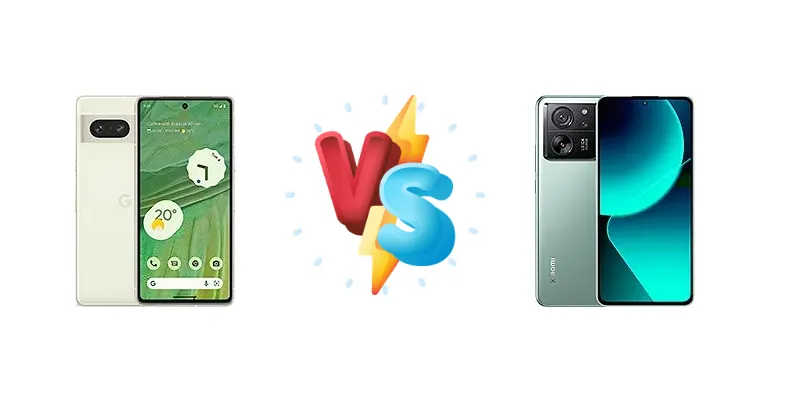
Google Pixel 7 vs Xiaomi 13T: A Detailed Comparison of AI and Performance
| Phones Images | |||||
|---|---|---|---|---|---|
|
🏆 Quick Verdict
For the average user prioritizing camera quality and software experience, the Google Pixel 7 emerges as the winner. Its Tensor G2 chip, coupled with Google’s image processing, consistently delivers superior photos and videos. However, the Xiaomi 13T’s significantly faster 67W charging and brighter display make it a strong contender for those valuing speed and media consumption.
| PHONES | ||
|---|---|---|
| Phone Names | Google Pixel 7 | Xiaomi 13T |
| Network | ||
|---|---|---|
| 2G bands | GSM 850 / 900 / 1800 / 1900 | GSM 850 / 900 / 1800 / 1900 |
| 3G bands | HSDPA 800 / 850 / 900 / 1700(AWS) / 1900 / 2100 | HSDPA 800 / 850 / 900 / 1700(AWS) / 1900 / 2100 |
| 4G bands | 1, 2, 3, 4, 5, 7, 8, 12, 13, 14, 17, 18, 19, 20, 25, 26, 28, 29, 30, 38, 40, 41, 42, 46, 48, 66, 71 - GQML3 | 1, 2, 3, 4, 5, 7, 8, 12, 13, 17, 18, 19, 20, 26, 28, 32, 38, 40, 41, 66 |
| 5G bands | 1, 2, 3, 4, 5, 7, 8, 12, 13, 14, 17, 18, 19, 20, 25, 26, 28, 29, 30, 38, 40, 41, 46, 48, 66, 71, 260, 261 SA/NSA/Sub6/mmWave - GQML3 | 1, 3, 5, 7, 8, 20, 28, 38, 40, 41, 66, 77, 78 SA/NSA |
| Speed | HSPA, LTE, 5G | HSPA, LTE, 5G |
| Technology | GSM / CDMA / HSPA / EVDO / LTE / 5G | GSM / HSPA / LTE / 5G |
| 1, 2, 3, 5, 7, 8, 12, 14, 20, 25, 28, 30, 38, 40, 41, 48, 66, 71, 75, 76, 77, 78 SA/NSA/Sub6 - GVU6C | - | |
| Launch | ||
|---|---|---|
| Announced | 2022, October 06 | 2023, September 26 |
| Status | Available. Released 2022, October 13 | Available. Released 2023, September 26 |
| Body | ||
|---|---|---|
| Build | Glass front (Gorilla Glass Victus), glass back (Gorilla Glass Victus), aluminum frame | Glass front (Gorilla Glass 5), glass back or silicone polymer back, plastic frame |
| Dimensions | 155.6 x 73.2 x 8.7 mm (6.13 x 2.88 x 0.34 in) | 162.2 x 75.7 x 8.5 mm (6.39 x 2.98 x 0.33 in) |
| SIM | Nano-SIM + eSIM | · Nano-SIM + eSIM· Nano-SIM + Nano-SIM |
| Weight | 197 g (6.95 oz) | 193 g or 197 g (6.81 oz) |
| IP68 dust/water resistant (up to 1.5m for 30 min) | - | |
| Display | ||
|---|---|---|
| Protection | Corning Gorilla Glass Victus | Corning Gorilla Glass 5 |
| Resolution | 1080 x 2400 pixels, 20:9 ratio (~416 ppi density) | 1220 x 2712 pixels, 20:9 ratio (~446 ppi density) |
| Size | 6.3 inches, 96.7 cm2 (~84.9% screen-to-body ratio) | 6.67 inches, 107.4 cm2 (~87.5% screen-to-body ratio) |
| Type | AMOLED, 90Hz, HDR10+, 1000 nits (HBM), 1400 nits (peak) | AMOLED, 68B colors, 144Hz, Dolby Vision, HDR10+, 1200 nits (HBM), 2600 nits (peak) |
| Always-on display | - | |
| Platform | ||
|---|---|---|
| CPU | Octa-core (2x2.85 GHz Cortex-X1 & 2x2.35 GHz Cortex-A78 & 4x1.80 GHz Cortex-A55) | Octa-core (1x3.1 GHz Cortex-A78 & 3x3.0 GHz Cortex-A78 & 4x2.0 GHz Cortex-A55) |
| Chipset | Google Tensor G2 (5 nm) | Mediatek Dimensity 8200 Ultra (4 nm) |
| GPU | Mali-G710 MP7 | Mali-G610 MC6 |
| OS | Android 13, upgradable to Android 15, up to 5 major Android upgrades | Android 13, up to 4 major Android upgrades, HyperOS |
| Memory | ||
|---|---|---|
| Card slot | No | No |
| Internal | 128GB 8GB RAM, 256GB 8GB RAM | 256GB 8GB RAM, 256GB 12GB RAM |
| UFS 3.1 | - | |
| Main Camera | ||
|---|---|---|
| Dual | 50 MP, f/1.9, 25mm (wide), 1/1.31", 1.2µm, dual pixel PDAF, OIS 12 MP, f/2.2, 114˚ (ultrawide), 1/2.9", 1.25µm | - |
| Features | Laser AF, Dual-LED flash, Pixel Shift, Auto-HDR, panorama | Leica lens, color spectrum sensor, LED flash, HDR, panorama |
| Single | 10.8 MP, f/2.2, 21mm (ultrawide), 1/3.1", 1.22µm | - |
| Triple | - | 50 MP, f/1.9, 24mm (wide), 1/1.28", 1.22µm, PDAF, OIS 50 MP, f/1.9, 50mm (telephoto), 1/2.88", 0.61µm, PDAF, 2x optical zoom 12 MP, f/2.2, 15mm (ultrawide), 1/3.06", 1.12µm |
| Video | 4K@30/60fps, 1080p@30/60/120/240fps; gyro-EIS, OIS, 10-bit HDR | 4K@30fps (HDR10+), 1080p@30/60/120fps, gyro-EIS |
| Selfie camera | ||
|---|---|---|
| Features | HDR, panorama | HDR |
| Single | 10.8 MP, f/2.2, 21mm (ultrawide), 1/3.1", 1.22µm | 20 MP, f/2.2, (wide), 0.8µm |
| Video | 4K@30/60fps, 1080p@30/60fps | 1080p@30fps, HDR10+ |
| Sound | ||
|---|---|---|
| 3.5mm jack | No | - |
| 35mm jack | No | No |
| Loudspeaker | Yes, with stereo speakers | Yes, with stereo speakers |
| Comms | ||
|---|---|---|
| Bluetooth | 5.2, A2DP, LE, aptX HD | 5.4, A2DP, LE |
| Infrared port | - | Yes |
| NFC | Yes | Yes (market/region dependent) |
| Positioning | GPS (L1+L5), GLONASS (G1), BDS (B1I+B1c+B2a), GALILEO (E1+E5a), QZSS (L1+L5) | GPS (L1+L5), GLONASS (G1), GALILEO (E1+E5a), QZSS (L1+L5), NavIC (L5), BDS |
| Radio | No | No |
| USB | USB Type-C 3.2 | USB Type-C 2.0, OTG |
| WLAN | Wi-Fi 802.11 a/b/g/n/ac/6e, tri-band, Wi-Fi Direct | Wi-Fi 802.11 a/b/g/n/ac/6, dual-band |
| Features | ||
|---|---|---|
| Sensors | Fingerprint (under display, optical), accelerometer, gyro, proximity, compass, barometer | Fingerprint (under display, optical), accelerometer, gyro, proximity, compass |
| Battery | ||
|---|---|---|
| Charging | 20W wired, PD3.0, 50% in 30 min 20W wireless Reverse wireless | 67W wired, PD3.0, QC4, 100% in 42 min |
| Type | Li-Ion 4355 mAh | Li-Po 5000 mAh |
| Misc | ||
|---|---|---|
| Colors | Obsidian, Lemongrass, Snow | Alpine Blue, Meadow Green, Black |
| Models | GVU6C, GQML3, GO3Z5 | 2306EPN60G |
| Price | € 199.00 / $ 179.26 / £ 189.99 / ₹ 28,499 | $ 255.96 / £ 326.27 / € 204.18 |
| SAR EU | - | 0.99 W/kg (head) 0.99 W/kg (body) |
| Tests | ||
|---|---|---|
| Battery life | Endurance rating 96h | - |
| Camera | Photo / Video | - |
| Display | Contrast ratio: Infinite (nominal) | - |
| Loudspeaker | -26.2 LUFS (Good) | - |
| Performance | AnTuTu: 813114 (v9) GeekBench: 3288 (v5.1) GFXBench: 59fps (ES 3.1 onscreen) | - |
Google Pixel 7
- Superior camera image processing and AI features
- Guaranteed software updates and long-term support
- Excellent integration with Google services
- Slower charging speed (20W)
- Less bright display compared to Xiaomi 13T
Xiaomi 13T
- Blazing-fast 67W wired charging
- Brighter display for outdoor visibility
- Potentially stronger raw CPU/GPU performance
- Software updates may be less frequent
- Camera performance relies more on hardware than software
Display Comparison
The Xiaomi 13T boasts a brighter display, reaching a measured 1264 nits compared to the Pixel 7’s 974 nits. This translates to better visibility under direct sunlight. Both displays feature an infinite (nominal) contrast ratio, suggesting excellent black levels. While neither specification details refresh rate, the Xiaomi 13T’s higher peak brightness is a clear advantage for outdoor use and HDR content viewing. The Pixel 7’s display, while slightly dimmer, benefits from Google’s color calibration expertise, potentially offering more accurate colors.
Camera Comparison
Both phones feature capable camera systems, but their approaches differ. The Pixel 7’s strength lies in Google’s computational photography, leveraging the Tensor G2’s AI capabilities to produce stunning images, particularly in challenging lighting conditions. While specific sensor details are absent, the Pixel 7’s reputation for image processing is a significant advantage. The Xiaomi 13T, while also capable, likely relies more on hardware specifications. Without detailed sensor information, it’s difficult to definitively assess its low-light performance. The absence of details regarding OIS on either phone makes it hard to assess video stabilization capabilities. We can assume both offer standard photo and video modes, but the Pixel 7’s software enhancements are a key differentiator.
Performance
The Xiaomi 13T’s MediaTek Dimensity 8200 Ultra (4nm) and its octa-core CPU configuration (1x3.1 GHz Cortex-A78, 3x3.0 GHz Cortex-A78, 4x2.0 GHz Cortex-A55) offer a different approach to performance than the Pixel 7’s Google Tensor G2 (5nm) with its (2x2.85 GHz Cortex-X1, 2x2.35 GHz Cortex-A78, 4x1.80 GHz Cortex-A55). The Dimensity 8200 Ultra, built on a 4nm process, generally offers strong CPU and GPU performance, potentially leading to smoother gaming experiences. However, the Tensor G2 excels in AI and machine learning tasks, powering features like Magic Eraser and Real Tone. The 5nm process of the Tensor G2 *could* offer better thermal efficiency, but real-world testing is needed to confirm sustained performance under load.
Battery Life
The Xiaomi 13T significantly outperforms the Pixel 7 in charging speed, achieving a full charge in just 42 minutes with its 67W wired charging, supporting PD3.0 and QC4. The Pixel 7, limited to 20W wired charging (PD3.0) and taking 30 minutes to reach 50%, lags behind considerably. Despite the Pixel 7’s reported 96-hour endurance rating, the Xiaomi 13T’s active use score of 12:23h and 101h endurance rating suggest superior real-world battery performance, especially for heavy users. The Pixel 7 also offers 20W wireless and reverse wireless charging, features absent from the Xiaomi 13T’s specifications.
Buying Guide
Buy the Google Pixel 7 if you need a consistently excellent camera experience, seamless software updates, and prioritize Google’s AI-powered features. It’s ideal for photography enthusiasts and those deeply integrated into the Google ecosystem. Buy the Xiaomi 13T if you prefer blazing-fast charging, a brighter display for outdoor visibility, and a more aggressive price point, making it a great choice for power users and media consumers.