
Pixel 7 vs. Galaxy S23 FE: Which Flagship Killer Delivers the Best Value?
| Phones Images | |||||
|---|---|---|---|---|---|
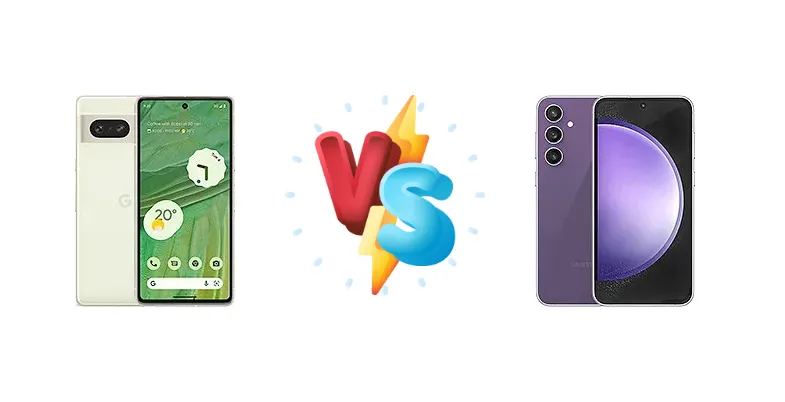
|
🏆 Quick Verdict
For the average user prioritizing computational photography and a clean software experience, the Google Pixel 7 emerges as the winner. Its Tensor G2 chip, while not a raw performance leader, excels in AI tasks, and its 96-hour endurance rating provides superior battery life. However, the S23 FE offers a more flexible feature set and wider availability.
| PHONES | ||
|---|---|---|
| Phone Names | Google Pixel 7 | Samsung Galaxy S23 FE |
| Network | ||
|---|---|---|
| 2G bands | GSM 850 / 900 / 1800 / 1900 | GSM 850 / 900 / 1800 / 1900 |
| 3G bands | HSDPA 800 / 850 / 900 / 1700(AWS) / 1900 / 2100 | HSDPA 850 / 900 / 1700(AWS) / 1900 / 2100 |
| 4G bands | 1, 2, 3, 4, 5, 7, 8, 12, 13, 14, 17, 18, 19, 20, 25, 26, 28, 29, 30, 38, 40, 41, 42, 46, 48, 66, 71 - GQML3 | 1, 2, 3, 4, 5, 7, 8, 12, 13, 17, 20, 26, 28, 38, 40, 41, 66 - International |
| 5G bands | 1, 2, 3, 4, 5, 7, 8, 12, 13, 14, 17, 18, 19, 20, 25, 26, 28, 29, 30, 38, 40, 41, 46, 48, 66, 71, 260, 261 SA/NSA/Sub6/mmWave - GQML3 | 1, 2, 3, 5, 7, 8, 20, 28, 38, 40, 41, 66, 77, 78 SA/NSA/Sub6 - International |
| Speed | HSPA, LTE, 5G | HSPA, LTE, 5G |
| Technology | GSM / CDMA / HSPA / EVDO / LTE / 5G | GSM / HSPA / LTE / 5G |
| 1, 2, 3, 5, 7, 8, 12, 14, 20, 25, 28, 30, 38, 40, 41, 48, 66, 71, 75, 76, 77, 78 SA/NSA/Sub6 - GVU6C | - | |
| Launch | ||
|---|---|---|
| Announced | 2022, October 06 | 2023, October 04 |
| Status | Available. Released 2022, October 13 | Available. Released 2023, October 05 |
| Body | ||
|---|---|---|
| Build | Glass front (Gorilla Glass Victus), glass back (Gorilla Glass Victus), aluminum frame | Glass front (Gorilla Glass 5), glass back (Gorilla Glass 5), aluminum frame |
| Dimensions | 155.6 x 73.2 x 8.7 mm (6.13 x 2.88 x 0.34 in) | 158 x 76.5 x 8.2 mm (6.22 x 3.01 x 0.32 in) |
| SIM | Nano-SIM + eSIM | · Nano-SIM· Nano-SIM + Nano-SIM· Nano-SIM + Nano-SIM + eSIM (max 2 at a time) |
| Weight | 197 g (6.95 oz) | 209 g (7.37 oz) |
| IP68 dust/water resistant (up to 1.5m for 30 min) | - | |
| Display | ||
|---|---|---|
| Protection | Corning Gorilla Glass Victus | Corning Gorilla Glass 5 |
| Resolution | 1080 x 2400 pixels, 20:9 ratio (~416 ppi density) | 1080 x 2340 pixels, 19.5:9 ratio (~403 ppi density) |
| Size | 6.3 inches, 96.7 cm2 (~84.9% screen-to-body ratio) | 6.4 inches, 100.5 cm2 (~83.2% screen-to-body ratio) |
| Type | AMOLED, 90Hz, HDR10+, 1000 nits (HBM), 1400 nits (peak) | Dynamic AMOLED 2X, 120Hz, HDR10+, 1450 nits (peak) |
| Always-on display | - | |
| Platform | ||
|---|---|---|
| CPU | Octa-core (2x2.85 GHz Cortex-X1 & 2x2.35 GHz Cortex-A78 & 4x1.80 GHz Cortex-A55) | Octa-core (1x2.8 GHz Cortex-X2 & 3x2.50 GHz Cortex-A710 & 4x1.8 GHz Cortex-A510) - InternationalOcta-core (1x3.00 GHz Cortex-X2 & 3x2.50 GHz Cortex-A710 & 4x1.80 GHz Cortex-A510) - USA |
| Chipset | Google Tensor G2 (5 nm) | Exynos 2200 (4 nm) - InternationalQualcomm SM8450 Snapdragon 8 Gen 1 (4 nm) - USA |
| GPU | Mali-G710 MP7 | Xclipse 920 - InternationalAdreno 730 - USA |
| OS | Android 13, upgradable to Android 15, up to 5 major Android upgrades | Android 13, up to 4 major Android upgrades, One UI 8 |
| Memory | ||
|---|---|---|
| Card slot | No | No |
| Internal | 128GB 8GB RAM, 256GB 8GB RAM | 128GB 8GB RAM, 256GB 8GB RAM |
| UFS 3.1 | - | |
| Main Camera | ||
|---|---|---|
| Dual | 50 MP, f/1.9, 25mm (wide), 1/1.31", 1.2µm, dual pixel PDAF, OIS 12 MP, f/2.2, 114˚ (ultrawide), 1/2.9", 1.25µm | - |
| Features | Laser AF, Dual-LED flash, Pixel Shift, Auto-HDR, panorama | LED flash, HDR, panorama |
| Single | 10.8 MP, f/2.2, 21mm (ultrawide), 1/3.1", 1.22µm | - |
| Triple | - | 50 MP, f/1.8, 23mm (wide), 1/1.57", 1.0µm, dual pixel PDAF, OIS 8 MP, f/2.4, 76mm (telephoto), 1/4.5", 1.0µm, PDAF, OIS, 3x optical zoom 12 MP, f/2.2, 13mm, 123˚ (ultrawide), 1/3.0", 1.12µm |
| Video | 4K@30/60fps, 1080p@30/60/120/240fps; gyro-EIS, OIS, 10-bit HDR | 8K@24fps, 4K@30/60fps, 1080p@30/60/120/240fps |
| Selfie camera | ||
|---|---|---|
| Features | HDR, panorama | - |
| Single | 10.8 MP, f/2.2, 21mm (ultrawide), 1/3.1", 1.22µm | 10 MP, f/2.4, 25mm (wide), 1/3.0", 1.22µm |
| Video | 4K@30/60fps, 1080p@30/60fps | 4K@30/60fps, 1080p@30/60fps; gyro-EIS |
| Sound | ||
|---|---|---|
| 3.5mm jack | No | - |
| 35mm jack | No | No |
| Loudspeaker | Yes, with stereo speakers | Yes, with stereo speakers |
| Comms | ||
|---|---|---|
| Bluetooth | 5.2, A2DP, LE, aptX HD | 5.3, A2DP, LE |
| NFC | Yes | Yes |
| Positioning | GPS (L1+L5), GLONASS (G1), BDS (B1I+B1c+B2a), GALILEO (E1+E5a), QZSS (L1+L5) | GPS, GLONASS, GALILEO, BDS |
| Radio | No | Unspecified |
| USB | USB Type-C 3.2 | USB Type-C, OTG |
| WLAN | Wi-Fi 802.11 a/b/g/n/ac/6e, tri-band, Wi-Fi Direct | Wi-Fi 802.11 a/b/g/n/ac/6e, dual-band, Wi-Fi Direct |
| Features | ||
|---|---|---|
| Sensors | Fingerprint (under display, optical), accelerometer, gyro, proximity, compass, barometer | Fingerprint (under display, optical), accelerometer, gyro, compass |
| Battery | ||
|---|---|---|
| Charging | 20W wired, PD3.0, 50% in 30 min 20W wireless Reverse wireless | 25W wired, PD3.0, 50% in 30 min 15W wireless Reverse wireless |
| Type | Li-Ion 4355 mAh | Li-Ion 4500 mAh |
| Misc | ||
|---|---|---|
| Colors | Obsidian, Lemongrass, Snow | Mint, Cream, Graphite, Purple, Indigo, Tangerine |
| Models | GVU6C, GQML3, GO3Z5 | SM-S711B, SM-S711B/DS, SM-S711U1, SM-S711U, SM-S711W, SM-S7110, SM-S711N |
| Price | € 199.00 / $ 179.26 / £ 189.99 / ₹ 28,499 | $ 219.95 / C$ 327.90 / £ 248.99 / € 272.00 / ₹ 34,999 |
| SAR | - | 0.80 W/kg (head) 0.72 W/kg (body) |
| SAR EU | - | 0.76 W/kg (head) 1.04 W/kg (body) |
| Tests | ||
|---|---|---|
| Battery life | Endurance rating 96h | - |
| Camera | Photo / Video | - |
| Display | Contrast ratio: Infinite (nominal) | - |
| Loudspeaker | -26.2 LUFS (Good) | - |
| Performance | AnTuTu: 813114 (v9) GeekBench: 3288 (v5.1) GFXBench: 59fps (ES 3.1 onscreen) | - |
Google Pixel 7
- Exceptional camera software and image processing
- Longer battery life (96h endurance)
- Clean and bloatware-free Android experience
- Less raw processing power compared to Snapdragon 8 Gen 1
- Limited availability compared to Samsung
Samsung Galaxy S23 FE
- More versatile feature set (DeX, etc.)
- Snapdragon 8 Gen 1 variant (US) offers strong performance
- Wider availability and established ecosystem
- Exynos 2200 variant (International) prone to thermal throttling
- Shorter battery life compared to Pixel 7
Display Comparison
Both the Pixel 7 and S23 FE boast excellent displays, with the S23 FE marginally edging out the Pixel 7 in peak brightness at 985 nits versus 974 nits. While both offer vibrant colors, the S23 FE’s display technology isn’t specified as LTPO, suggesting a standard 120Hz refresh rate, while the Pixel 7’s is likely variable, potentially improving efficiency. The 'Infinite' contrast ratio on the Pixel 7 is a marketing term, but both displays deliver deep blacks thanks to their OLED panels. Bezels are comparable, offering an immersive viewing experience on both devices.
Camera Comparison
Both phones are equipped with versatile camera systems, but their approaches differ. While both offer photo and video capabilities, the Pixel 7 excels in computational photography, leveraging the Tensor G2’s processing power for superior image quality, especially in challenging lighting conditions. The S23 FE’s camera specs aren’t detailed enough to compare sensor sizes, but Samsung’s image processing tends to favor more saturated colors and sharper details. The inclusion of OIS (Optical Image Stabilization) on both devices is crucial for stable videos and sharper low-light photos. The 2MP macro camera on the S23 FE is likely a marketing gimmick and won’t significantly impact image quality.
Performance
The chipset is where the biggest divergence lies. The Pixel 7’s Google Tensor G2 (5nm) prioritizes AI and machine learning tasks, while the S23 FE ships with either the Exynos 2200 (4nm - International) or Snapdragon 8 Gen 1 (4nm - USA). The Snapdragon 8 Gen 1, particularly in the US variant, offers a theoretical performance advantage in raw CPU and GPU power, with a peak Cortex-X2 clock speed of 3.00 GHz compared to the Pixel 7’s 2.85 GHz Cortex-X1. However, the Exynos 2200 has historically faced thermal throttling concerns, potentially limiting sustained performance. The Tensor G2’s architecture, while not as powerful on paper, is optimized for Google’s AI features, like Magic Eraser and Photo Unblur. Both phones feature 8GB of RAM, but the Pixel 7 utilizes LPDDR5X, offering faster memory speeds.
Battery Life
The Pixel 7 boasts an impressive 96-hour endurance rating, indicating exceptional battery life. The S23 FE, with an active use score of 8:28 hours, falls short of the Pixel 7’s longevity. While the S23 FE supports 25W wired charging, matching the Pixel 7’s 50% in 30-minute claim, the Pixel 7 also offers 20W wireless and reverse wireless charging, providing greater flexibility. The 4nm process node of the Snapdragon 8 Gen 1 (US S23 FE) offers better thermal efficiency than the 5nm Exynos, potentially leading to less throttling and improved battery life in that variant.
Buying Guide
Buy the Google Pixel 7 if you need a phone with exceptional camera software, particularly for still photography and video processing, and value a smooth, bloatware-free Android experience. Buy the Samsung Galaxy S23 FE if you prefer a more customizable interface, a wider range of features like DeX, and the option of a Snapdragon processor for potentially better gaming performance (US model).