
Google Pixel 7 vs Samsung Galaxy S23: The Ultimate Showdown
| Phones Images | |||||
|---|---|---|---|---|---|
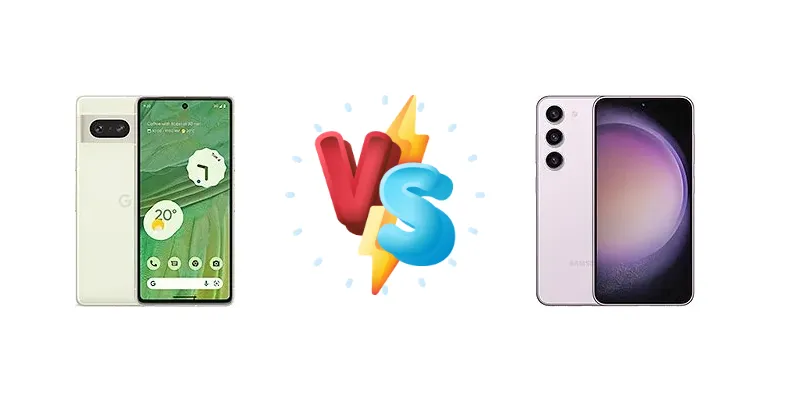
|
🏆 Quick Verdict
The Galaxy S23 edges out the Pixel 7 thanks to its significantly faster Snapdragon 8 Gen 2 chipset, brighter display, and slightly better battery life. However, the Pixel 7’s software experience and potentially superior computational photography make it a strong contender, especially for those prioritizing Google's ecosystem.
| PHONES | ||
|---|---|---|
| Phone Names | Google Pixel 7 | Samsung Galaxy S23 |
| Network | ||
|---|---|---|
| 2G bands | GSM 850 / 900 / 1800 / 1900 | GSM 850 / 900 / 1800 / 1900 |
| 3G bands | HSDPA 800 / 850 / 900 / 1700(AWS) / 1900 / 2100 | HSDPA 850 / 900 / 1700(AWS) / 1900 / 2100 |
| 4G bands | 1, 2, 3, 4, 5, 7, 8, 12, 13, 14, 17, 18, 19, 20, 25, 26, 28, 29, 30, 38, 40, 41, 42, 46, 48, 66, 71 - GQML3 | 1, 2, 3, 4, 5, 7, 8, 12, 13, 17, 18, 19, 20, 25, 26, 28, 32, 38, 39, 40, 41, 66 - International |
| 5G bands | 1, 2, 3, 4, 5, 7, 8, 12, 13, 14, 17, 18, 19, 20, 25, 26, 28, 29, 30, 38, 40, 41, 46, 48, 66, 71, 260, 261 SA/NSA/Sub6/mmWave - GQML3 | 1, 2, 3, 5, 7, 8, 12, 20, 25, 28, 38, 40, 41, 66, 75, 77, 78 SA/NSA/Sub6 - International |
| Speed | HSPA, LTE, 5G | HSPA, LTE (up to 7CA), 5G |
| Technology | GSM / CDMA / HSPA / EVDO / LTE / 5G | GSM / CDMA / HSPA / EVDO / LTE / 5G |
| 1, 2, 3, 5, 7, 8, 12, 14, 20, 25, 28, 30, 38, 40, 41, 48, 66, 71, 75, 76, 77, 78 SA/NSA/Sub6 - GVU6C | 1, 7, 25, 28, 41, 66, 71, 78, 258, 260, 261 SA/NSA/Sub6/mmWave - USA | |
| Launch | ||
|---|---|---|
| Announced | 2022, October 06 | 2023, February 01 |
| Status | Available. Released 2022, October 13 | Available. Released 2023, February 17 |
| Body | ||
|---|---|---|
| Build | Glass front (Gorilla Glass Victus), glass back (Gorilla Glass Victus), aluminum frame | Glass front (Gorilla Glass Victus 2), glass back (Gorilla Glass Victus 2), aluminum frame |
| Dimensions | 155.6 x 73.2 x 8.7 mm (6.13 x 2.88 x 0.34 in) | 146.3 x 70.9 x 7.6 mm (5.76 x 2.79 x 0.30 in) |
| SIM | Nano-SIM + eSIM | · Nano-SIM + eSIM· Nano-SIM + Nano-SIM + eSIM (max 2 at a time) |
| Weight | 197 g (6.95 oz) | 168 g (5.93 oz) |
| IP68 dust/water resistant (up to 1.5m for 30 min) | IP68 dust/water resistant (up to 1.5m for 30 min) Armor aluminum frame with tougher drop and scratch resistance (advertised) | |
| Display | ||
|---|---|---|
| Protection | Corning Gorilla Glass Victus | Corning Gorilla Glass Victus 2 |
| Resolution | 1080 x 2400 pixels, 20:9 ratio (~416 ppi density) | 1080 x 2340 pixels, 19.5:9 ratio (~425 ppi density) |
| Size | 6.3 inches, 96.7 cm2 (~84.9% screen-to-body ratio) | 6.1 inches, 90.1 cm2 (~86.8% screen-to-body ratio) |
| Type | AMOLED, 90Hz, HDR10+, 1000 nits (HBM), 1400 nits (peak) | Dynamic AMOLED 2X, 120Hz, HDR10+, 1200 nits (HBM), 1750 nits (peak) |
| Always-on display | Always-on display | |
| Platform | ||
|---|---|---|
| CPU | Octa-core (2x2.85 GHz Cortex-X1 & 2x2.35 GHz Cortex-A78 & 4x1.80 GHz Cortex-A55) | Octa-core (1x3.36 GHz Cortex-X3 & 2x2.8 GHz Cortex-A715 & 2x2.8 GHz Cortex-A710 & 3x2.0 GHz Cortex-A510) |
| Chipset | Google Tensor G2 (5 nm) | Qualcomm SM8550-AC Snapdragon 8 Gen 2 (4 nm) |
| GPU | Mali-G710 MP7 | Adreno 740 |
| OS | Android 13, upgradable to Android 15, up to 5 major Android upgrades | Android 13, up to 4 major Android upgrades, One UI 8 |
| Memory | ||
|---|---|---|
| Card slot | No | No |
| Internal | 128GB 8GB RAM, 256GB 8GB RAM | 128GB 8GB RAM, 256GB 8GB RAM, 512GB 8GB RAM |
| UFS 3.1 | UFS 3.1 - 128GB only UFS 4.0 | |
| Main Camera | ||
|---|---|---|
| Dual | 50 MP, f/1.9, 25mm (wide), 1/1.31", 1.2µm, dual pixel PDAF, OIS 12 MP, f/2.2, 114˚ (ultrawide), 1/2.9", 1.25µm | - |
| Features | Laser AF, Dual-LED flash, Pixel Shift, Auto-HDR, panorama | LED flash, auto-HDR, panorama |
| Single | 10.8 MP, f/2.2, 21mm (ultrawide), 1/3.1", 1.22µm | 12 MP, f/2.2, 26mm (wide), Dual Pixel PDAF |
| Triple | - | 50 MP, f/1.8, 24mm (wide), 1/1.56", 1.0µm, dual pixel PDAF, OIS 10 MP, f/2.4, 70mm (telephoto), 1/3.94", 1.0µm, PDAF, OIS, 3x optical zoom 12 MP, f/2.2, 13mm, 120˚ (ultrawide), 1/2.55" 1.4µm, Super Steady video |
| Video | 4K@30/60fps, 1080p@30/60/120/240fps; gyro-EIS, OIS, 10-bit HDR | 8K@24/30fps, 4K@30/60fps, 1080p@30/60/120/240fps, HDR10+, stereo sound rec., gyro-EIS |
| Selfie camera | ||
|---|---|---|
| Features | HDR, panorama | HDR, HDR10+ |
| Single | 10.8 MP, f/2.2, 21mm (ultrawide), 1/3.1", 1.22µm | 12 MP, f/2.2, 26mm (wide), 1/3.2", 1.12µm, dual pixel PDAF |
| Video | 4K@30/60fps, 1080p@30/60fps | 4K@30/60fps, 1080p@30fps |
| Sound | ||
|---|---|---|
| 3.5mm jack | No | No |
| 35mm jack | No | No |
| Loudspeaker | Yes, with stereo speakers | Yes, with stereo speakers |
| - | 32-bit/384kHz audio Tuned by AKG | |
| Comms | ||
|---|---|---|
| Bluetooth | 5.2, A2DP, LE, aptX HD | 5.3, A2DP, LE |
| NFC | Yes | Yes |
| Positioning | GPS (L1+L5), GLONASS (G1), BDS (B1I+B1c+B2a), GALILEO (E1+E5a), QZSS (L1+L5) | GPS, GLONASS, BDS, GALILEO |
| Radio | No | No |
| USB | USB Type-C 3.2 | USB Type-C 3.2, OTG |
| WLAN | Wi-Fi 802.11 a/b/g/n/ac/6e, tri-band, Wi-Fi Direct | Wi-Fi 802.11 a/b/g/n/ac/6e, tri-band, Wi-Fi Direct |
| Features | ||
|---|---|---|
| Sensors | Fingerprint (under display, optical), accelerometer, gyro, proximity, compass, barometer | Fingerprint (under display, ultrasonic), accelerometer, gyro, proximity, compass, barometer |
| - | Samsung DeX, Samsung Wireless DeX (desktop experience support) Bixby natural language commands and dictation Samsung Pay (Visa, MasterCard certified) | |
| Battery | ||
|---|---|---|
| Charging | 20W wired, PD3.0, 50% in 30 min 20W wireless Reverse wireless | 25W wired, PD3.0, 50% in 30 min 15W wireless (Qi) 4.5W reverse wireless |
| Type | Li-Ion 4355 mAh | Li-Ion 3900 mAh |
| Misc | ||
|---|---|---|
| Colors | Obsidian, Lemongrass, Snow | Phantom Black, Cream, Green, Lavender, Graphite, Lime |
| Models | GVU6C, GQML3, GO3Z5 | SM-S911B, SM-S911B/DS, SM-S911U, SM-S911U1, SM-S911W, SM-S911N, SM-S9110, SM-S911E, SM-S911E/DS |
| Price | € 199.00 / $ 179.26 / £ 189.99 / ₹ 28,499 | $ 237.95 / C$ 336.75 / £ 255.00 / € 322.41 / ₹ 49,990 |
| SAR | - | 0.95 W/kg (head) 0.88 W/kg (body) |
| SAR EU | - | 0.96 W/kg (head) 1.30 W/kg (body) |
| Tests | ||
|---|---|---|
| Battery life | Endurance rating 96h | Endurance rating 101h |
| Camera | Photo / Video | Photo / Video |
| Display | Contrast ratio: Infinite (nominal) | Contrast ratio: Infinite (nominal) |
| Loudspeaker | -26.2 LUFS (Good) | -27.0 LUFS (Good) |
| Performance | AnTuTu: 813114 (v9) GeekBench: 3288 (v5.1) GFXBench: 59fps (ES 3.1 onscreen) | AnTuTu: 1231075 (v9) GeekBench: 4950 (v5.1) GFXBench: 110fps (ES 3.1 onscreen) |
Google Pixel 7
- Excellent computational photography
- Clean and smooth Android experience
- Guaranteed software updates
- Competitive price
- Reverse wireless charging
- Slower processor compared to S23
- Less versatile camera system (no telephoto)
- Slightly shorter battery life
- Slower wireless charging
Samsung Galaxy S23
- Blazing-fast Snapdragon 8 Gen 2 processor
- Brighter and smoother display (120Hz)
- More versatile camera system (telephoto lens)
- Slightly better battery life
- Premium build quality
- Higher price
- Samsung's One UI can be divisive
- Slower wireless charging compared to Pixel 7
- Reverse wireless charging slower
Display Comparison
The Samsung Galaxy S23 boasts a significantly brighter display, reaching 1198 nits compared to the Pixel 7's 974 nits. Both have excellent contrast ratios (infinite nominal), but the S23's higher brightness makes it more visible in direct sunlight. Color accuracy is excellent on both, though Samsung's display tends to be more saturated by default. The S23 also has a slightly higher refresh rate (120Hz vs 90Hz on the Pixel 7), resulting in smoother scrolling.
Camera Comparison
Both phones offer excellent camera systems. The Pixel 7 is renowned for its computational photography prowess, producing consistently impressive images with excellent dynamic range and detail. The Galaxy S23 offers more versatility with its telephoto lens, allowing for greater zoom capabilities. Video recording is strong on both, but the S23 generally offers slightly better stabilization and dynamic range. Subjectively, Pixel's image processing tends to be more natural, while Samsung's can be more vibrant.
Performance
The Galaxy S23's Snapdragon 8 Gen 2 is a clear winner in the performance category. It offers substantially faster processing speeds and improved efficiency compared to the Pixel 7's Tensor G2. While the Pixel 7 is capable, the S23 handles demanding tasks and games with greater ease and less heat. The Snapdragon chip also benefits from wider software optimization.
Battery Life
The Galaxy S23 demonstrates slightly better battery endurance, with an endurance rating of 101h compared to the Pixel 7's 96h. Active use scores also favor the S23 (11:27h vs. estimated 9-10h for the Pixel 7). While both offer wireless charging, the S23's 15W wireless charging is slower than the Pixel 7's 20W wireless charging.
Buying Guide
The Google Pixel 7 is ideal for users deeply invested in the Google ecosystem, those who value a clean Android experience with guaranteed updates, and those who prioritize computational photography. The Samsung Galaxy S23 is best suited for power users who demand top-tier performance, a vibrant and bright display, and a versatile camera system with more hardware features.