
Asus ROG Phone 7 Ultimate vs. Google Pixel 7: A Deep Dive into Gaming and AI
| Phones Images | |||||
|---|---|---|---|---|---|
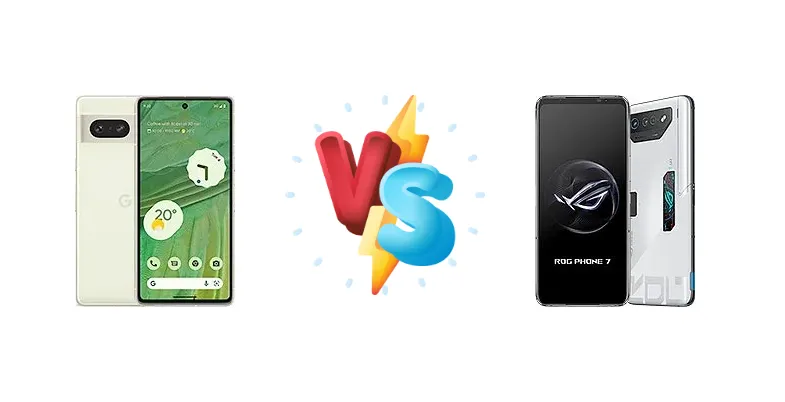
|
🏆 Quick Verdict
For the average user prioritizing camera quality, software experience, and everyday usability, the Google Pixel 7 is the better choice. However, gamers and power users demanding maximum performance and battery life will find the Asus ROG Phone 7 Ultimate to be the superior option.
| PHONES | ||
|---|---|---|
| Phone Names | Google Pixel 7 | Asus ROG Phone 7 Ultimate |
| Network | ||
|---|---|---|
| 2G bands | GSM 850 / 900 / 1800 / 1900 | GSM 850 / 900 / 1800 / 1900 |
| 3G bands | HSDPA 800 / 850 / 900 / 1700(AWS) / 1900 / 2100 | HSDPA 800 / 850 / 900 / 1700(AWS) / 1900 / 2100 |
| 4G bands | 1, 2, 3, 4, 5, 7, 8, 12, 13, 14, 17, 18, 19, 20, 25, 26, 28, 29, 30, 38, 40, 41, 42, 46, 48, 66, 71 - GQML3 | 1, 2, 3, 4, 5, 7, 8, 12, 17, 18, 19, 20, 25, 26, 28, 32, 34, 38, 39, 40, 41, 42, 43, 48, 66 - International |
| 5G bands | 1, 2, 3, 4, 5, 7, 8, 12, 13, 14, 17, 18, 19, 20, 25, 26, 28, 29, 30, 38, 40, 41, 46, 48, 66, 71, 260, 261 SA/NSA/Sub6/mmWave - GQML3 | 1, 2, 3, 5, 7, 8, 12, 18, 20, 25, 26, 28, 38, 40, 41, 48, 66, 77, 78, 79 SA/NSA/Sub6 - International |
| Speed | HSPA, LTE, 5G | HSPA, LTE (Up to 7CA), 5G |
| Technology | GSM / CDMA / HSPA / EVDO / LTE / 5G | GSM / CDMA / HSPA / LTE / 5G |
| 1, 2, 3, 5, 7, 8, 12, 14, 20, 25, 28, 30, 38, 40, 41, 48, 66, 71, 75, 76, 77, 78 SA/NSA/Sub6 - GVU6C | 1, 3, 5, 8, 28, 41, 77, 78, 79 SA/NSA/Sub6 - China | |
| Launch | ||
|---|---|---|
| Announced | 2022, October 06 | 2023, April 13 |
| Status | Available. Released 2022, October 13 | Available. Released 2023, May |
| Body | ||
|---|---|---|
| Build | Glass front (Gorilla Glass Victus), glass back (Gorilla Glass Victus), aluminum frame | Glass front (Gorilla Glass Victus), glass back (Gorilla Glass 3), aluminum frame |
| Dimensions | 155.6 x 73.2 x 8.7 mm (6.13 x 2.88 x 0.34 in) | 173 x 77 x 10.3 mm (6.81 x 3.03 x 0.41 in) |
| SIM | Nano-SIM + eSIM | Nano-SIM + Nano-SIM |
| Weight | 197 g (6.95 oz) | 239 g (8.43 oz) |
| IP68 dust/water resistant (up to 1.5m for 30 min) | Built-in motorized cooling air vent (AeroActive Portal) IP54 water resistant 2" OLED display (on the back) Pressure sensitive zones (Gaming triggers) | |
| Display | ||
|---|---|---|
| Protection | Corning Gorilla Glass Victus | Corning Gorilla Glass Victus |
| Resolution | 1080 x 2400 pixels, 20:9 ratio (~416 ppi density) | 1080 x 2448 pixels (~395 ppi density) |
| Size | 6.3 inches, 96.7 cm2 (~84.9% screen-to-body ratio) | 6.78 inches, 109.5 cm2 (~82.2% screen-to-body ratio) |
| Type | AMOLED, 90Hz, HDR10+, 1000 nits (HBM), 1400 nits (peak) | AMOLED, 1B colors, 165Hz, HDR10+, 1000 nits (HBM), 1500 nits (peak) |
| Always-on display | - | |
| Platform | ||
|---|---|---|
| CPU | Octa-core (2x2.85 GHz Cortex-X1 & 2x2.35 GHz Cortex-A78 & 4x1.80 GHz Cortex-A55) | Octa-core (1x3.2 GHz Cortex-X3 & 2x2.8 GHz Cortex-A715 & 2x2.8 GHz Cortex-A710 & 3x2.0 GHz Cortex-A510) |
| Chipset | Google Tensor G2 (5 nm) | Qualcomm SM8550-AB Snapdragon 8 Gen 2 (4 nm) |
| GPU | Mali-G710 MP7 | Adreno 740 |
| OS | Android 13, upgradable to Android 15, up to 5 major Android upgrades | Android 13, up to 2 major Android upgrades |
| Memory | ||
|---|---|---|
| Card slot | No | No |
| Internal | 128GB 8GB RAM, 256GB 8GB RAM | 512GB 16GB RAM |
| UFS 3.1 | UFS 4.0 NTFS support for external storage | |
| Main Camera | ||
|---|---|---|
| Dual | 50 MP, f/1.9, 25mm (wide), 1/1.31", 1.2µm, dual pixel PDAF, OIS 12 MP, f/2.2, 114˚ (ultrawide), 1/2.9", 1.25µm | - |
| Features | Laser AF, Dual-LED flash, Pixel Shift, Auto-HDR, panorama | LED flash, HDR, panorama |
| Single | 10.8 MP, f/2.2, 21mm (ultrawide), 1/3.1", 1.22µm | - |
| Triple | - | 50 MP, f/1.9, 24mm (wide), 1/1.56", 1.0µm, PDAF 13 MP, f/2.2, 13mm, 120˚ (ultrawide) 5 MP (macro) |
| Video | 4K@30/60fps, 1080p@30/60/120/240fps; gyro-EIS, OIS, 10-bit HDR | 8K@24fps, 4K@30/60fps, 1080p@30/60/120/240fps, 720p@480fps; gyro-EIS, HDR10+ |
| Selfie camera | ||
|---|---|---|
| Features | HDR, panorama | Panorama, HDR |
| Single | 10.8 MP, f/2.2, 21mm (ultrawide), 1/3.1", 1.22µm | 32 MP, f/2.5, 29mm (wide), 1/3.2", 0.7µm |
| Video | 4K@30/60fps, 1080p@30/60fps | 1080p@30fps |
| Sound | ||
|---|---|---|
| 3.5mm jack | No | Yes |
| 35mm jack | No | Yes |
| Loudspeaker | Yes, with stereo speakers | Yes, with stereo speakers (2 amplifiers) |
| - | 32-bit/384kHz audio | |
| Comms | ||
|---|---|---|
| Bluetooth | 5.2, A2DP, LE, aptX HD | 5.3, A2DP, LE, aptX HD, aptX Adaptive, aptX Lossless |
| NFC | Yes | Yes |
| Positioning | GPS (L1+L5), GLONASS (G1), BDS (B1I+B1c+B2a), GALILEO (E1+E5a), QZSS (L1+L5) | GPS (L1+L5), GLONASS (L1), BDS (B1I+B1c+B2a), GALILEO (E1+E5a), QZSS (L1+L5), NavIC (L5) |
| Radio | No | No |
| USB | USB Type-C 3.2 | USB Type-C 3.1 (side), DisplayPort 1.4; USB Type-C 2.0 (bottom), OTG, accessory connector |
| WLAN | Wi-Fi 802.11 a/b/g/n/ac/6e, tri-band, Wi-Fi Direct | Wi-Fi 802.11 a/b/g/n/ac/6e/7, tri-band, Wi-Fi Direct |
| Features | ||
|---|---|---|
| Sensors | Fingerprint (under display, optical), accelerometer, gyro, proximity, compass, barometer | Fingerprint (under display, optical), accelerometer, gyro, proximity, compass |
| Battery | ||
|---|---|---|
| Charging | 20W wired, PD3.0, 50% in 30 min 20W wireless Reverse wireless | 65W wired, PD3.0, QC5, 100% in 42 min 10W reverse wired |
| Type | Li-Ion 4355 mAh | Li-Po 6000 mAh |
| Misc | ||
|---|---|---|
| Colors | Obsidian, Lemongrass, Snow | Storm White |
| Models | GVU6C, GQML3, GO3Z5 | - |
| Price | € 199.00 / $ 179.26 / £ 189.99 / ₹ 28,499 | About 780 EUR |
| Tests | ||
|---|---|---|
| Battery life | Endurance rating 96h | Endurance rating 131h |
| Camera | Photo / Video | Photo / Video |
| Display | Contrast ratio: Infinite (nominal) | Contrast ratio: Infinite (nominal) |
| Loudspeaker | -26.2 LUFS (Good) | -25.5 LUFS (Very good) |
| Performance | AnTuTu: 813114 (v9) GeekBench: 3288 (v5.1) GFXBench: 59fps (ES 3.1 onscreen) | AnTuTu: 1325105 (v9) GeekBench: 5139 (v5.5), 5567 (v6) GFXBench: 107fps (ES 3.1 onscreen) |
Google Pixel 7
- Exceptional camera quality and image processing
- Clean and intuitive Android software experience
- Compact and manageable form factor
- Less powerful chipset compared to Snapdragon 8 Gen 2
- Slower charging speed
Asus ROG Phone 7 Ultimate
- Unmatched gaming performance and sustained speeds
- Massive battery life and fast 65W charging
- Dedicated gaming features and accessories
- Bulky and less ergonomic design
- Camera performance not as refined as the Pixel 7
Display Comparison
The Asus ROG Phone 7 Ultimate boasts a brighter display at 1095 nits compared to the Pixel 7’s 974 nits, offering improved visibility in direct sunlight. Both displays share an infinite (nominal) contrast ratio, but the ROG Phone’s higher peak brightness is a tangible advantage for outdoor use. While neither specification details refresh rate, the ROG Phone line historically features high refresh rate panels optimized for gaming, a feature likely present here, while the Pixel 7’s refresh rate is standard. The ROG Phone’s larger size also allows for a more immersive gaming experience.
Camera Comparison
Both phones offer photo and video capabilities, but the Pixel 7’s strength lies in its computational photography prowess powered by the Tensor G2. While sensor details are absent, Google’s image processing algorithms are renowned for their dynamic range and detail. The ROG Phone 7 Ultimate, while capable, prioritizes gaming features over camera innovation. Without specific sensor information, it’s reasonable to assume the ROG Phone’s camera system is geared towards general use rather than the Pixel 7’s photographic excellence. The absence of details on OIS or lens apertures makes a direct comparison difficult, but the Pixel 7’s software optimizations are a significant advantage.
Performance
The core difference lies in the chipsets: the Google Pixel 7 utilizes the Google Tensor G2 (5nm), while the Asus ROG Phone 7 Ultimate is powered by the Qualcomm Snapdragon 8 Gen 2 (4nm). The Snapdragon 8 Gen 2’s 4nm process offers superior thermal efficiency compared to the Tensor G2’s 5nm node, translating to less throttling during prolonged, demanding tasks like gaming. The Snapdragon 8 Gen 2’s CPU configuration – a 1x3.2 GHz Cortex-X3 prime core – is a step up from the Pixel 7’s 2x2.85 GHz Cortex-X1 cores, promising faster single-core performance. This difference is crucial for responsiveness and demanding applications. The ROG Phone’s likely inclusion of faster LPDDR5x RAM further enhances its performance edge.
Battery Life
The Asus ROG Phone 7 Ultimate dominates in battery endurance with a rating of 131 hours, significantly exceeding the Pixel 7’s 96 hours. This is coupled with 65W wired charging (100% in 42 minutes) compared to the Pixel 7’s 20W charging (50% in 30 minutes). The ROG Phone also offers 10W reverse wired charging, while the Pixel 7 provides reverse wireless charging. The ROG Phone’s larger battery capacity and faster charging speed make it ideal for users who need all-day battery life and quick top-ups, especially during gaming sessions.
Buying Guide
Buy the Google Pixel 7 if you need a consistently excellent camera, a clean and intuitive software experience with exclusive AI features, and a more manageable form factor for daily use. Buy the Asus ROG Phone 7 Ultimate if you prioritize sustained gaming performance, a massive battery, and features specifically designed for competitive mobile gaming, even if it means a larger device and a more aggressive aesthetic.