
Google Pixel 6a vs Pixel 4a: A Detailed Comparison
| Phones Images | |||||
|---|---|---|---|---|---|
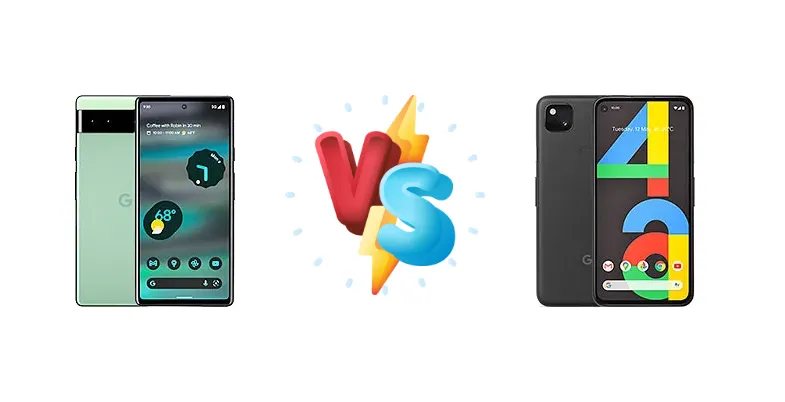
|
🏆 Quick Verdict
The Pixel 6a is the clear winner, offering a significantly faster processor, brighter display, and longer battery life. While the Pixel 4a remains a solid budget option, the 6a's upgrades make it the more compelling choice for most users, especially considering the price difference isn't substantial.
| PHONES | ||
|---|---|---|
| Phone Names | Google Pixel 6a | Google Pixel 4a |
| Network | ||
|---|---|---|
| 2G bands | GSM 850 / 900 / 1800 / 1900 | GSM 850 / 900 / 1800 / 1900 |
| 3G bands | HSDPA 800 / 850 / 900 / 1700(AWS) / 1900 / 2100 | HSDPA 850 / 900 / 1700(AWS) / 1900 / 2100 |
| 4G bands | 1, 2, 3, 4, 5, 7, 8, 12, 13, 14, 17, 18, 19, 20, 25, 26, 28, 29, 30, 38, 39, 40, 41, 42, 48, 66, 71 - GX7AS, GB62Z (USA/Canada) | 1, 2, 3, 4, 5, 7, 8, 12, 13, 14, 17, 18, 20, 25, 26, 28, 29, 30, 38, 39, 40, 41, 66, 71 |
| 5G bands | 1, 2, 3, 5, 7, 8, 12, 20, 25, 28, 30, 38, 40, 41, 48, 66, 71, 77, 78 SA/NSA/Sub6 - GX7AS (USA/Canada) | - |
| Speed | HSPA, LTE, 5G | HSPA 42.2/5.76 Mbps, LTE (3CA) Cat12 600/75 Mbps |
| Technology | GSM / HSPA / LTE / 5G | GSM / HSPA / LTE |
| 1, 2, 3, 5, 7, 8, 12, 20, 25, 28, 30, 40, 48, 66, 71, 77, 78 SA/NSA/Sub6 - G1AZG (International) | - | |
| Launch | ||
|---|---|---|
| Announced | 2022, May 11 | 2020, August 03 |
| Status | Available. Released 2022, July 21 | Available. Released 2020, August 20 |
| Body | ||
|---|---|---|
| Build | Glass front (Gorilla Glass 3), aluminum frame, plastic back | Glass front (Gorilla Glass 3), plastic back, plastic frame |
| Dimensions | 152.2 x 71.8 x 8.9 mm (5.99 x 2.83 x 0.35 in) | 144 x 69.4 x 8.2 mm (5.67 x 2.73 x 0.32 in) |
| SIM | Nano-SIM + eSIM | Nano-SIM + eSIM |
| Weight | 178 g (6.28 oz) | 143 g (5.04 oz) |
| IP67 dust/water resistant (up to 1m for 30 min) | - | |
| Display | ||
|---|---|---|
| Protection | Corning Gorilla Glass 3 | Corning Gorilla Glass 3 |
| Resolution | 1080 x 2400 pixels, 20:9 ratio (~429 ppi density) | 1080 x 2340 pixels, 19.5:9 ratio (~443 ppi density) |
| Size | 6.1 inches, 90.7 cm2 (~83.0% screen-to-body ratio) | 5.81 inches, 83.2 cm2 (~83.3% screen-to-body ratio) |
| Type | OLED, HDR | OLED, HDR |
| Always-on display | Always-on display | |
| Platform | ||
|---|---|---|
| CPU | Octa-core (2x2.80 GHz Cortex-X1 & 2x2.25 GHz Cortex-A76 & 4x1.80 GHz Cortex-A55) | Octa-core (2x2.2 GHz Kryo 470 Gold & 6x1.8 GHz Kryo 470 Silver) |
| Chipset | Google Tensor (5 nm) | Qualcomm SDM730 Snapdragon 730G (8 nm) |
| GPU | Mali-G78 MP20 | Adreno 618 |
| OS | Android 12, upgradable to Android 15, up to 5 major Android upgrades | Android 10, upgradable to Android 13 |
| Memory | ||
|---|---|---|
| Card slot | No | No |
| Internal | 128GB 6GB RAM | 128GB 6GB RAM |
| UFS 3.1 | UFS 2.1 | |
| Main Camera | ||
|---|---|---|
| Dual | 12.2 MP, f/1.7, 27mm, (wide), 1/2.55", 1.4µm, dual pixel PDAF, OIS 12 MP, f/2.2, 17mm, 114˚ (ultrawide), 1.25µm | - |
| Features | Dual-LED flash, Pixel Shift, Auto-HDR, panorama | LED flash, Pixel Shift, Auto-HDR, panorama |
| Single | 8 MP, f/2.0, 24mm (wide), 1.12µm | 12.2 MP, f/1.7, 27mm (wide), 1/2.55", 1.4µm, dual pixel PDAF, OIS |
| Video | 4K@30/60fps, 1080p@30/60/120/240fps; gyro-EIS, OIS | 4K@30fps, 1080p@30/60/120fps; gyro-EIS |
| Selfie camera | ||
|---|---|---|
| Features | HDR, panorama | HDR |
| Single | 8 MP, f/2.0, 24mm (wide), 1.12µm | 8 MP, f/2.0, 24mm (wide), 1.12µm |
| Video | 1080p@30fps | 1080p@30fps |
| Sound | ||
|---|---|---|
| 3.5mm jack | No | Yes |
| 35mm jack | No | Yes |
| Loudspeaker | Yes, with stereo speakers | Yes, with stereo speakers |
| Comms | ||
|---|---|---|
| Bluetooth | 5.2, A2DP, LE | 5.0, A2DP, LE, aptX HD |
| NFC | Yes | Yes |
| Positioning | GPS, GLONASS, GALILEO, QZSS | GPS, GLONASS, GALILEO, QZSS, BDS |
| Radio | No | No |
| USB | USB Type-C 3.1 | USB Type-C 3.1 |
| WLAN | Wi-Fi 802.11 a/b/g/n/ac/6e, dual-band, Wi-Fi Direct | Wi-Fi 802.11 a/b/g/n/ac, dual-band, Wi-Fi Direct, DLNA |
| Features | ||
|---|---|---|
| Sensors | Fingerprint (under display, optical), accelerometer, gyro, proximity, compass, barometer | Fingerprint (rear-mounted), accelerometer, gyro, proximity, compass, barometer |
| Battery | ||
|---|---|---|
| Charging | 18W wired, PD3.0 | 18W wired, PD2.0 |
| Type | Li-Po 4410 mAh | Li-Po 3140 mAh |
| Misc | ||
|---|---|---|
| Colors | Chalk, Charcoal, Sage | Just Black, Barely Blue |
| Models | GX7AS, GB62Z, G1AZG, GB17L | G025J, GA02099, G025N |
| Price | $ 138.99 / C$ 228.74 / ₹ 23,999 | $ 139.99 / C$ 159.99 |
| Tests | ||
|---|---|---|
| Battery life | Endurance rating 94h | Endurance rating 76h |
| Display | Contrast ratio: Infinite (nominal) | Contrast ratio: Infinite (nominal) |
| Performance | - | AnTuTu: 268714 (v8) GeekBench: 6426 (v4.4), 1626 (v5.1) GFXBench: 17fps (ES 3.1 onscreen) |
Google Pixel 6a
- Faster Processor (Google Tensor)
- Brighter Display
- Longer Battery Life
- Improved Camera
- Modern Design
- Slightly larger size
- No expandable storage
Google Pixel 4a
- More Compact Size
- Lower Price (when available)
- Headphone Jack
- Slower Processor
- Dimmer Display
- Shorter Battery Life
- Older Camera Technology
Display Comparison
The Pixel 6a boasts a brighter display (876 nits vs 803 nits) offering better visibility in sunlight. Both have excellent contrast ratios (Infinite nominal), providing deep blacks and vibrant colors. The 6a's slightly larger size also contributes to a more immersive viewing experience.
Camera Comparison
Both Pixels offer excellent camera performance for their price range, thanks to Google's computational photography prowess. However, the Pixel 6a's newer hardware and software algorithms generally produce slightly better images, especially in low-light conditions. The 6a also benefits from additional camera features.
Performance
This is where the Pixel 6a truly shines. The Google Tensor chipset is significantly faster than the Snapdragon 730G in the Pixel 4a. Expect smoother multitasking, quicker app loading times, and a more responsive overall experience on the 6a. Gaming performance is also noticeably improved.
Battery Life
The Pixel 6a has a substantial advantage in battery life, achieving an endurance rating of 94 hours compared to the Pixel 4a's 76 hours. This translates to significantly longer usage between charges, making the 6a a more reliable choice for power users.
Buying Guide
The Pixel 6a is ideal for users who prioritize performance, a vibrant display, and a modern camera system. It's a great choice for those upgrading from older phones or seeking a reliable mid-range device. The Pixel 4a is best suited for budget-conscious buyers who primarily need a phone for basic tasks like calls, texts, and light browsing, and are less concerned with top-tier performance.