
Google Pixel 6 vs Xiaomi Mi 11i: A Deep Dive into Mid-Range Champions
| Phones Images | |||||
|---|---|---|---|---|---|
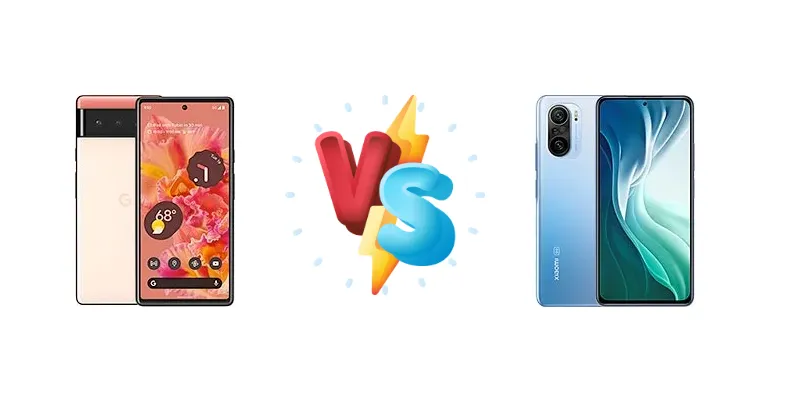
|
🏆 Quick Verdict
For the average user prioritizing camera quality, software experience, and long-term updates, the Google Pixel 6 is the superior choice. While the Xiaomi Mi 11i boasts faster charging and slightly better battery endurance, the Pixel 6’s Tensor chip and computational photography capabilities offer a more refined and feature-rich experience.
| PHONES | ||
|---|---|---|
| Phone Names | Google Pixel 6 | Xiaomi Mi 11i |
| Network | ||
|---|---|---|
| 2G bands | GSM 850 / 900 / 1800 / 1900 | GSM 850 / 900 / 1800 / 1900 |
| 3G bands | HSDPA 800 / 850 / 900 / 1700(AWS) / 1900 / 2100 | HSDPA 850 / 900 / 1700(AWS) / 1900 / 2100 |
| 4G bands | 1, 2, 3, 4, 5, 7, 8, 12, 13, 14, 17, 18, 19, 20, 25, 26, 28, 29, 30, 32, 38, 39, 40, 41, 42, 46, 48, 66, 71 - GB7N6, G9S9B16 | 1, 2, 3, 4, 5, 7, 8, 12, 17, 20, 28, 38, 40, 41, 66 |
| 5G bands | 1, 2, 3, 5, 7, 8, 12, 14, 20, 25, 28, 30, 38, 40, 41, 48, 66, 71, 77, 78, 257, 258, 260, 261 SA/NSA/Sub6/mmWave - G9S9B | 1, 3, 5, 7, 8, 20, 28, 38, 41, 77, 78 SA/NSA |
| Speed | HSPA, LTE, 5G | HSPA, LTE, 5G |
| Technology | GSM / CDMA / HSPA / EVDO / LTE / 5G | GSM / HSPA / LTE / 5G |
| 1, 2, 3, 5, 7, 8, 12, 14, 20, 25, 28, 30, 38, 40, 41, 48, 66, 71, 77, 78 SA/NSA/Sub6 - GB7N6 | - | |
| Launch | ||
|---|---|---|
| Announced | 2021, October 19 | 2021, March 29 |
| Status | Available. Released 2021, October 28 | Available. Released 2021, May 31 |
| Body | ||
|---|---|---|
| Build | Glass front (Gorilla Glass Victus), glass back (Gorilla Glass 6), aluminum frame | - |
| Dimensions | 158.6 x 74.8 x 8.9 mm (6.24 x 2.94 x 0.35 in) | 163.7 x 76.4 x 7.8 mm (6.44 x 3.01 x 0.31 in) |
| SIM | Nano-SIM + eSIM | Nano-SIM + Nano-SIM |
| Weight | 207 g (7.30 oz) | 196 g (6.91 oz) |
| IP68 dust/water resistant (up to 1.5m for 30 min) | IP53, dust and splash resistant | |
| Display | ||
|---|---|---|
| Protection | Corning Gorilla Glass Victus | Corning Gorilla Glass 5 |
| Resolution | 1080 x 2400 pixels, 20:9 ratio (~411 ppi density) | 1080 x 2400 pixels, 20:9 ratio (~395 ppi density) |
| Size | 6.4 inches, 98.9 cm2 (~83.4% screen-to-body ratio) | 6.67 inches, 107.4 cm2 (~85.9% screen-to-body ratio) |
| Type | AMOLED, 90Hz, HDR10+ | Super AMOLED, 120Hz, HDR10+, 900 nits (HBM), 1300 nits (peak) |
| Always-on display | - | |
| Platform | ||
|---|---|---|
| CPU | Octa-core (2x2.80 GHz Cortex-X1 & 2x2.25 GHz Cortex-A76 & 4x1.80 GHz Cortex-A55) | Octa-core (1x2.84 GHz Cortex-X1 & 3x2.42 GHz Cortex-A78 & 4x1.80 GHz Cortex-A55) |
| Chipset | Google Tensor (5 nm) | Qualcomm SM8350 Snapdragon 888 5G (5 nm) |
| GPU | Mali-G78 MP20 | Adreno 660 |
| OS | Android 12, upgradable to Android 15, up to 5 major Android upgrades | Android 11, MIUI 12 |
| Memory | ||
|---|---|---|
| Card slot | No | No |
| Internal | 128GB 8GB RAM, 256GB 8GB RAM | 128GB 8GB RAM, 256GB 8GB RAM |
| UFS 3.1 | UFS 3.1 | |
| Main Camera | ||
|---|---|---|
| Dual | 50 MP, f/1.9, 25mm (wide), 1/1.31", 1.2µm, dual pixel PDAF, OIS 12 MP, f/2.2, 17mm, 114˚ (ultrawide), 1.25µm | - |
| Features | Laser AF, Dual-LED flash, Pixel Shift, Auto-HDR, panorama | Color spectrum sensor, LED flash, HDR, panorama |
| Single | 8 MP, f/2.0, 24mm (wide), 1.12µm | 20 MP, f/2.5, (wide), 1/3.4", 0.8µm |
| Triple | - | 108 MP, f/1.8, 26mm (wide), 1/1.52", 0.7µm, PDAF 8 MP, f/2.2, 119˚ (ultrawide) 5 MP, f/2.4, 50mm (telephoto macro), 1/5.0", 1.12µm, AF |
| Video | 4K@30/60fps, 1080p@30/60/120/240fps; gyro-EIS, OIS | 8K@30fps, 4K@30/60fps, 1080p@30/60/120/240/960fps, gyro-EIS, HDR10+ |
| Selfie camera | ||
|---|---|---|
| Features | HDR, panorama | HDR |
| Single | 8 MP, f/2.0, 24mm (wide), 1.12µm | 20 MP, f/2.5, (wide), 1/3.4", 0.8µm |
| Video | 1080p@30fps | 1080p@30fps, 720p@120fps |
| Sound | ||
|---|---|---|
| 3.5mm jack | No | No |
| 35mm jack | No | No |
| Loudspeaker | Yes, with stereo speakers | Yes, with stereo speakers |
| - | 24-bit/192kHz audio | |
| Comms | ||
|---|---|---|
| Bluetooth | 5.2, A2DP, LE, aptX HD | 5.2, A2DP, LE |
| Infrared port | - | Yes |
| NFC | Yes | Yes (market/region dependent) |
| Positioning | GPS (L1+L5), GLONASS (G1), BDS (B1I+B1c+B2a), GALILEO (E1+E5a), QZSS (L1+L5) | GPS (L1+L5), GLONASS (L1), BDS (B1I+B1c+B2a), GALILEO (E1+E5a), QZSS (L1+L5), NavIC (L5) |
| Radio | No | No |
| USB | USB Type-C 3.1 | USB Type-C 2.0, OTG |
| WLAN | Wi-Fi 802.11 a/b/g/n/ac/6e, dual-band, Wi-Fi Direct | Wi-Fi 802.11 a/b/g/n/ac/6, dual-band, Wi-Fi Direct |
| Features | ||
|---|---|---|
| Sensors | Fingerprint (under display, optical), accelerometer, gyro, proximity, compass, barometer | Fingerprint (side-mounted), accelerometer, gyro, proximity, compass, barometer |
| Battery | ||
|---|---|---|
| Charging | Wired (based on 30W charger), PD3.0, 50% in 30 min 21W wireless Reverse wireless | 33W wired, PD3.0, QC3, 100% in 52 min |
| Type | Li-Ion 4614 mAh | Li-Po 4520 mAh |
| Misc | ||
|---|---|---|
| Colors | Sorta Seafoam, Kinda Coral, Stormy Black | Celestial Silver, Frosty White, Cosmic Black |
| Models | GB7N6, G9S9B16, G9S9B, GR1YH | M2012K11G |
| Price | $ 172.48 / C$ 238.84 / £ 169.99 / € 191.89 / ₹ 23,719 | About 230 EUR |
| SAR | - | 0.95 W/kg (head) 0.74 W/kg (body) |
| SAR EU | - | 0.57 W/kg (head) 0.77 W/kg (body) |
| Tests | ||
|---|---|---|
| Battery life | Endurance rating 86h | Endurance rating 96h |
| Camera | Photo / Video | Photo / Video |
| Display | Contrast ratio: Infinite (nominal) | Contrast ratio: Infinite (nominal) |
| Loudspeaker | -26.9 LUFS (Good) | -26.0 LUFS (Very good) |
| Performance | AnTuTu: 676831 (v9) GeekBench: 2899 (v5.1) GFXBench: 57fps (ES 3.1 onscreen) | AnTuTu: 690021 (v8) GeekBench: 3641 (v5.1) |
Google Pixel 6
- Superior camera performance and computational photography
- Clean Android experience with guaranteed updates
- AI-powered features and Tensor chip optimization
- Shorter battery life compared to the Mi 11i
- Slower wired charging speed
Xiaomi Mi 11i
- Faster charging speeds (33W)
- Longer battery life (96h endurance rating)
- Higher peak display brightness for outdoor visibility
- MIUI software can be bloated and less intuitive
- Camera performance lags behind the Pixel 6
Display Comparison
Both the Pixel 6 and Mi 11i feature displays with an 'Infinite' (nominal) contrast ratio, suggesting excellent black levels. However, the Mi 11i distinguishes itself with a measured peak brightness of 939 nits, significantly brighter than the Pixel 6’s unspecified peak brightness. This translates to better outdoor visibility for the Mi 11i. While both likely utilize AMOLED panels, the Pixel 6’s display technology isn’t detailed, potentially lacking features like adaptive refresh rates found in other devices at this price point. The Mi 11i’s higher brightness is a clear advantage for users who frequently consume content outdoors.
Camera Comparison
Both phones offer photo and video capabilities, but the Pixel 6 leverages Google’s renowned computational photography. While sensor sizes aren’t specified, the Pixel 6’s Tensor chip excels at image processing, delivering exceptional dynamic range and detail, particularly in challenging lighting conditions. The Mi 11i’s Snapdragon 888 also provides strong image processing, but lacks the dedicated AI hardware of the Tensor. The Pixel 6’s software algorithms are a significant differentiator, offering features like Magic Eraser and Motion Mode. The Mi 11i’s camera system is capable, but the Pixel 6 consistently produces more visually appealing and technically impressive results.
Performance
The core difference lies in the chipsets. The Xiaomi Mi 11i’s Snapdragon 888 (5nm) features a 2.84 GHz Cortex-X1 prime core, alongside three 2.42 GHz Cortex-A78 cores and four 1.80 GHz Cortex-A55 cores. The Pixel 6 counters with Google’s Tensor (5nm) chip, utilizing a 2.80 GHz Cortex-X1 and 2.25 GHz Cortex-A76 cores, plus four 1.80 GHz Cortex-A55 cores. While both are 5nm, the Tensor chip’s architecture is optimized for machine learning tasks, impacting image processing and voice recognition. The Mi 11i’s Snapdragon 888 generally delivers higher peak GPU performance, benefiting demanding games, but the Tensor chip’s efficiency and AI capabilities provide a smoother, more intelligent overall experience. Both devices utilize an octa-core configuration, but the Tensor’s focus is on AI acceleration.
Battery Life
The Xiaomi Mi 11i boasts an endurance rating of 96 hours, exceeding the Pixel 6’s 86-hour rating. This suggests the Mi 11i offers better real-world battery life, likely due to the Snapdragon 888’s efficiency and a potentially optimized software experience. The Mi 11i supports 33W wired charging, reaching 100% in 52 minutes, while the Pixel 6 utilizes 30W wired charging (with PD3.0) achieving 50% in 30 minutes. The Pixel 6 also offers 21W wireless charging and reverse wireless charging, features absent on the Mi 11i. While the Mi 11i charges faster to 100%, the Pixel 6’s wireless charging options add convenience.
Buying Guide
Buy the Google Pixel 6 if you need a smartphone with exceptional camera capabilities, a clean and consistently updated Android experience, and benefit from Google’s AI-powered features. Buy the Xiaomi Mi 11i if you prioritize raw performance for gaming, faster charging speeds, and a slightly longer-lasting battery, and are comfortable with Xiaomi’s MIUI software.