
Google Pixel 6 vs Sony Xperia 1 III: A Deep Dive into Android Flagships
| Phones Images | |||||
|---|---|---|---|---|---|
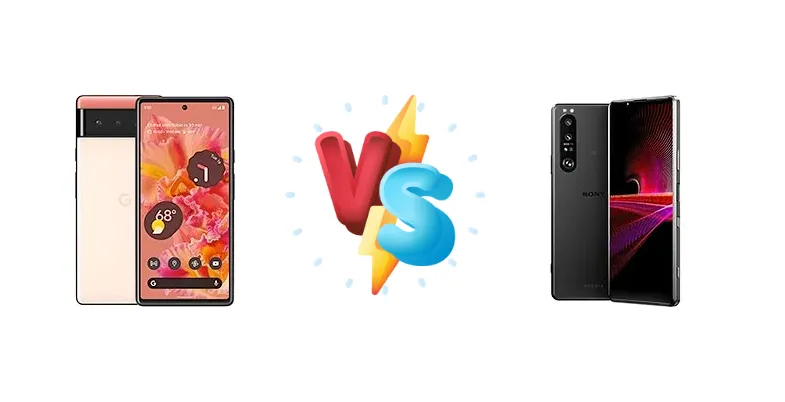
|
🏆 Quick Verdict
For the average user, the Google Pixel 6 emerges as the stronger recommendation. Its Tensor chip delivers a unique and often superior software experience, coupled with exceptional camera capabilities, all at a more accessible price point. While the Xperia 1 III excels in specific areas like display brightness, its higher cost and less refined software don't justify the premium for most.
| PHONES | ||
|---|---|---|
| Phone Names | Google Pixel 6 | Sony Xperia 1 III |
| Network | ||
|---|---|---|
| 2G bands | GSM 850 / 900 / 1800 / 1900 | GSM 850 / 900 / 1800 / 1900 |
| 3G bands | HSDPA 800 / 850 / 900 / 1700(AWS) / 1900 / 2100 | HSDPA 800 / 850 / 900 / 1700(AWS) / 1900 / 2100 |
| 4G bands | 1, 2, 3, 4, 5, 7, 8, 12, 13, 14, 17, 18, 19, 20, 25, 26, 28, 29, 30, 32, 38, 39, 40, 41, 42, 46, 48, 66, 71 - GB7N6, G9S9B16 | 1, 2, 3, 4, 5, 7, 8, 12, 13, 17, 19, 20, 25, 26, 28, 29, 32, 34, 38, 39, 40, 41, 46, 66 - Europe |
| 5G bands | 1, 2, 3, 5, 7, 8, 12, 14, 20, 25, 28, 30, 38, 40, 41, 48, 66, 71, 77, 78, 257, 258, 260, 261 SA/NSA/Sub6/mmWave - G9S9B | 1, 3, 5, 7, 8, 20, 28, 38, 40, 41, 77, 78 SA/NSA/Sub6 - Europe |
| Speed | HSPA, LTE, 5G | HSPA, LTE, 5G |
| Technology | GSM / CDMA / HSPA / EVDO / LTE / 5G | GSM / HSPA / LTE / 5G |
| 1, 2, 3, 5, 7, 8, 12, 14, 20, 25, 28, 30, 38, 40, 41, 48, 66, 71, 77, 78 SA/NSA/Sub6 - GB7N6 | SA/NSA/Sub6/mmWave - USA (specific) | |
| Launch | ||
|---|---|---|
| Announced | 2021, October 19 | 2021, April 14 |
| Status | Available. Released 2021, October 28 | Available. Released 2021, August 25 |
| Body | ||
|---|---|---|
| Build | Glass front (Gorilla Glass Victus), glass back (Gorilla Glass 6), aluminum frame | Glass front (Gorilla Glass Victus), glass back (Gorilla Glass 6), aluminum frame |
| Dimensions | 158.6 x 74.8 x 8.9 mm (6.24 x 2.94 x 0.35 in) | 165 x 71 x 8.2 mm (6.50 x 2.80 x 0.32 in) |
| SIM | Nano-SIM + eSIM | Nano-SIM + Nano-SIM |
| Weight | 207 g (7.30 oz) | 186 g / 187.1 g (mmWave) (6.56 oz) |
| IP68 dust/water resistant (up to 1.5m for 30 min) | IP65/IP68 dust/water resistant (up to 1.5m for 30 min) | |
| Display | ||
|---|---|---|
| Protection | Corning Gorilla Glass Victus | Corning Gorilla Glass Victus |
| Resolution | 1080 x 2400 pixels, 20:9 ratio (~411 ppi density) | 1644 x 3840 pixels, 21:9 ratio (~643 ppi density) |
| Size | 6.4 inches, 98.9 cm2 (~83.4% screen-to-body ratio) | 6.5 inches, 98.6 cm2 (~84.2% screen-to-body ratio) |
| Type | AMOLED, 90Hz, HDR10+ | OLED, 1B colors, 120Hz, HDR BT.2020 |
| Always-on display | Runs at 1096 x 2560 pixels except for select use cases | |
| Platform | ||
|---|---|---|
| CPU | Octa-core (2x2.80 GHz Cortex-X1 & 2x2.25 GHz Cortex-A76 & 4x1.80 GHz Cortex-A55) | Octa-core (1x2.84 GHz Cortex-X1 & 3x2.42 GHz Cortex-A78 & 4x1.80 GHz Cortex-A55) |
| Chipset | Google Tensor (5 nm) | Qualcomm SM8350 Snapdragon 888 5G (5 nm) |
| GPU | Mali-G78 MP20 | Adreno 660 |
| OS | Android 12, upgradable to Android 15, up to 5 major Android upgrades | Android 11, upgradable to Android 13 |
| Memory | ||
|---|---|---|
| Card slot | No | microSDXC (uses shared SIM slot) |
| Internal | 128GB 8GB RAM, 256GB 8GB RAM | 256GB 12GB RAM, 512GB 12GB RAM |
| UFS 3.1 | UFS 3.X | |
| Main Camera | ||
|---|---|---|
| Dual | 50 MP, f/1.9, 25mm (wide), 1/1.31", 1.2µm, dual pixel PDAF, OIS 12 MP, f/2.2, 17mm, 114˚ (ultrawide), 1.25µm | - |
| Features | Laser AF, Dual-LED flash, Pixel Shift, Auto-HDR, panorama | Zeiss optics, Zeiss T* lens coating, color spectrum sensor, LED flash, panorama, HDR, eye tracking |
| Single | 8 MP, f/2.0, 24mm (wide), 1.12µm | 8 MP, f/2.0, 24mm (wide), 1/4", 1.12µm |
| Triple | - | 12 MP, f/1.7, 24mm (wide), 1/1.7", 1.8µm, dual pixel PDAF, OIS 12 MP, f/2.3, 70mm (telephoto), f/2.8, 105mm (telephoto), 1/2.9", dual pixel PDAF, 3x/4.4x optical zoom, OIS 12 MP, f/2.2, 124˚, 16mm (ultrawide), 1/2.6", dual pixel PDAF 0.3 MP, TOF 3D, (depth) |
| Video | 4K@30/60fps, 1080p@30/60/120/240fps; gyro-EIS, OIS | 4K@24/25/30/60/120fps HDR, 1080p@30/60/120fps; 5-axis gyro-EIS, OIS |
| Selfie camera | ||
|---|---|---|
| Features | HDR, panorama | HDR |
| Single | 8 MP, f/2.0, 24mm (wide), 1.12µm | 8 MP, f/2.0, 24mm (wide), 1/4.0", 1.12µm |
| Video | 1080p@30fps | 1080p@30fps, 5-axis gyro-EIS |
| Sound | ||
|---|---|---|
| 3.5mm jack | No | Yes |
| 35mm jack | No | Yes |
| Loudspeaker | Yes, with stereo speakers | Yes, with stereo speakers |
| - | 24-bit/192kHz audio Dynamic vibration system | |
| Comms | ||
|---|---|---|
| Bluetooth | 5.2, A2DP, LE, aptX HD | 5.2, A2DP, LE, aptX HD, aptX Adaptive |
| NFC | Yes | Yes |
| Positioning | GPS (L1+L5), GLONASS (G1), BDS (B1I+B1c+B2a), GALILEO (E1+E5a), QZSS (L1+L5) | GPS, GLONASS, BDS, GALILEO, QZSS |
| Radio | No | No |
| USB | USB Type-C 3.1 | USB Type-C 3.1, OTG, video output |
| WLAN | Wi-Fi 802.11 a/b/g/n/ac/6e, dual-band, Wi-Fi Direct | Wi-Fi 802.11 a/b/g/n/ac/6, dual-band, Wi-Fi Direct, DLNA |
| Features | ||
|---|---|---|
| Sensors | Fingerprint (under display, optical), accelerometer, gyro, proximity, compass, barometer | Fingerprint (side-mounted), accelerometer, gyro, proximity, barometer, compass |
| - | Native Sony Alpha camera support | |
| Battery | ||
|---|---|---|
| Charging | Wired (based on 30W charger), PD3.0, 50% in 30 min 21W wireless Reverse wireless | 30W wired, PD, 50% in 30 min Wireless Reverse wireless |
| Type | Li-Ion 4614 mAh | Li-Po 4500 mAh |
| Misc | ||
|---|---|---|
| Colors | Sorta Seafoam, Kinda Coral, Stormy Black | Frosted Black, Frosted Gray, Frosted Purple |
| Models | GB7N6, G9S9B16, G9S9B, GR1YH | XQBC62/V, XQBC52V.UKCX, SO-51B, SOG03, A101SO, XQ-BC62, XQ-BC72, XQ-BC52, XQ-BC01, XQ-BC11, XQ-BC21, XQ-BC72 |
| Price | $ 172.48 / C$ 238.84 / £ 169.99 / € 191.89 / ₹ 23,719 | € 505.26 / $ 903.43 |
| Tests | ||
|---|---|---|
| Battery life | Endurance rating 86h | Endurance rating 82h |
| Camera | Photo / Video | Photo / Video |
| Display | Contrast ratio: Infinite (nominal) | Contrast ratio: Infinite (nominal) |
| Loudspeaker | -26.9 LUFS (Good) | -26.5 LUFS (Good) |
| Performance | AnTuTu: 676831 (v9) GeekBench: 2899 (v5.1) GFXBench: 57fps (ES 3.1 onscreen) | AnTuTu: 607423 (v8) GeekBench: 3515 (v5.1) GFXBench: 54fps (ES 3.1 onscreen) |
Google Pixel 6
- Exceptional computational photography
- Unique AI-powered features with Tensor chip
- Clean and timely Android updates
- Display brightness may be lower than competitors
- Potential for software bugs early in the lifecycle
Sony Xperia 1 III
- Bright and color-accurate display
- Pro-grade camera features and manual controls
- Traditional Android experience
- Higher price point
- Snapdragon 888 can throttle under load
Display Comparison
The Sony Xperia 1 III boasts a significant advantage in display brightness, reaching a measured 620 nits, compared to the Pixel 6’s unspecified but likely lower peak brightness. Both displays share an 'Infinite' (nominal) contrast ratio, suggesting excellent black levels. However, the Xperia 1 III’s higher brightness translates to better outdoor visibility. While both likely utilize OLED panels, the Xperia 1 III’s focus on color accuracy, a hallmark of Sony’s displays, makes it preferable for professional photo and video editing. The Pixel 6, while still excellent, likely prioritizes color vibrancy over absolute accuracy.
Camera Comparison
Both devices offer versatile camera systems capable of both photo and video capture. However, their approaches differ significantly. The Pixel 6 leverages Google’s computational photography prowess, relying on software algorithms to enhance image quality. The Xperia 1 III, on the other hand, emphasizes manual control and a more natural image processing style. While specific sensor sizes aren’t provided, the Xperia 1 III’s pro-grade features, like real-time eye autofocus and 4K 120fps video recording, cater to experienced photographers and videographers. The Pixel 6 excels in low-light photography and portrait mode, thanks to its AI-powered processing. The absence of detailed camera specs for both makes a direct comparison difficult, but the Xperia 1 III’s feature set suggests a more comprehensive toolkit for serious creators.
Performance
Both phones utilize octa-core CPUs built on a 5nm process, but their architectures differ. The Pixel 6’s Google Tensor chip features a 2x2.80 GHz Cortex-X1 prime core, paired with 2x2.25 GHz Cortex-A76 cores and 4x1.80 GHz Cortex-A55 cores. The Xperia 1 III employs the Qualcomm Snapdragon 888 5G, with a 1x2.84 GHz Cortex-X1, 3x2.42 GHz Cortex-A78 cores, and 4x1.80 GHz Cortex-A55 cores. The Snapdragon 888 is known for its raw GPU power, potentially giving the Xperia 1 III an edge in graphically demanding games. However, the Tensor chip’s integrated AI capabilities offer unique advantages in tasks like voice recognition and image processing. Thermal management is a potential concern for the Snapdragon 888, which is known to throttle under sustained load, while the Tensor chip’s architecture may offer better efficiency.
Battery Life
Both the Pixel 6 and Xperia 1 III achieve similar endurance ratings – 86 hours for the Pixel 6 and 82 hours for the Xperia 1 III. This suggests comparable real-world battery life despite the Pixel 6’s slightly higher rating. Both support 30W wired charging with PD, achieving a 50% charge in 30 minutes. Both also offer wireless and reverse wireless charging. The Pixel 6’s 21W wireless charging is slightly slower than the Xperia 1 III’s unspecified wireless charging speed, but the difference is unlikely to be significant for most users. The similar endurance ratings indicate that software optimization and power efficiency play a larger role than battery capacity alone.
Buying Guide
Buy the Google Pixel 6 if you need a smartphone that excels in computational photography, offers a clean and intuitive software experience with timely updates, and provides excellent value for money. Buy the Sony Xperia 1 III if you are a professional content creator or avid multimedia consumer who prioritizes a bright, color-accurate display, manual camera controls, and a more traditional Android experience.