
Google Pixel 6 vs Samsung Galaxy A72: A Detailed Comparison of Performance, Camera, and Battery
| Phones Images | |||||
|---|---|---|---|---|---|
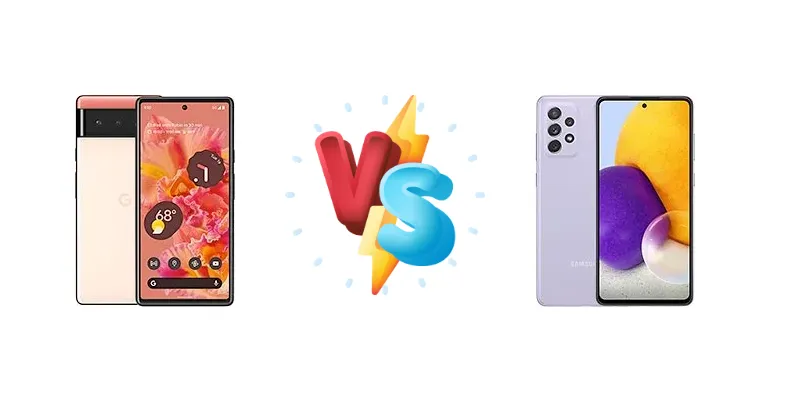
|
🏆 Quick Verdict
For users prioritizing camera quality and a smooth, responsive experience, the Google Pixel 6 is the clear winner. However, the Samsung Galaxy A72 excels in battery endurance and offers a compelling value proposition for those seeking a reliable, long-lasting device without breaking the bank.
| PHONES | ||
|---|---|---|
| Phone Names | Google Pixel 6 | Samsung Galaxy A72 |
| Network | ||
|---|---|---|
| 2G bands | GSM 850 / 900 / 1800 / 1900 | GSM 850 / 900 / 1800 / 1900 |
| 3G bands | HSDPA 800 / 850 / 900 / 1700(AWS) / 1900 / 2100 | HSDPA 850 / 900 / 1700(AWS) / 1900 / 2100 |
| 4G bands | 1, 2, 3, 4, 5, 7, 8, 12, 13, 14, 17, 18, 19, 20, 25, 26, 28, 29, 30, 32, 38, 39, 40, 41, 42, 46, 48, 66, 71 - GB7N6, G9S9B16 | 1, 2, 3, 4, 5, 7, 8, 12, 17, 20, 26, 28, 32, 38, 40, 41, 66 |
| 5G bands | 1, 2, 3, 5, 7, 8, 12, 14, 20, 25, 28, 30, 38, 40, 41, 48, 66, 71, 77, 78, 257, 258, 260, 261 SA/NSA/Sub6/mmWave - G9S9B | - |
| Speed | HSPA, LTE, 5G | HSPA, LTE |
| Technology | GSM / CDMA / HSPA / EVDO / LTE / 5G | GSM / HSPA / LTE |
| 1, 2, 3, 5, 7, 8, 12, 14, 20, 25, 28, 30, 38, 40, 41, 48, 66, 71, 77, 78 SA/NSA/Sub6 - GB7N6 | - | |
| Launch | ||
|---|---|---|
| Announced | 2021, October 19 | 2021, March 17 |
| Status | Available. Released 2021, October 28 | Available. Released 2021, March 26 |
| Body | ||
|---|---|---|
| Build | Glass front (Gorilla Glass Victus), glass back (Gorilla Glass 6), aluminum frame | Glass front (Gorilla Glass 5), plastic frame, plastic back |
| Dimensions | 158.6 x 74.8 x 8.9 mm (6.24 x 2.94 x 0.35 in) | 165 x 77.4 x 8.4 mm (6.50 x 3.05 x 0.33 in) |
| SIM | Nano-SIM + eSIM | · Nano-SIM· Nano-SIM + Nano-SIM |
| Weight | 207 g (7.30 oz) | 203 g (7.16 oz) |
| IP68 dust/water resistant (up to 1.5m for 30 min) | IP67 dust/water resistant (up to 1m for 30 min) | |
| Display | ||
|---|---|---|
| Protection | Corning Gorilla Glass Victus | Corning Gorilla Glass 5 |
| Resolution | 1080 x 2400 pixels, 20:9 ratio (~411 ppi density) | 1080 x 2400 pixels, 20:9 ratio (~394 ppi density) |
| Size | 6.4 inches, 98.9 cm2 (~83.4% screen-to-body ratio) | 6.7 inches, 107.8 cm2 (~84.4% screen-to-body ratio) |
| Type | AMOLED, 90Hz, HDR10+ | Super AMOLED, 90Hz, 800 nits (HBM) |
| Always-on display | Always-on display | |
| Platform | ||
|---|---|---|
| CPU | Octa-core (2x2.80 GHz Cortex-X1 & 2x2.25 GHz Cortex-A76 & 4x1.80 GHz Cortex-A55) | Octa-core (2x2.3 GHz Kryo 465 Gold & 6x1.8 GHz Kryo 465 Silver) |
| Chipset | Google Tensor (5 nm) | Qualcomm SM7125 Snapdragon 720G (8 nm) |
| GPU | Mali-G78 MP20 | Adreno 618 |
| OS | Android 12, upgradable to Android 15, up to 5 major Android upgrades | Android 11, upgradable to Android 12, One UI 4.1 |
| Memory | ||
|---|---|---|
| Card slot | No | microSDXC (uses shared SIM slot) |
| Internal | 128GB 8GB RAM, 256GB 8GB RAM | 128GB 6GB RAM, 128GB 8GB RAM, 256GB 6GB RAM, 256GB 8GB RAM |
| UFS 3.1 | - | |
| Main Camera | ||
|---|---|---|
| Dual | 50 MP, f/1.9, 25mm (wide), 1/1.31", 1.2µm, dual pixel PDAF, OIS 12 MP, f/2.2, 17mm, 114˚ (ultrawide), 1.25µm | - |
| Features | Laser AF, Dual-LED flash, Pixel Shift, Auto-HDR, panorama | LED flash, panorama, HDR |
| Quad | - | 64 MP, f/1.8, 26mm (wide), 1/1.7", 0.8µm, PDAF, OIS 8 MP, f/2.4, (telephoto), 1.0µm, PDAF, OIS, 3x optical zoom 12 MP, f/2.2, 123˚ (ultrawide), 1.12µm 5 MP (macro) |
| Single | 8 MP, f/2.0, 24mm (wide), 1.12µm | - |
| Video | 4K@30/60fps, 1080p@30/60/120/240fps; gyro-EIS, OIS | 4K@30fps, 1080p@30/60fps; gyro-EIS |
| Selfie camera | ||
|---|---|---|
| Features | HDR, panorama | HDR |
| Single | 8 MP, f/2.0, 24mm (wide), 1.12µm | 32 MP, f/2.2, 26mm (wide), 1/2.8", 0.8µm |
| Video | 1080p@30fps | 4K@30fps, 1080p@30fps |
| Sound | ||
|---|---|---|
| 3.5mm jack | No | Yes |
| 35mm jack | No | Yes |
| Loudspeaker | Yes, with stereo speakers | Yes, with stereo speakers |
| Comms | ||
|---|---|---|
| Bluetooth | 5.2, A2DP, LE, aptX HD | 5.0, A2DP, LE |
| NFC | Yes | Yes (market/region dependent) |
| Positioning | GPS (L1+L5), GLONASS (G1), BDS (B1I+B1c+B2a), GALILEO (E1+E5a), QZSS (L1+L5) | GPS, GLONASS, GALILEO, BDS |
| Radio | No | FM radio |
| USB | USB Type-C 3.1 | USB Type-C 2.0, OTG |
| WLAN | Wi-Fi 802.11 a/b/g/n/ac/6e, dual-band, Wi-Fi Direct | Wi-Fi 802.11 a/b/g/n/ac, dual-band, Wi-Fi Direct |
| Features | ||
|---|---|---|
| Sensors | Fingerprint (under display, optical), accelerometer, gyro, proximity, compass, barometer | Fingerprint (under display, optical), accelerometer, gyro, compass |
| - | Virtual proximity sensing | |
| Battery | ||
|---|---|---|
| Charging | Wired (based on 30W charger), PD3.0, 50% in 30 min 21W wireless Reverse wireless | 25W wired |
| Type | Li-Ion 4614 mAh | Li-Ion 5000 mAh |
| Misc | ||
|---|---|---|
| Colors | Sorta Seafoam, Kinda Coral, Stormy Black | Awesome Black, Awesome White, Awesome Violet, Awesome Blue |
| Models | GB7N6, G9S9B16, G9S9B, GR1YH | SM-A725F, SM-A725F/DS, SM-A725M, SM-A725M/DS |
| Price | $ 172.48 / C$ 238.84 / £ 169.99 / € 191.89 / ₹ 23,719 | £ 174.89 / € 359.99 |
| SAR EU | - | 0.23 W/kg (head) 1.17 W/kg (body) |
| Tests | ||
|---|---|---|
| Battery life | Endurance rating 86h | Endurance rating 117h |
| Camera | Photo / Video | Photo / Video |
| Display | Contrast ratio: Infinite (nominal) | Contrast ratio: Infinite (nominal) |
| Loudspeaker | -26.9 LUFS (Good) | -26.4 LUFS (Good) |
| Performance | AnTuTu: 676831 (v9) GeekBench: 2899 (v5.1) GFXBench: 57fps (ES 3.1 onscreen) | AnTuTu: 279342 (v8) GeekBench: 6483 (v4.4), 1627 (v5.1) GFXBench: 15fps (ES 3.1 onscreen) |
Google Pixel 6
- Significantly faster processor with Google Tensor
- Superior camera performance and image processing
- Timely software updates and feature drops
- Shorter battery life compared to the A72
- Potentially higher price point
Samsung Galaxy A72
- Exceptional battery life for all-day usage
- Bright and vibrant display with 825 nits peak brightness
- More affordable price point
- Less powerful processor for demanding tasks
- Camera performance not as advanced as the Pixel 6
Display Comparison
Both the Pixel 6 and Galaxy A72 boast 'Infinite' contrast ratios, suggesting excellent black levels. However, the A72 distinguishes itself with a measured peak brightness of 825 nits, offering superior visibility in direct sunlight. While the Pixel 6’s display quality is generally excellent, the lack of a specified peak brightness figure leaves it at a disadvantage for outdoor use. The A72’s panel is likely a Super AMOLED, known for its vibrant colors, while the Pixel 6 utilizes a standard OLED panel. Both devices likely employ PWM dimming for brightness control, but specific frequencies aren't provided, making it difficult to assess potential flicker-related issues.
Camera Comparison
Both phones offer photo and video capabilities, but the Pixel 6 leverages Google’s renowned computational photography expertise. While sensor sizes and specific lens details aren’t provided, the Pixel 6’s Tensor chip includes dedicated image processing hardware, enabling features like Magic Eraser and Real Tone. The A72’s camera system is likely more reliant on software processing, but it may lack the same level of sophistication. The A72’s camera is still capable of producing good results, but the Pixel 6 is expected to deliver superior image quality, particularly in challenging lighting conditions. The inclusion of OIS on both devices is expected, but the Pixel 6’s advanced algorithms likely provide more effective stabilization.
Performance
The core difference lies in the chipsets. The Google Pixel 6’s Google Tensor (5nm) is architecturally more advanced than the Samsung Galaxy A72’s Qualcomm Snapdragon 720G (8nm). Tensor’s octa-core configuration, featuring Cortex-X1 and A76 cores clocked at 2.80 GHz and 2.25 GHz respectively, promises significantly faster processing speeds compared to the A72’s Kryo 465 Gold cores at 2.3 GHz. This translates to snappier app launches, smoother multitasking, and improved performance in demanding games. The 5nm fabrication process of the Tensor chip also contributes to better thermal efficiency, potentially reducing throttling during sustained workloads. The A72’s Snapdragon 720G is a capable mid-range chip, but it simply cannot match the raw power of the Tensor.
Battery Life
The Samsung Galaxy A72 takes a decisive lead in battery endurance, achieving an impressive 117-hour rating compared to the Pixel 6’s 86 hours. This difference is significant and suggests the A72 will comfortably last a full day, even with heavy usage. While the Pixel 6 supports faster wired charging at 30W (50% in 30 minutes) and 21W wireless charging with reverse wireless capabilities, the A72’s 25W wired charging is still respectable. The A72’s larger battery capacity, combined with the more efficient Snapdragon 720G, results in a clear advantage in overall battery life.
Buying Guide
Buy the Google Pixel 6 if you need a powerful processor for demanding tasks, exceptional camera capabilities with Google’s image processing, and timely software updates. Buy the Samsung Galaxy A72 if you prefer a phone with exceptional battery life, a bright and vibrant display for media consumption, and a more affordable price tag, even if it means sacrificing some processing power.